
Why HVAC Replacement Is a Smart Investment for Glendale, AZ Homeowners
Why HVAC replacement is a smart investment comes down to a simple truth that every Glendale homeowner eventually faces: at some point, an aging system costs more to keep running than to replace. In a desert climate where your air conditioner runs harder and longer than almost anywhere else in the country, that tipping point arrives faster than most people expect.
Here is a quick summary of why replacing your HVAC system makes financial sense:
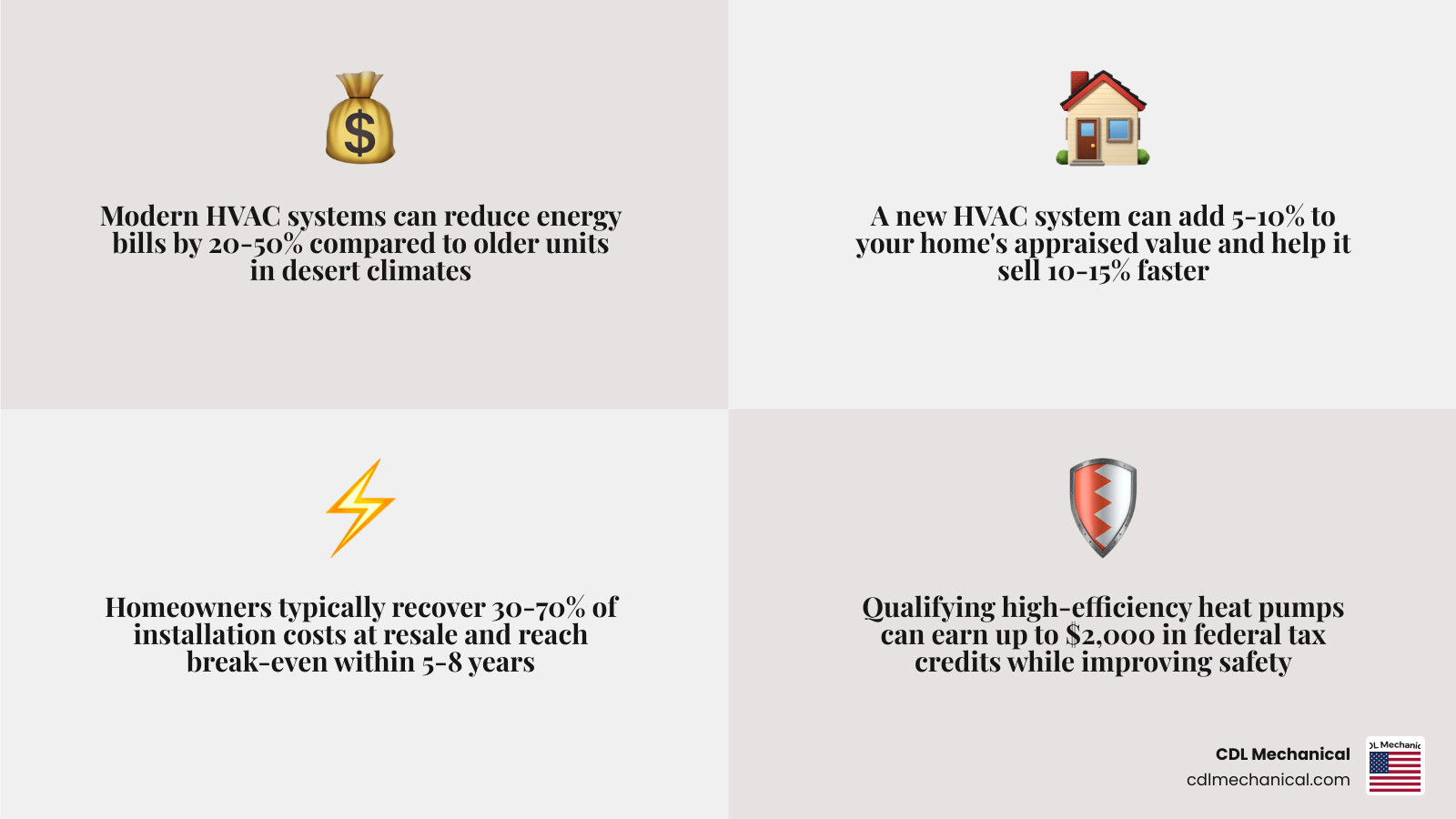
- Energy savings: Modern high-efficiency systems can cut heating and cooling costs by 20-50% compared to older units
- Home value: A new system can add 5-10% to your home’s appraised value
- Faster sale: Homes with new HVAC systems sell 10-15% faster than comparable homes with aging equipment
- Cost recovery: Homeowners typically recoup 30-70% of installation costs at resale
- Safety: Aging systems carry real risks, including carbon monoxide exposure from cracked heat exchangers
- Tax incentives: Qualifying high-efficiency heat pump installations can earn federal tax credits up to $2,000 in 2026
- Payback period: Most high-efficiency systems reach break-even within 5-8 years through energy savings alone
For Glendale homeowners, the stakes are especially high. Your HVAC system accounts for nearly half of your total home energy bill, and the relentless Phoenix-area heat accelerates equipment wear in ways that simply do not apply in milder climates. When a system starts breaking down repeatedly or pushing your utility bills higher despite regular maintenance, continuing to repair it is often just delaying an inevitable — and increasingly expensive — decision.
I’m Joshua Michael Bartlett, founder of CDL Mechanical and a Texas-based HVAC professional with over 20 years of hands-on experience helping homeowners navigate exactly this kind of decision. My work with why HVAC replacement is a smart investment has shown me time and again that the homeowners who plan ahead — rather than waiting for a complete system failure in the middle of a 115°F Arizona summer — consistently come out ahead financially and in comfort. Let’s walk through the full picture so you can make a confident, informed choice.
Why hvac replacement is a smart investment glossary:
The Financial Framework: Why HVAC Replacement Is a Smart Investment
When we talk to homeowners in Glendale and across the Phoenix West Valley, we often find them caught in a frustrating cycle of minor repairs. It starts with a worn-out capacitor, followed by a fan motor replacement a year later, and then a minor refrigerant leak. This is what we in the industry call the “repair spiral.” It is the process of pouring hard-earned money into a system that is fundamentally near the end of its operational life.
To help our customers make an objective, logical decision, we recommend using two classic industry benchmarks: the 50% Rule and the $5,000 Rule.
The 50% Rule is straightforward: if a single repair estimate costs more than half of what a brand-new system would cost to purchase and install, you should always replace the unit. Continuing to patch up a system under these conditions is like putting brand-new tires on a shopping cart with a broken wheel. It might roll for another few yards, but the underlying structure is still compromised.
The $5,000 Rule adds an age-adjusted calculation to the mix. To use it, you simply multiply the age of your HVAC unit by the repair quote you received. If the resulting number is greater than 5,000, replacing the system is the smarter financial move. For example:
- If a 6-year-old system needs a minor repair, multiplying 6 by that repair cost yields a number well under the 5,000 threshold. Repairing is the practical choice.
- If a 13-year-old system needs a major component replacement, multiplying 13 by that repair quote will easily clear the 5,000 mark. In this scenario, replacement is mathematically the superior long-term investment.
To understand how these decisions play out over several years, it helps to read up on HVAC Repair vs New Unit: Long-Term Savings 101. Proactive planning prevents you from making a rushed, emergency decision when your system fails during a major heatwave. For more help determining which path is right for your home, take a look at our guide on The HVAC Crossroads: When to Patch It Up and When to Move On.
Below is a quick reference table comparing key indicators that point toward repairing versus replacing your heating and cooling equipment:
| Repair Indicators | Replacement Indicators |
|---|---|
| System is under 10 years old | System is over 12–15 years old |
| Minor electrical issues (capacitor, contactor) | Failed compressor or cracked heat exchanger |
| Energy bills are stable and predictable | Utility bills have risen 20–40% without explanation |
| System uses eco-friendly R-410A or R-454B | System uses obsolete, expensive R-22 refrigerant |
| Home experiences even, consistent temperatures | Frequent “hot and cold spots” throughout the house |
| Repair cost multiplied by age is under 5,000 | Repair cost multiplied by age is over 5,000 |
How System Age and Desert Climate Dictate Your Next Steps
In the Phoenix West Valley, our local climate changes the rules of HVAC longevity. While a central air conditioner or heat pump might easily last 15 to 20 years in a mild coastal region, the extreme heat of Glendale, Peoria, and Surprise puts immense physical strain on mechanical components.
During our triple-digit summer days, attic temperatures can easily exceed 140°F. Your air conditioner has to work twice as hard to reject heat from your home, causing the compressor and fan motors to run almost continuously for months on end. This constant operation accelerates wear and tear, meaning that a system in the desert often reaches the end of its reliable lifespan years earlier than a system installed elsewhere.
Understanding the expected lifespan of your equipment under these unique conditions is vital. We have put together detailed resources to help you evaluate your current system’s age and health, including How Long Does an AC Last in the Desert? and our comprehensive Beginner’s Guide to Average Lifespan of an HVAC System in the Phoenix West Valley.
Why HVAC Replacement Is a Smart Investment for Lowering Utility Bills
If your cooling system was installed over a decade ago, it was likely built under older seasonal energy efficiency standards. Today, efficiency is measured by the updated SEER2 (Seasonal Energy Efficiency Ratio 2) standards, which use more rigorous testing conditions to reflect real-world performance.
Older, single-stage air conditioners operate like a light switch: they are either running at 100% capacity or they are completely off. This constant on-and-off cycling consumes massive amounts of electricity. Modern high-efficiency systems, however, utilize variable-speed technology. A variable-speed compressor acts more like a smooth accelerator pedal, adjusting its output in tiny increments to match the exact cooling load of your home.
By running at lower, highly efficient speeds for longer periods, a variable-speed system maintains incredibly consistent indoor temperatures while using a fraction of the energy. Upgrading from an outdated unit to a high-efficiency system can reduce your cooling energy consumption by 20% to 50%.
For a deep dive into the financial mathematics of these utility savings, you can read more in Counting the Coins Saved by High Efficiency Equipment. While high-efficiency systems require a higher initial commitment, the monthly operational savings can help the system pay for itself over time. To learn more about how these modern systems perform under real-world conditions, explore The Cold Hard Truth About High Efficiency Cooling Systems.
Maximizing Property Value and Resale Appeal
When you put your home on the market, prospective buyers are looking for peace of mind. In Arizona, a home’s air conditioner is not a luxury; it is a critical piece of life-safety infrastructure. If a buyer walks into an open house and sees an outdoor condenser unit covered in rust, or hears a loud, rattling compressor, they immediately start calculating the future cost of replacement.
A new, professionally installed HVAC system completely shifts the psychology of the transaction. It signals to buyers that the home has been meticulously maintained, removing one of the most common inspection hurdles before it can even be raised.
Furthermore, real estate appraisers recognize a new HVAC system as a significant capital improvement. Depending on the size of your home and the type of system installed, a new heating and cooling setup can add 5% to 10% to your home’s appraised value. This adjustment directly strengthens your asking price and protects your equity during negotiations.

To explore how these mechanical upgrades influence prospective buyers, check out HVAC Upgrades: How to Win Over Buyers Before They Even Step Inside. If you are wondering whether your current system is actively dragging down your home’s market value, you will find valuable insights in Is Your Old AC Killing Your Resale Price?.
Strategic Timing: Why HVAC Replacement Is a Smart Investment Before Selling
Many homeowners ask us if they should replace their system before listing their home or simply wait to see if the buyer’s inspector flags it. In our experience, waiting is almost always the more expensive path.
If an older system is flagged during a home inspection, the buyer will typically demand substantial concessions or ask for a price reduction that far exceeds the actual cost of a replacement. They may also demand that you pay for emergency replacement services, giving you zero time to shop around, compare options, or choose a system that fits your budget. By proactively replacing the system before listing, you retain complete control over the installation schedule, the equipment choice, and the overall project scope.
To help you decide whether to make this upgrade before selling or to let it ride, we recommend reading To Fix or to Flip: Your HVAC Repair vs Replacement Cost Guide. If you are trying to determine if your current unit can survive one more Arizona summer, our Can Your Old AC Make It Another Summer? Repair vs Replace Mini Guide offers practical advice for making that call.
Critical Safety Indicators and Modern Technology Upgrades
While financial return on investment is a major driver, safety is the single most critical reason to consider an immediate HVAC replacement.
In gas furnaces, the heat exchanger is the metal component that transfers heat from the combustion chamber to the air blowing through your home’s ducts. Over years of thermal expansion and contraction, older heat exchangers can develop microscopic cracks. A cracked heat exchanger is an immediate safety hazard because it can allow deadly carbon monoxide gas to leak directly into your household air supply. Because carbon monoxide is odorless and colorless, these cracks are often only discovered during professional seasonal maintenance. If a technician identifies a cracked heat exchanger, the system must be shut down immediately for safety reasons, making replacement a necessity.
Another critical factor driving replacements in 2026 is the ongoing transition of chemical refrigerants. For decades, residential air conditioners relied on R-22 refrigerant (commonly known as Freon). Due to its ozone-depleting properties, the EPA completely phased out the production and import of R-22.
If your older system still uses R-22 and develops a refrigerant leak, repairing it has become incredibly expensive due to the extreme scarcity of the gas. Furthermore, the industry is currently transitioning from R-410A to newer, more environmentally friendly options like R-454B. Investing in a modern system ensures that your home uses current, readily available refrigerants that are inexpensive to service and highly efficient.
Modern systems also bring massive advancements in indoor air quality (IAQ). Today’s high-efficiency systems are designed to accommodate advanced filtration, such as MERV 13 or HEPA filters, without restricting airflow or placing extra strain on the blower motor. When paired with whole-home air purifiers, UV lights, and smart thermostats, a new system actively scrubs dust, pollen, and desert allergens from your air, creating a healthier living environment for your family.
Frequently Asked Questions about HVAC Replacement
Navigating the choice to replace your heating and cooling system can bring up plenty of questions. Below, we have answered some of the most common inquiries we receive from homeowners in Glendale and the surrounding West Valley communities.
Does a new HVAC system actually increase a home’s resale value?
Yes, a new HVAC system is a proven way to increase your home’s resale value and market appeal. On average, a new system adds 5% to 10% to a property’s appraised value. More importantly, it acts as a powerful “value protector.”
In a hot desert climate, a functional, high-efficiency cooling system is a baseline requirement for buyers. When buyers see a brand-new system with a transferable warranty, it eliminates their fear of an immediate, expensive mechanical failure. This confidence leads to cleaner offers, fewer demands for seller concessions, and a faster overall sale.
How does the 50% rule help decide between repair and replacement?
The 50% Rule acts as an objective financial guardrail. If a technician provides a repair estimate that is equal to or greater than 50% of the cost of a complete system replacement, investing in the repair is generally a poor financial decision.
Older mechanical systems are prone to compounding failures; fixing one worn-out component does not prevent the next oldest part from failing shortly down the line. Applying this rule helps you avoid throwing good money after bad.
What safety risks make immediate HVAC replacement necessary?
The most critical safety risk is a cracked heat exchanger in a gas furnace, which can leak carbon monoxide into your home. Electrical hazards, such as short-cycling that damages the wiring harness or poses a fire risk, also demand immediate attention.
Finally, severe refrigerant leaks in older systems using phased-out R-22 refrigerant present both environmental hazards and unsustainable repair costs, making a modern replacement the only safe, sensible path forward.
Conclusion
Deciding to replace your home’s heating and cooling system is a major step, but when you look at the long-term energy savings, the immediate safety improvements, and the positive impact on your home’s value, it is clear why HVAC replacement is a smart investment.
At CDL Mechanical, we are proud to be a family-owned business serving Glendale, AZ, and our neighbors throughout the Phoenix West Valley—including Peoria, Sun City, Goodyear, Avondale, and Surprise. We treat every customer like a member of our own family, providing honest, expert guidance without high-pressure sales tactics. We will perform a meticulous Manual J load calculation to ensure your new system is sized perfectly for your home’s unique layout, ensuring maximum comfort and efficiency for years to come.
Do not wait for your aging system to leave you stranded in the desert heat. Schedule your professional HVAC services in Glendale, AZ today and let us help you make the smartest investment for your home’s future comfort.