
What Every Glendale Homeowner Should Know About How a Heat Pump Heats and Cools Your Home
Understanding how a heat pump heats and cools your home is simpler than it sounds — and for homeowners in Glendale, AZ, where summers are brutal and winters can still catch you off guard, it matters more than ever.
Here’s the short answer:
In cooling mode (summer):
- The heat pump pulls warm air from inside your home
- Refrigerant absorbs that heat at the indoor coil
- The compressor moves the refrigerant outside
- Heat is released outdoors, and cooled air circulates back inside
In heating mode (winter):
- The heat pump extracts heat energy from outdoor air — even cold air
- Refrigerant absorbs that heat at the outdoor coil
- The compressor raises the temperature
- Warm air is released indoors through the indoor coil
The key difference from a traditional furnace or air conditioner? A heat pump doesn’t generate heat — it moves it. That one distinction is why heat pumps can deliver up to three times more heat energy than the electrical energy they consume.
Most homeowners don’t think much about their HVAC system until something goes wrong. But knowing the basics of how your heat pump works can help you catch problems early, make smarter decisions about your system, and stay comfortable year-round without wasting energy.
I’m Joshua Michael Bartlett, founder of CDL Mechanical and a Texas-based HVAC professional with over 20 years of hands-on experience — including working with the heat pump systems that handle the full spectrum of how a heat pump heats and cools your home in demanding climates. In the sections ahead, I’ll walk you through everything you need to know, from the refrigerant cycle to sizing, efficiency ratings, and Arizona rebates.
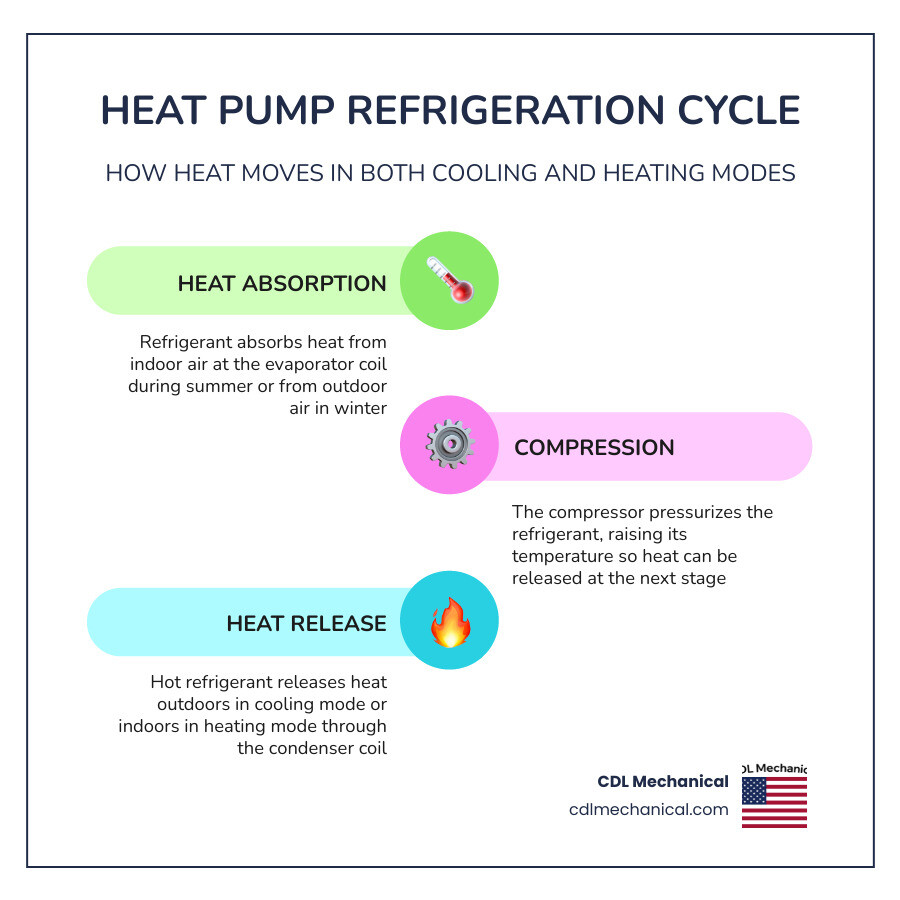
Know your how a heat pump heats and cools your home terms:
The Basic Science: How a Heat Pump Heats and Cools Your Home
To truly grasp how these systems perform their magic, we have to look at the underlying physics. Two core scientific fields govern HVAC systems: thermodynamics and fluid mechanics.

According to the second law of thermodynamics, heat naturally flows from a high-temperature area to a lower-temperature area. Left to its own devices, heat will always seek out the cold. A heat pump, however, reverses this natural flow. By utilizing mechanical work (powered by electricity) and a specialized chemical compound called refrigerant, it forces heat to move in the opposite direction.
Fluid mechanics comes into play through the relationship between the pressure and temperature of fluids. When you compress a gas, its temperature rises. When you allow that same gas to expand, its temperature drops significantly. By constantly cycling refrigerant between liquid and gas states through compression and expansion, we can manipulate where heat is absorbed and where it is released.
To understand how this operates in standard central systems, you can read more about How Does Central Heating and Cooling Work? to see how air handler blowers, ductwork, and coils interact to distribute conditioned air throughout your home.
The Cooling Cycle: How a Heat Pump Heats and Cools Your Home in Summer
During our intense Glendale summers, a heat pump functions identically to a standard central air conditioner. In fact, an air conditioner is technically a one-way heat pump. The process of removing heat from your home follows these key steps:
- Heat Extraction at the Evaporator Coil: Warm indoor air is pulled across the indoor coil (which acts as the evaporator). Inside this coil, cold liquid refrigerant absorbs heat from your household air. As the refrigerant absorbs this thermal energy, it boils and evaporates into a low-pressure gas.
- The Compressor Step: This low-pressure refrigerant gas travels through copper lines to the outdoor unit. Here, the compressor squeezes the gas, raising both its pressure and its temperature.
- Heat Release at the Condenser Coil: The hot, high-pressure gas enters the outdoor coil (acting as the condenser). A fan blows ambient outdoor air across the coil. Because the refrigerant is hotter than the outdoor air, heat naturally flows out of the refrigerant and dissipates into the environment. As it cools, the refrigerant condenses back into a high-pressure liquid.
- The Expansion Valve: The liquid refrigerant passes through an expansion valve, which drops its pressure rapidly. This pressure drop causes the refrigerant’s temperature to plummet, turning it back into a cold, low-pressure liquid ready to return indoors and repeat the cycle.
This continuous cycle extracts heat and moisture from your indoor air, leaving behind cool, dehumidified comfort. For a deeper look at high-efficiency cooling mechanics, check out The Cold Hard Truth About High Efficiency Cooling Systems.
The Heating Cycle: How a Heat Pump Heats and Cools Your Home in Winter
When winter arrives in Glendale and the desert temperatures dip after sunset, we simply flip the thermostat to “heat.” This triggers the system’s reversing valve, which physically redirects the flow of refrigerant.
Instead of sending hot gas to the outdoor unit, the compressor sends it straight to the indoor coil.
- Outdoor Heat Absorption: The outdoor coil now acts as the evaporator. The cold refrigerant circulating through it is much colder than the outdoor air. Because of this temperature difference, the refrigerant extracts thermal energy from the outdoor air — yes, even air that feels cold to us contains a significant amount of heat energy down to sub-zero temperatures.
- Compression: The warmed refrigerant gas travels to the compressor, where it is compressed into a highly pressurized, hot gas.
- Indoor Heat Release: This hot gas is sent to the indoor coil (now acting as the condenser). The indoor fan blows cool household air across the hot coil. The air absorbs the heat from the coil and is blown through your ductwork, warming your home.
- Expansion: The refrigerant condenses back into a liquid, travels back outside through the expansion valve to lower its pressure and temperature, and prepares to absorb more outdoor heat.
Key Components and Types of Heat Pumps
Every heat pump relies on a highly coordinated team of components to manage how a heat pump heats and cools your home. The essential parts include:
- The Compressor: The heart of the system, located in the outdoor unit. It pumps refrigerant and applies pressure to raise its temperature.
- The Reversing Valve: The brain of the operation. It physically switches the direction of refrigerant flow, allowing the system to transition between heating and cooling.
- The Expansion Valve: A metering device that regulates the flow and pressure of the refrigerant.
- The Coils: The indoor and outdoor heat exchangers where heat is transferred.
- The Refrigerant: The chemical messenger that carries heat back and forth. Modern systems use advanced refrigerants with lower boiling points to optimize heat transfer.
While all heat pumps operate on these same basic thermodynamic principles, they are configured in several different ways depending on your property’s needs.
- Air-Source Heat Pumps: The most common type. They exchange heat between your indoor air and the outdoor air. They are highly efficient, easy to install, and ideal for the Glendale climate.
- Geothermal (Ground-Source) Heat Pumps: These systems exchange heat with the ground rather than the air. Because temperatures underground remain stable year-round (usually around 50 to 60 degrees), geothermal systems are incredibly efficient. However, they require extensive excavation to bury loop pipes, making them more common on larger properties.
- Water-Source Heat Pumps: Similar to geothermal, but they exchange heat with a nearby body of water or well.
- Ducted Systems: These connect to a central air handler and use a network of metal or flexible ductwork to distribute air throughout the entire home.
- Ductless Mini-Splits: These systems bypass ductwork entirely. Individual indoor air-handling units are mounted directly on the wall in specific rooms, connected to an outdoor compressor by a small conduit. They are perfect for home additions, historic homes, or creating customized comfort zones.
To help you compare your options, here is a breakdown of the primary heat pump types:
| Feature | Air-Source Heat Pump | Geothermal (Ground-Source) | Ductless Mini-Split |
|---|---|---|---|
| Heat Source/Sink | Outdoor Air | Underground Soil/Rock | Outdoor Air |
| Distribution Method | Central Ductwork | Central Ductwork or Hydronic | Direct Wall-Mounted Units |
| Glendale Suitability | Excellent (highly cost-effective) | High efficiency, but high installation footprint | Perfect for zoning or homes without ducts |
| Efficiency (COP) | 2.0 to 4.5+ | 3.5 to 5.0+ | 3.0 to 4.5+ |
If you are exploring these options for your home, you can read more details on our Heat Pumps service page, and find out whether they are the right fit for our desert environment by reading Are Heat Pumps Efficient in Desert Climates or Just a Dry Dream?.
Maximizing Efficiency, Sizing, and Arizona Rebates
A heat pump is only as good as its sizing and installation. If a system is too small, it will run constantly, struggling to keep your home cool during a 115°F Glendale summer day. If it is oversized, it will cycle on and off too rapidly (short-cycling). This wastes energy, subjects components to excessive wear and tear, and fails to properly dehumidify your home.
At CDL Mechanical, we never use “rule of thumb” sizing based solely on square footage. Instead, we perform a precise Manual J Load Calculation. This industry-standard protocol takes into account:
- The exact square footage and layout of your home
- Local climate data for Glendale and the Phoenix metro area
- The orientation of your home relative to the sun
- Insulation levels in your attic and walls
- The type, size, and shading of your windows
- Air infiltration rates (airtightness)
When evaluating heat pump efficiency, there are three primary metrics to look for:
- SEER2 (Seasonal Energy Efficiency Ratio 2): Measures cooling efficiency over a typical cooling season. The higher the rating, the less electricity the system uses to cool your home. You can learn more about this by reading Understanding SEER Ratings and Their Importance.
- HSPF2 (Heating Seasonal Performance Factor 2): Measures heating efficiency over a typical heating season.
- COP (Coefficient of Performance): A direct ratio of heat delivered to energy consumed. A COP of 3.0 means the system delivers three times more thermal energy than the electrical energy it uses to run.
To see how these efficiency metrics compare to traditional combustion systems, read our guide on Heat Pump vs Gas Furnace vs Electric Furnace: 3 Key Factors.
Tax Credits and Rebates for Glendale Homeowners
Upgrading to a high-efficiency heat pump is more affordable than ever thanks to federal and state financial incentives.
Under the federal Inflation Reduction Act (IRA), Glendale homeowners can claim a 25C tax credit of 30% of the total installation cost, up to $2,000, for qualifying Energy Star certified heat pumps. Because we are in July 2026, these programs are fully active and highly streamlined.
Additionally, Arizona utility companies like SRP and APS offer substantial rebates for qualifying high-efficiency heat pump installations. To help you navigate these savings, we have compiled several comprehensive guides:
- Learn about federal programs: The Arizona Homeowner’s Guide to Inflation Reduction Act Benefits
- Discover how to maximize your savings: How to Get Paid for Upgrading to a Heat Pump in Arizona
- Find out which equipment qualifies: What HVAC Systems Qualify for Tax Credits and Rebates?
- See all available local options: The Ultimate Guide to Arizona Energy Rebates for HVAC Upgrades
Frequently Asked Questions About Heat Pumps
Do heat pumps work in extreme cold or hot desert temperatures?
Yes, absolutely. There is a common misconception that heat pumps only work in mild climates.
In extreme cold, modern cold-climate heat pumps utilize variable-speed inverter compressors and advanced refrigerants to operate efficiently at outdoor temperatures well below -15°F. If temperatures drop below the system’s optimal operating limit, the heat pump can automatically engage an auxiliary heat source (such as electric resistance heating coils or a paired gas furnace in a dual-fuel configuration) to keep your home warm.
In extreme desert heat, high-efficiency heat pumps easily handle outdoor temperatures of 115°F and above. Because cooling is based on the same refrigeration cycle as standard ACs, they perform beautifully.
During winter operation in humid or freezing climates, frost can accumulate on the outdoor coil. When this happens, the heat pump automatically initiates a defrost cycle. It temporarily reverses back into cooling mode for a few minutes to send hot refrigerant gas to the outdoor coil, melting the frost. During this brief cycle, auxiliary heating elements turn on indoors so you never feel a cold draft.
What maintenance does a heat pump require?
While heat pumps are incredibly durable, they require regular care to maintain peak efficiency.
- Filter Changes: Change your air filters every 1 to 3 months. Clogged filters restrict airflow, forcing your system to work harder and consume more electricity.
- Debris Clearance: Keep the area around your outdoor unit free of leaves, grass clippings, weeds, and debris. The system needs clear airflow to exchange heat efficiently.
- Fan Motor Care: Have a professional inspect and, if necessary, lubricate the fan motor every few years to prevent friction and wear.
- Professional Tune-Ups: We highly recommend scheduling professional maintenance twice a year — once in the spring before the cooling season, and once in the fall before the heating season. This ensures your electrical connections, refrigerant charge, coils, and reversing valve are all in perfect working order.
How long do heat pumps typically last?
With proper maintenance, a high-quality heat pump typically lasts about 15 years. Because they run year-round (providing both heating and cooling), they experience more operational wear than a standalone furnace. Consistent preventive maintenance is the single best way to maximize your system’s lifespan and keep your utility bills low.
Conclusion
Now that you know the fundamentals of how a heat pump heats and cools your home, you can see why these systems have become the gold standard for energy-efficient comfort. By moving heat instead of creating it, they keep your family comfortable in the Glendale heat while keeping your energy bills under control.
At CDL Mechanical, we are proud to be a family-owned HVAC company serving Glendale, AZ, and surrounding communities like Phoenix, Peoria, Sun City, Scottsdale, and Tempe. We treat our customers like family, delivering honest advice, meticulous installations, and reliable maintenance.
If you are ready to upgrade your home comfort, explore our Heat Pumps services or contact us today to schedule your personalized consultation!