
Should I Repair or Replace My HVAC System? Here’s How to Decide
Should I repair or replace my HVAC system is one of the most stressful questions a homeowner can face — especially when it’s 110°F outside in Glendale, AZ and the AC just quit. The good news: the answer doesn’t have to be a guessing game.
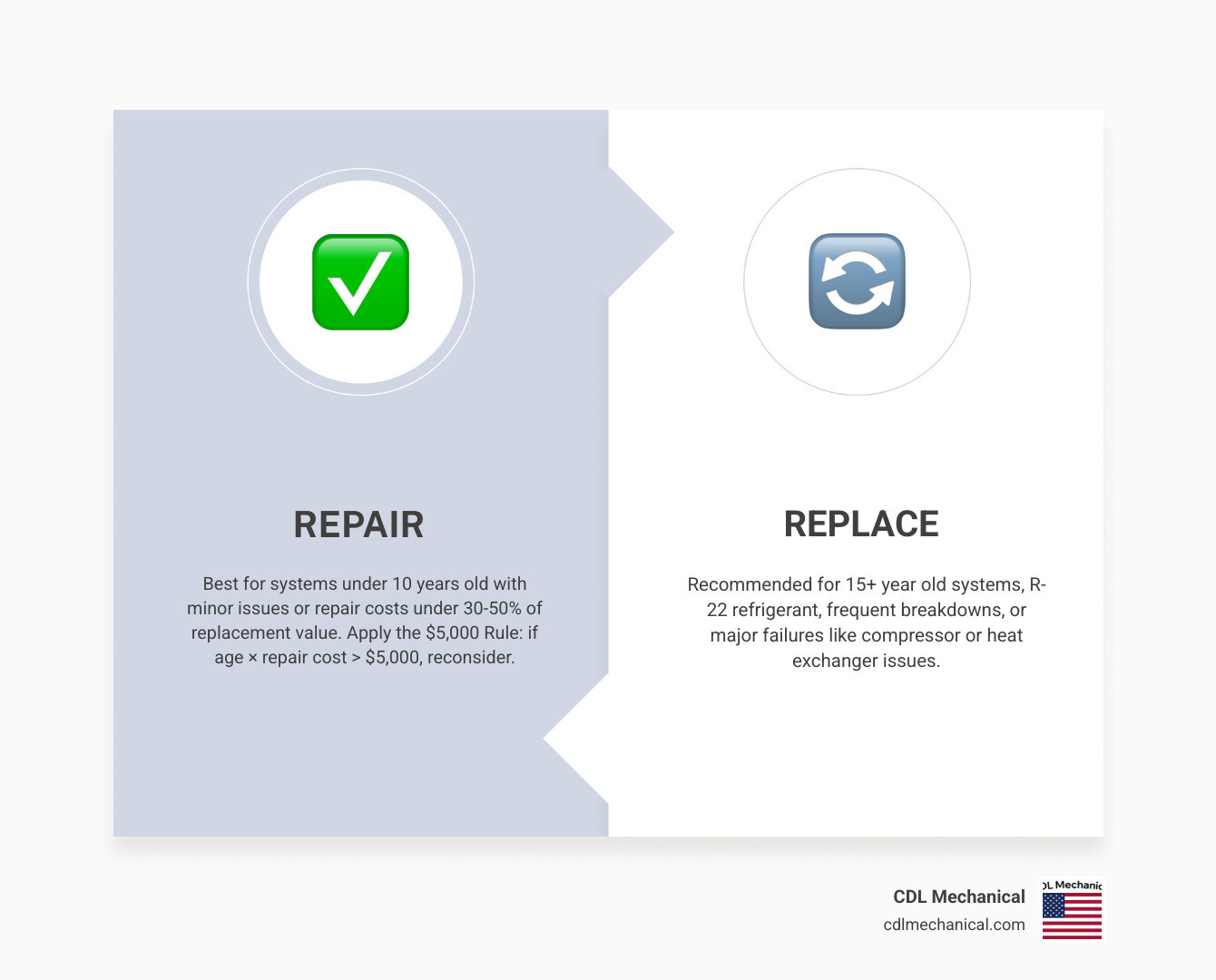
Here’s a quick framework to point you in the right direction:
| Situation | Likely Best Choice |
|---|---|
| System is under 10 years old, minor repair needed | Repair |
| Repair cost is less than 30% of a new system’s price | Repair |
| System is 15+ years old with recurring problems | Replace |
| Repair cost exceeds 50% of a new system’s price | Replace |
| System uses R-22 refrigerant and needs major work | Replace |
| Cracked heat exchanger or carbon monoxide risk detected | Replace immediately |
| Age × repair cost exceeds $5,000 (the 5,000 Rule) | Replace |
| System under active manufacturer’s warranty | Repair |
Use this as your starting point. The sections below walk through each factor in detail so you can make a confident, informed call.
Making this decision well matters more than most homeowners realize. The Department of Energy estimates that a new HVAC system can cut monthly energy costs by 20–40% compared to an aging unit. And getting the repair-vs-replace call right can save you thousands of dollars — not just once, but every time your system reaches a crossroads.
The challenge is that there’s no single magic rule. Your system’s age, repair history, refrigerant type, energy efficiency rating, and how long you plan to stay in your home all play a role. Oversimplify it, and you either spend money on a repair that just delays the inevitable — or you replace a system that had years of reliable life left.
In the Phoenix metro area, the stakes are even higher. HVAC systems here run harder and longer than almost anywhere else in the country, which changes the math on both lifespan and long-term savings. A system that might last 18 years in a mild climate may hit its limits much sooner under relentless desert conditions.
I’m Joshua Michael Bartlett, founder of CDL Mechanical, and with over 20 years of hands-on experience in the HVAC trade — including countless repair-or-replace evaluations for homeowners across the greater Phoenix area — I’ve built my approach around honest, pressure-free guidance on exactly this question: should I repair or replace my HVAC system? Let’s break it down the right way.
Common Signs Your System Needs Professional Attention
When your home starts feeling more like a sauna than a sanctuary, it’s a clear signal that something is wrong. However, not every hiccup requires a full teardown. Recognizing the early warning signs can help you catch issues before they escalate into a total system failure.
Common red flags include uneven cooling, where one room feels like the Arctic while another is sweltering. You might also notice unusual noises—banging, screeching, or persistent clicking—coming from your outdoor unit or furnace. Another major indicator is short cycling, which is when your system turns on and off frequently without ever reaching the desired temperature. This puts immense strain on the compressor and can cause your utility bills to skyrocket.
In our humid monsoon seasons or even during the dry heat, poor humidity control is another sign of a struggling unit. If your home feels “sticky” or you notice excess dust, your system may no longer be able to manage the air quality effectively. When these issues arise, seeking expert Air Conditioner Repair is the first step toward a diagnosis.
When should i repair or replace my hvac system based on performance?
If you are asking should i repair or replace my hvac system, start by looking at the specific nature of the performance failure. Airflow issues are often tied to ductwork or blower motors. If the fix is minor—like a faulty thermostat, a blown capacitor, or a dirty evaporator coil—repairing the unit is almost always the smarter move, especially for systems under 10 years old.
However, if the performance issues are structural, such as a leaking coil or a seized motor in a 15-year-old unit, you have to weigh the cost of the fix against the remaining life of the machine. For a deeper dive into whether your unit can survive another Arizona July, check out our Can Your Old Ac Make It Another Summer Repair Vs Replace Mini Guide.
Identifying the “Repair Spiral”
We often see homeowners fall into the “Repair Spiral.” This happens when you fix one part, only for another to fail three months later. If you’ve had to call for service three or more times in the last three years, you aren’t just paying for repairs; you’re paying a “hidden tax” on an unreliable system.
Frequent breakdowns and rising utility bills are the two biggest signs of systemic decline. If your energy consumption has increased significantly despite your habits staying the same, your unit is likely working twice as hard to produce half the cooling. At this point, the reliability of the system is compromised, and continuing to “patch it up” may be throwing good money after bad.
The Financial Framework: Using the 5,000 Rule and the 50% Rule
Deciding between a fix and a fresh start is often a math problem. To remove the emotion from the decision, we use two industry-standard benchmarks: the 5,000 Rule and the 50% Rule. These help us determine if a repair is a sound investment or a temporary band-aid.
| Rule | Methodology | When to Replace |
|---|---|---|
| The 5,000 Rule | Age of system × Repair cost | If the total is over $5,000 |
| The 50% Rule | Repair cost vs. Replacement price | If repair is >50% of new system cost |
How the 5,000 Rule helps you decide if you should repair or replace my hvac system
The 5,000 Rule is a favorite for many of our Ac Services professionals because it factors in the age of the equipment. For example, if you have a 12-year-old system facing a $500 repair, the math is 12 × 500 = 6,000. Since 6,000 is greater than 5,000, the rule suggests replacement.
Conversely, if a 5-year-old unit needs that same $500 repair (5 × 500 = 2,500), it makes total sense to fix it. This rule accounts for the fact that older systems have a higher risk of subsequent failures, making expensive repairs on aging hardware a poor long-term value.
Understanding the 50% Rule
The 50% Rule is even more direct. If a single repair costs more than half the price of a brand-new, high-efficiency system, you should almost always choose the upgrade. Why? Because a new system comes with a fresh 10-year warranty, significantly higher energy efficiency (SEER2), and the peace of mind that it won’t break down during the next heatwave. Investing half the price of a new unit into an old, out-of-warranty machine is rarely a winning strategy.
Critical Factors That Tip the Scales Toward Replacement

While rules of thumb are helpful, some factors are “deal-breakers” that make replacement the only logical choice. These usually involve safety, obsolete technology, or catastrophic component failure.
Safety concerns and major component failures
Your family’s safety is non-negotiable. If a technician discovers a cracked heat exchanger in your gas furnace, this is a critical safety hazard. A cracked heat exchanger can leak carbon monoxide into your home, which can be lethal. In this scenario, we recommend immediate replacement of the furnace.
Similarly, major electrical issues that pose a fire hazard or a completely seized compressor on a unit over 10 years old are major red flags. Replacing a compressor is like putting a new engine in a car with 250,000 miles; the rest of the components are still old and likely to fail soon, often leading to a “domino effect” of repairs.
The R-22 phase-out and technical obsolescence
If your system was manufactured before 2010, it likely uses R-22 refrigerant (often called Freon). The EPA officially phased out the production and import of R-22 in 2020 because it depletes the ozone layer.
As a result, the remaining supply of R-22 is extremely scarce and incredibly expensive. A single refrigerant recharge for an old R-22 unit can cost a significant fraction of a new system. If an R-22 system develops a leak in the evaporator coil, we almost always advise Air Conditioning Installation Replacement rather than attempting a repair. It simply isn’t worth investing in an obsolete platform.
Why Glendale Homeowners Should Consider a Full System Upgrade
Living in Glendale, Peoria, or Surprise means our HVAC systems face some of the harshest conditions in the world. Our units run for 8 to 10 months a year, often in temperatures exceeding 110°F. This extreme runtime means an Arizona HVAC system ages much faster than one in a cooler climate.
Upgrading to a modern system isn’t just about avoiding repairs; it’s about adapting to our environment. New SEER2 standards, which took effect in 2023, ensure that modern units are significantly more efficient than those built even a decade ago. For more on navigating this process locally, see our Residential Ac Replacement In Phoenix A Homeowners Survival Guide.
Benefits of modern energy-efficient technology
Modern HVAC technology has come a long way. Variable-speed motors allow your AC to run at lower speeds for longer periods, which provides much better humidity control and more even temperatures throughout the home.
When you combine a high-efficiency unit with a smart thermostat, the energy savings are substantial. The Department of Energy notes that switching to a high-efficiency system can save 20% to 40% on cooling costs. In the desert, where summer electric bills can be staggering, those savings add up fast, often helping the system pay for itself over its lifespan. Learn more about your options for Air Conditioning Installation Replacement.
Long-term residency vs. short-term plans
How long do you plan to stay in your home? If you are planning to move in the next year, a minor repair might be the most practical choice. However, if this is your “forever home” or you plan to stay for at least 5 years, a replacement is a strategic investment.
A new system increases your home’s value and appeal to buyers. More importantly, it provides you with years of comfort and warranty protection, shielding you from the stress of emergency breakdowns.
Frequently Asked Questions about should i repair or replace my hvac system
How long do HVAC systems last in the Arizona desert?
While the national average for an HVAC system is 15 to 20 years, the intense heat in the Phoenix Valley usually shortens that to about 12 to 15 years. The constant runtime during our long summers causes components to wear out faster. However, consistent Ac Services—including annual tune-ups and regular filter changes—can help push your system toward the longer end of that range.
Is it worth repairing a system that uses R-22 refrigerant?
Generally, no. Because R-22 is no longer produced, the cost to fix a leak and recharge the system is prohibitively high. Furthermore, if your system uses R-22, it is likely at least 14 years old and nearing the end of its functional life. Investing in a recharge is often a temporary fix for a system that will likely face another major failure soon.
Can I replace just the outdoor unit?
Technically, you can sometimes replace just the condenser (the outdoor unit), but we strongly advise against it. HVAC systems are designed as “matched sets.” If you pair a new, high-efficiency outdoor unit with an old indoor evaporator coil, the system will not operate at its rated efficiency. This mismatch can lead to premature compressor failure, reduced comfort, and potentially voided manufacturer warranties. Replacing both units ensures you get the full benefits of the new technology.
Conclusion
Deciding should i repair or replace my hvac system is a big move, but you don’t have to make it alone. At CDL Mechanical, we’ve spent years helping our neighbors in Glendale, Peoria, and throughout the Valley find the right balance between cost and comfort.
As a family-owned company, we treat every home like our own. We aren’t here to upsell you on a system you don’t need, but we also won’t let you throw money away on a “zombie” unit that is destined to fail when you need it most. Whether you need a quick fix to get through the week or a full system upgrade to lower your bills for the next decade, we are here to provide honest, expert guidance.
Ready to get a professional opinion on your system’s health? Contact us today for the best HVAC Services Glendale AZ has to offer.