
The Honest Answer to When to Repair vs Replace Your HVAC System
When to repair vs replace your hvac system comes down to five key factors: the age of your system, the cost of the repair, how often it has broken down, whether it poses a safety risk, and how long you plan to stay in your home.
Here is a quick guide to help you decide:
| Situation | Recommended Action |
|---|---|
| System is under 10 years old, isolated issue | Repair |
| Repair cost x system age exceeds $5,000 | Replace |
| Repair cost exceeds 50% of a new system’s value | Replace |
| 3 or more repairs in the last 3 years | Replace |
| Cracked heat exchanger or carbon monoxide risk | Replace immediately |
| System uses R-22 (Freon) refrigerant | Replace |
| System is over 10 years old (AC) or 15 years old (furnace) | Strongly consider replacing |
| System is under warranty, minor issue | Repair |
Most homeowners face this decision at the worst possible moment — when the AC quits on a 115°F Glendale summer afternoon or the heat stops working on a cold January night. The stress of that moment can lead to rushed decisions that either waste money on a dying system or push you into a replacement you did not need yet.
This guide cuts through that stress. Whether your system is showing early warning signs or you are staring down a major repair bill right now, we will walk you through the numbers, the safety factors, and the practical questions that lead to the right call — for your home, your budget, and your comfort.
I’m Joshua Bartlett, founder of CDL Mechanical, and with over 20 years of hands-on experience in the HVAC trade here in Arizona, I have helped countless Glendale homeowners work through exactly this decision — when to repair vs replace your hvac system — with honesty and no pressure. That same straightforward approach is what you will find in every section of this guide.
The Math of Comfort: When to Repair vs Replace Your HVAC System
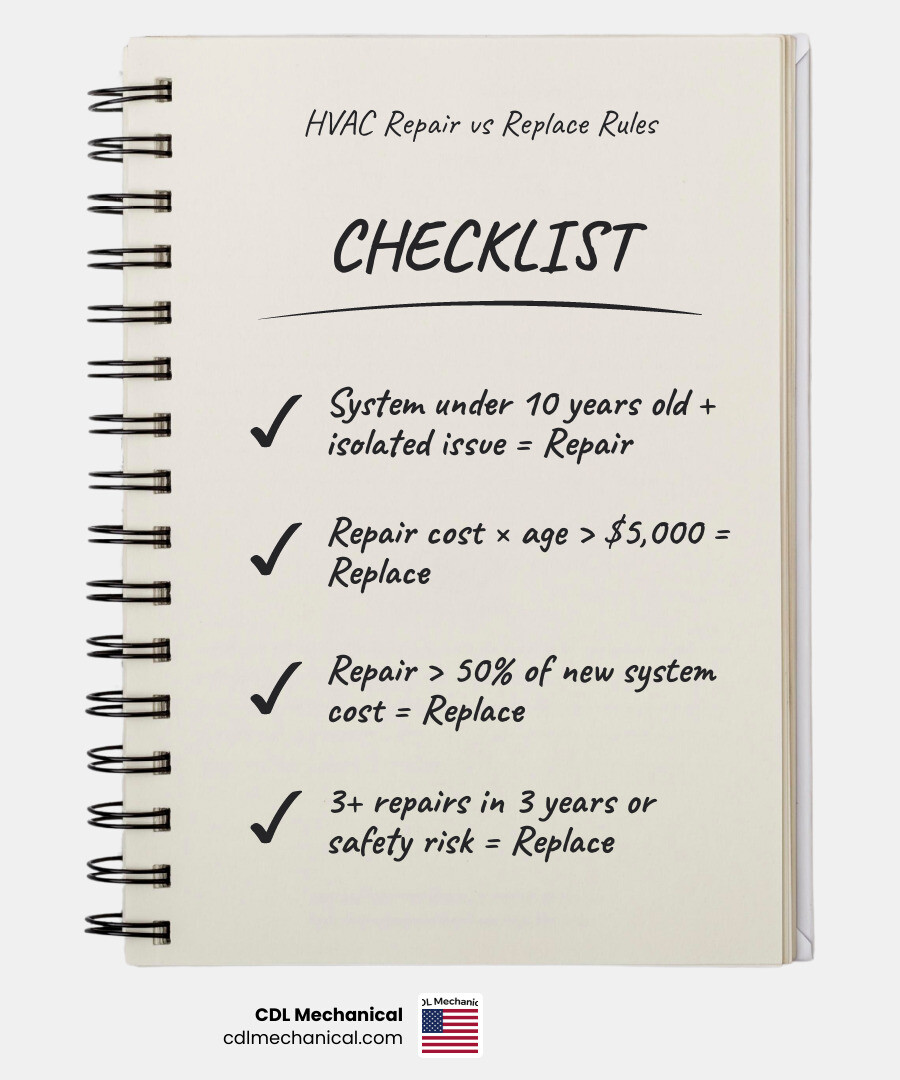
When a major component fails, the first thing most of us do is look at the bank account. But looking at a single repair bill in isolation is a mistake. To make a smart financial decision, we use two industry-standard formulas: the “$5,000 Rule” and the “50% Rule.”
The $5,000 Rule is a favorite among our technicians because it is incredibly simple. You multiply the age of your unit by the repair estimate. If the total is more than $5,000, the system is technically “totaled,” and a replacement is the better investment. For example, if you have a 12-year-old AC unit and the Air Conditioner Repair quote is $500, your total is $6,000. That’s a clear sign that you’re throwing good money after bad.
The 50% Rule is even more direct. If the cost of a single repair exceeds 50% of the value of a brand-new, modern system, we almost always recommend replacement. Why? Because a new system comes with a fresh 10-year warranty, significantly higher efficiency, and the peace of mind that you won’t be calling us again next month for a different part.
Beyond the math, we look at the “Repair Spiral.” Statistically, HVAC systems that have required three or more repairs in a three-year period are nearing the end of their functional life. These “nickle and dime” repairs often mask a systemic decline. If your technician is on your Christmas card list because you see them so often, it is time to consider an upgrade.
[TABLE] Comparing the $5,000 Rule vs. the 50% Rule
| Rule | Calculation | Decision Threshold | Best For |
|---|---|---|---|
| $5,000 Rule | Age of Unit x Repair Cost | If > $5,000, Replace | Aging systems with moderate repair costs |
| 50% Rule | Repair Cost vs. New Unit Price | If > 50%, Replace | Younger systems facing catastrophic failure (e.g., compressor) |
Lifespan and Climate: The Glendale Factor
In many parts of the country, an air conditioner might last 15 to 20 years. Here in Glendale, Peoria, and Surprise, our equipment works much harder. The extreme desert heat means our systems run longer and under higher pressure than a unit in a milder climate.
- Air Conditioners: In Arizona, the average life expectancy is often 12 to 15 years.
- Furnaces: These typically last 15 to 20 years, as they don’t face the same grueling workload as our cooling systems.
- Heat Pumps: Because they provide both heating and cooling, they work year-round. Expect about 15 years of reliable service.
When you are deciding when to repair vs replace your hvac system, you have to factor in “climate-adjusted aging.” A 10-year-old unit in Phoenix has likely worked as many hours as a 15-year-old unit in Seattle. If your system is already at that 12-year mark, it has survived many brutal summers, and its internal components are likely experiencing significant fatigue. This is where Air Conditioning Installation & Replacement becomes a conversation about reliability rather than just a luxury.
Why Age Matters When Deciding When to Repair vs Replace Your HVAC System
We often talk about the “10-year threshold.” Most manufacturer warranties expire at 10 years. Once you are “out of pocket” for major parts like compressors or evaporator coils, the financial logic shifts heavily toward replacement.
System fatigue isn’t just about parts breaking; it’s about efficiency dropping. As a system ages, it loses roughly 5% to 10% of its efficiency at its half-life due to wear on the motor and scale on the coils. By the time a unit hits 15 years, it might be using 30% more electricity to produce the same amount of cooling it did on day one. If you’re wondering if your current unit can survive the upcoming 110-degree days, check out our Can Your Old AC Make It Another Summer? Repair vs Replace Mini-Guide.
Red Flags and Safety Hazards That Demand Action
While efficiency and cost are important, safety is non-negotiable. There are certain “red flag” scenarios where we will tell you that replacement isn’t just a suggestion—it’s a necessity for your family’s safety.
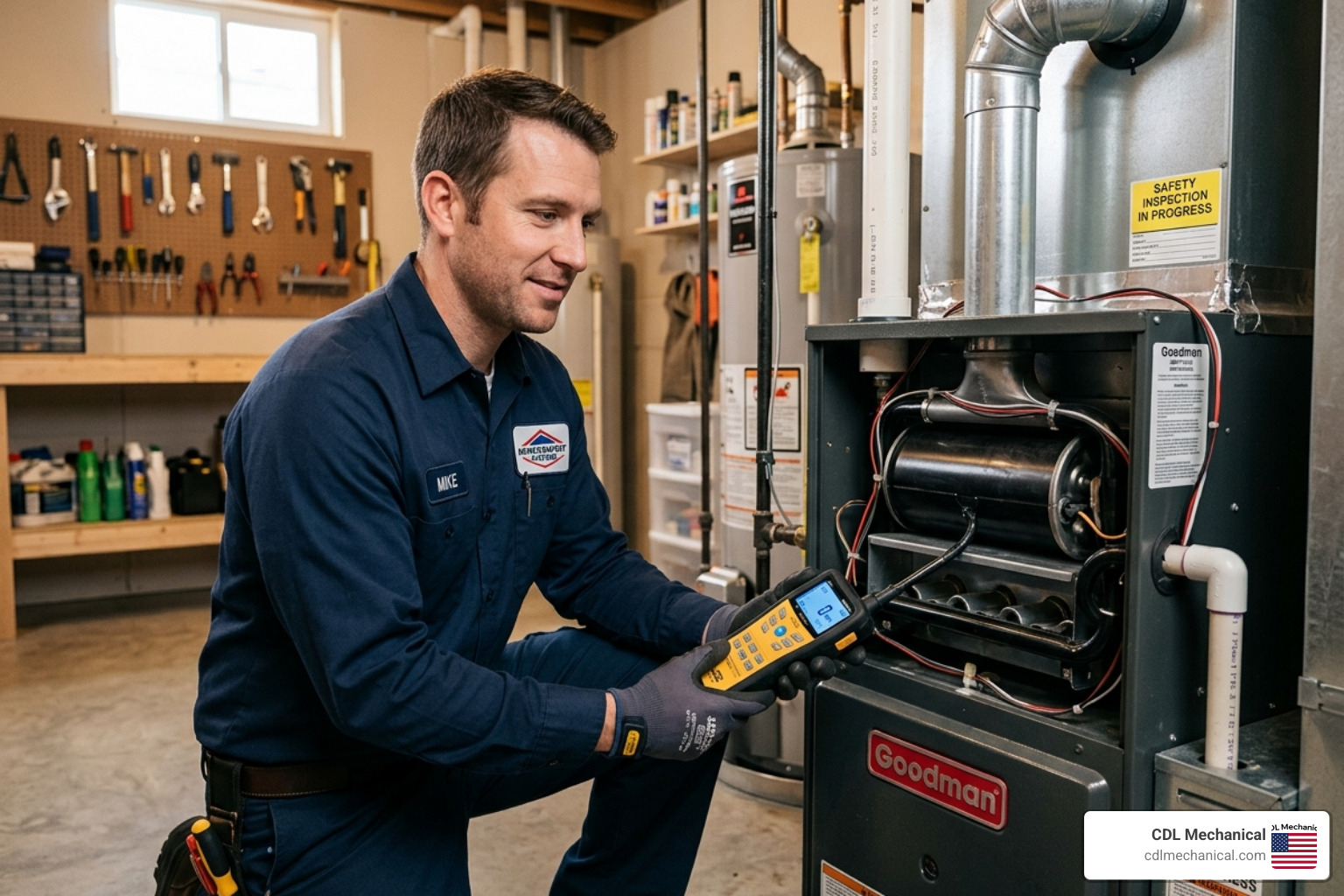
The most serious hazard is a cracked heat exchanger in a gas furnace. The heat exchanger is the metal wall that separates the toxic combustion gases (like carbon monoxide) from the air being blown into your home. If that metal develops even a hairline crack, carbon monoxide can leak into your living space. Because this is a life-threatening risk, a cracked heat exchanger almost always mandates a system replacement, as the cost of the part and labor often rivals the price of a new, safer furnace.
Another major driver for replacement is the R-22 (Freon) phase-out. As of May 2026, R-22 is long out of production. If your older system has a refrigerant leak, the cost to “recharge” it is astronomical because the supply of recycled Freon is so limited. We call this the “R-22 Trap.” Investing $1,000 or more just to put gas into a 15-year-old system that will likely leak again is a poor investment. Modern systems use much more environmentally friendly and affordable refrigerants. For more on how these regulations have shifted, see our guide on What You Need to Know About HVAC Changes in 2025.
Performance Warning Signs: When to Repair vs Replace Your HVAC System
Sometimes the signs aren’t as dramatic as a gas leak, but they are just as telling. If you notice these symptoms, your system is waving a white flag:
- Frequent Cycling: If your AC turns on and off every few minutes (short-cycling), it’s either oversized, failing, or struggling to keep up. This puts immense strain on the compressor.
- Excessive Dust: A failing blower motor or leaky ductwork can pull dust from your attic or crawlspace into your home. If you’re changing filters every week and still seeing dust, the system is failing its filtration duties.
- Uneven Temperatures: Does your kitchen feel like a sauna while your bedroom is an icebox? This often points to a system that no longer has the static pressure to move air correctly through your home.
- Humidity Issues: In the desert, we don’t deal with much humidity, but your AC is still responsible for removing moisture. If your home feels “sticky,” the system isn’t running long enough cycles to dehumidify.
While some of these can be fixed with a tune-up, there are many 5 Benefits of AC Repair Service that can extend the life of a younger system, but if these issues persist on an older unit, it’s a sign of systemic failure.
Modern Efficiency and Financial Incentives
One of the biggest arguments for replacement is the massive leap in technology over the last decade. If you are replacing a system from 2010, you aren’t just getting a “new” version of what you had; you are moving into a different era of comfort.
Modern units are rated by SEER2 (Seasonal Energy Efficiency Ratio). In 2026, the minimum standards are much higher than they were even five years ago. Upgrading from an old 10 SEER unit to a modern 16 or 18 SEER2 unit can reduce your cooling energy consumption by 20% to 40%. For a deeper dive into these numbers, read Understanding SEER Ratings and Their Importance.
We also now have access to variable-speed technology. Older systems were either “on” or “off”—like a light switch. Variable-speed systems are like a dimmer switch; they can run at 30% capacity to maintain a perfect temperature, using far less energy and providing much quieter operation. Pair this with a smart thermostat, and you can manage your home’s climate from your phone while you’re at a Diamondbacks game.
Long-Term Savings When You Decide to Repair vs Replace Your HVAC System
The upfront cost of a new system is significant, but in 2026, there are more ways than ever to offset that cost. Thanks to the Inflation Reduction Act (IRA), federal tax credits can cover up to 30% of the cost of high-efficiency heat pumps (up to $2,000 annually).
Additionally, many local utility providers in the Glendale area offer substantial rebates for installing ENERGY STAR certified equipment. When you combine these tax credits and rebates with the 20-40% monthly savings on your electric bill, a new system often pays for itself within 7 to 10 years. We also offer various Financing Options for HVAC Replacement to help make the transition easier on your monthly budget.
Frequently Asked Questions about HVAC Replacement
Should I replace the entire system or just the failing component?
We almost always recommend replacing the entire system (both the indoor evaporator coil and the outdoor condenser). HVAC systems are designed as “matched sets.” If you put a brand-new, high-efficiency outdoor unit on a 15-year-old indoor coil, the system will not reach its rated SEER2 efficiency. It’s like putting a Ferrari engine in a 1990s sedan—it might run, but it won’t perform the way it was intended, and it will likely lead to premature failure of the new part. Matching your components ensures you get the full warranty and the highest energy savings. If you’re unsure which path to take, our guide on How to Choose the Right AC System can help.
How do leaky ducts affect my replacement decision?
A new AC unit is only as good as the “veins” it uses to pump air. If your ductwork is leaky or poorly insulated, you could be losing 20% to 30% of your cooled air into your attic before it ever reaches your living room. When we evaluate a system for replacement, we always check the static pressure and duct integrity. In some cases, repairing the ducts can make your old system work better, but if you are buying a new high-efficiency unit, sealing your ducts is essential to actually see those energy savings on your bill.
Does my length of stay in the home influence the choice?
Absolutely. If you plan to move in the next year or two, a repair might be the most logical “band-aid” to get you through the sale. However, keep in mind that a 15-year-old HVAC system is a major red flag for home inspectors. Many buyers will ask for a price reduction or a full replacement credit before closing. If you plan to stay in your home for five years or more, the energy savings and warranty protection of a new system make it the clear winner. Plus, many modern warranties are transferable, which can be a huge selling point for a future buyer.
Conclusion
Deciding when to repair vs replace your hvac system doesn’t have to be a “high-stakes guessing game.” At CDL Mechanical, we believe in giving you the facts so you can make the best decision for your family. Whether that means a simple capacitor fix to get you through the season or a full high-efficiency upgrade to slash your summer power bills, we are here to help.
We treat every customer in Glendale, Peoria, and the surrounding Phoenix metro area like family. That means we won’t push you into a replacement you don’t need, but we also won’t let you waste money on a system that is a safety risk or a financial sinkhole.
Don’t wait for your system to fail in the middle of a record-breaking heatwave. Schedule your professional HVAC evaluation in Glendale, AZ with us today, and let’s make sure your home stays comfortable all year long.