
Average Lifespan of an Air Conditioner in Arizona
How long does an AC last in the desert is one of the most important questions you can ask as a Glendale, AZ homeowner — because the answer is very different from what most national guides will tell you.
Here’s a quick breakdown before we dive deeper:
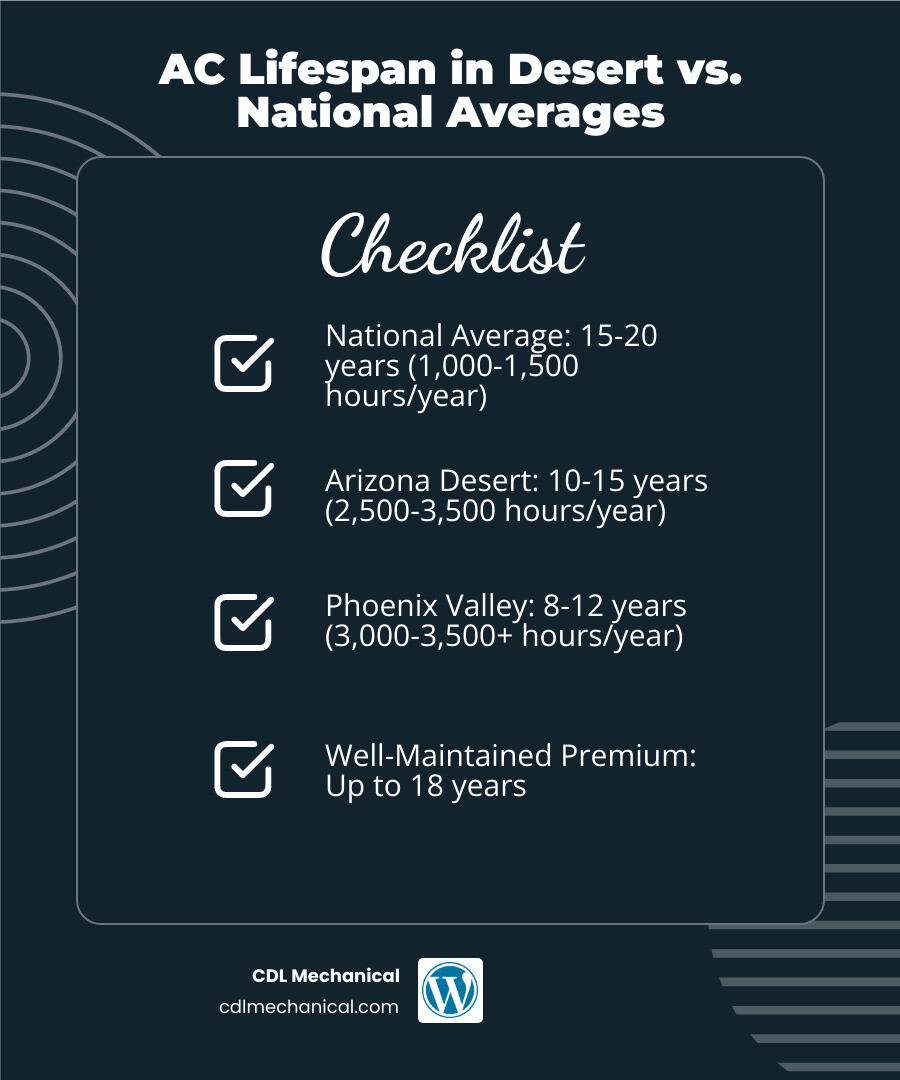
| Climate | Typical AC Lifespan | Annual Operating Hours |
|---|---|---|
| National Average | 15-20 years | 1,000-1,500 hours |
| Arizona Desert | 10-15 years | 2,500-3,500 hours |
| Yuma / Phoenix Valley | 8-12 years | 3,000-3,500+ hours |
| Well-Maintained Premium Units (AZ) | Up to 18 years | Varies |
The desert is simply harder on air conditioners than almost anywhere else in the country. Phoenix and Tucson regularly see temperatures above 110°F, and in Glendale, your AC doesn’t get much of a break — running eight months or more per year at full capacity. That kind of workload compresses years of mechanical wear into a much shorter window. A system that might last 20 years in Minneapolis could be done in 12 in the Valley.
That’s not a reason to panic. It is a reason to understand what you’re working with so you can make smart decisions about maintenance, repairs, and replacement before a 115-degree July afternoon makes the choice for you.
I’m Joshua Michael Bartlett, founder of CDL Mechanical, and with over 20 years in the HVAC trade — much of it in the demanding desert Southwest — I’ve seen how long does an AC last in the desert when it’s properly cared for versus when it’s not. In the sections below, I’ll walk you through everything you need to know to get the most life out of your system.
When we talk about equipment longevity, we have to look at the odometer, not just the calendar. In most parts of the country, an air conditioner is a seasonal convenience. In Arizona, it is a life-support system. Because of our extreme heat and extended cooling seasons, the average lifespan of a central AC unit in the Phoenix Valley typically falls between 10 and 15 years.
While a homeowner in a milder climate might comfortably expect 20 years of service, that is often an unrealistic goal for a desert system. In fact, a 12-year-old unit in Glendale has often clocked more “miles” than a 24-year-old unit in the Midwest. If you are trying to gauge where your system stands, check out our Residential AC Replacement In Phoenix A Homeowners Survival Guide for a deeper look at what to expect as your unit ages.
How long does an ac last in the desert compared to the national average?
The national average for AC lifespan is 15 to 20 years, but that assumes the unit is running about 1,000 to 1,500 hours per year. In the desert, our systems often run for 2,500 to 3,500 hours annually.
Think of it like a car: if you drive 5,000 miles a year, your engine might last 30 years. If you drive 50,000 miles a year, you’ll be looking for a replacement much sooner. The mechanical wear on compressors, fan motors, and capacitors is relentless here. When it hits 115°F outside, your AC has to work 30-40% harder just to maintain a standard indoor temperature compared to a 95°F day. This constant high-load operation is why professional HVAC Services Glendale AZ are so vital for keeping these hardworking machines from burning out prematurely.
The impact of April 2026 climate trends on system longevity
As we move through April 2026, we are seeing even more “shoulder season” heat. Summers are starting earlier and ending later, meaning the “off-season” where your AC can rest is shrinking. This thermal stress—the constant expansion and contraction of metal components under extreme heat—leads to refrigerant leaks and electrical failures.
Staying updated on What You Need To Know About HVAC Changes In 2025 is important because newer efficiency standards and refrigerant regulations (like the shift away from R-410A) are changing how we maintain and replace these systems to handle the increasing desert demand.
Key Factors Determining How Long an AC Lasts in the Desert
Not every AC unit in Arizona is destined for an early grave. Several factors can either shave years off your system’s life or add them back. The most critical factor actually happens on day one: installation quality. A poorly installed unit can lose five years of its life immediately due to improper airflow or incorrect refrigerant charges.
Proper sizing is equally important. We use Manual J calculations to ensure a unit isn’t too small (which causes it to run forever) or too large (which causes “short-cycling” that kills the compressor). If you’re considering a new system, ensure you get expert Air Conditioning Installation Replacement to set your home up for long-term success.
How long does an ac last in the desert with regular maintenance?
With a strict maintenance schedule, a premium AC unit in Arizona can reach the 18-year mark. Skipping maintenance in the desert is like skipping oil changes on a truck you use for heavy towing every single day.
Routine check-ups allow us to catch small issues—like a weakening capacitor or a slightly dirty coil—before they cause the compressor to overheat and fail. There are 5 Benefits Of Routine AC Maintenance that directly correlate to longevity, including lower pressure on moving parts and better energy efficiency. Consistent Air Conditioning Maintenance is the single best investment you can make to avoid an emergency replacement.
Environmental stressors unique to the Southwest
Our environment is uniquely hostile to machinery.
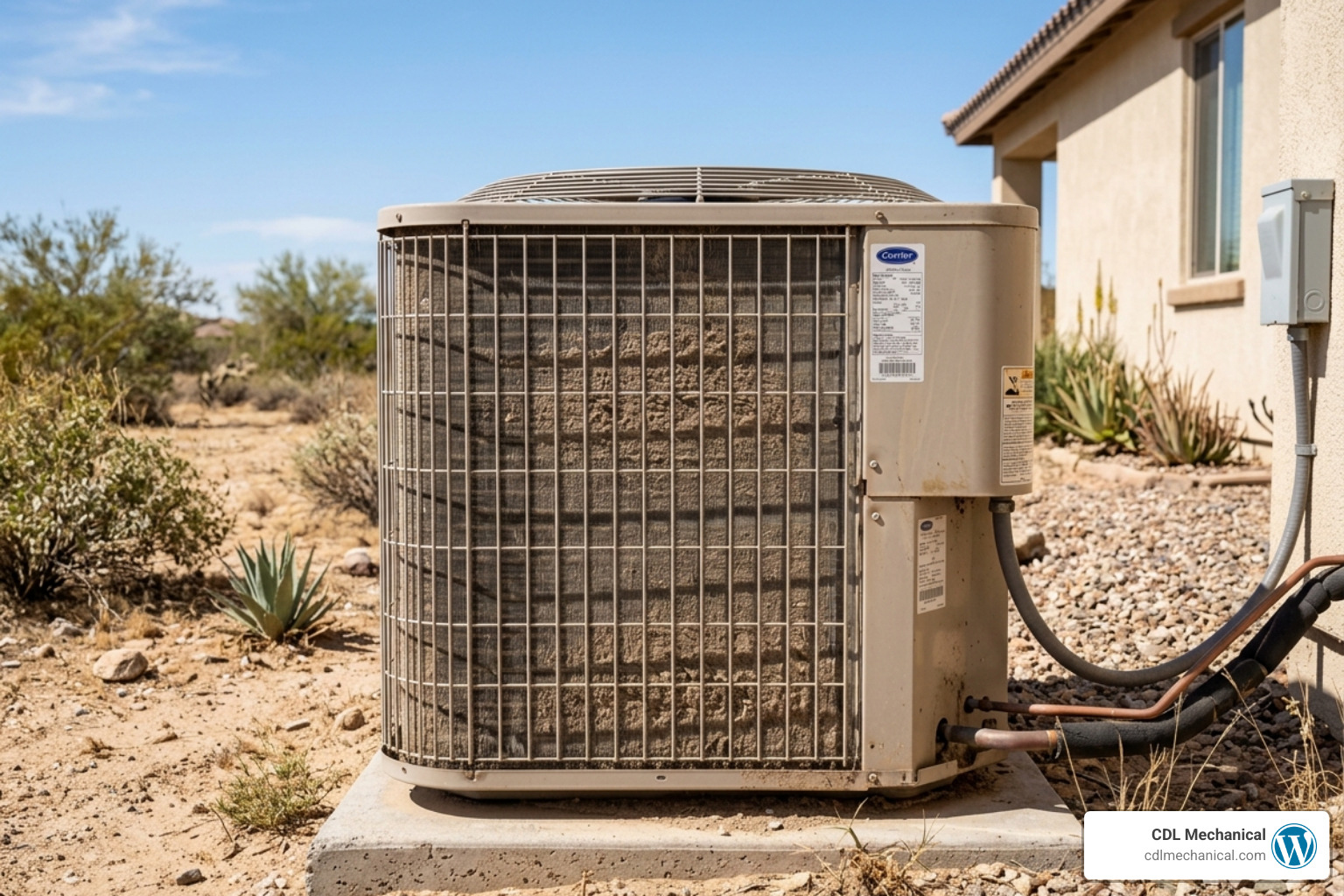
- Haboobs and Dust: Desert dust is often alkaline and abrasive. It coats condenser coils, acting like a blanket that traps heat. This forces the system to run longer and hotter to move heat out of your home.
- Monsoon Humidity: While we are a “dry heat” state, the monsoon season adds humidity that makes the AC work harder to dehumidify your air.
- UV Degradation: The intense Arizona sun can actually become a problem for plastic components and insulation on the outdoor unit.
When these factors lead to a breakdown, prompt Air Conditioner Repair is necessary to prevent a small problem from cascading into a total system failure.
Warning Signs Your Desert AC is Nearing End-of-Life
Your AC will usually tell you when it’s tired; you just have to know what to listen for. If your energy bills are creeping up 15-25% without a rate hike, your system is likely losing its efficiency. Frequent breakdowns—where you’re calling a tech twice a summer—are another red flag.
Uneven cooling or a system that runs constantly but never quite reaches the thermostat setting are signs that the “heart” of the system (the compressor) is failing. If you are debating whether to keep pouring money into an old unit, our Can Your Old AC Make It Another Summer Repair Vs Replace Mini Guide can help you weigh the risks. Additionally, Understanding SEER Ratings And Their Importance can show you how much you might save by switching to a modern, high-efficiency unit.
The $5,000 rule for repair vs. replacement
In the HVAC industry, we often use the “$5,000 Rule” to help homeowners decide. You multiply the age of the unit by the cost of the repair. If the total exceeds $5,000, it’s usually time to replace.
For example:
- Scenario A: A 12-year-old unit needs a $500 repair. (12 x 500 = 6,000). Replace.
- Scenario B: An 8-year-old unit needs a $300 repair. (8 x 300 = 2,400). Repair.
While not a hard law, it helps put the 5 Benefits Of AC Repair Service into perspective against the long-term cost of keeping an aging system on life support.
Refrigerant obsolescence and R-22 systems
If your AC was built before 2010, it likely uses R-22 refrigerant (often called Freon). This refrigerant has been phased out by the EPA, making it incredibly expensive and difficult to find. If an R-22 system develops a leak, the cost of the refrigerant alone often makes the repair unwise.
Upgrading to a modern system that uses eco-friendly refrigerants is often the only logical path. Knowing How To Choose The Right AC System involves looking at the current refrigerant standards to ensure your new investment won’t become obsolete in a few years.
Essential Maintenance to Extend System Life
You don’t need a toolbox to help your AC last longer. The most important DIY task is changing your air filters. In the desert, we recommend checking them every 30 days. If you have pets or there has been a recent dust storm, you might need to change them even more frequently. A clogged filter chokes the system, causing the blower motor to burn out and the coils to freeze.
Beyond filters, a professional Spring AC Tune Up Checklist should be your annual tradition. This includes cleaning the condenser coils to remove that alkaline desert dust. We often offer The Best AC Maintenance Deals In Peoria AZ For Budget Friendly Cooling to make sure every family in our community can afford to protect their equipment.
Seasonal tasks for Glendale homeowners
In Glendale and surrounding areas, we recommend a bi-annual inspection: once in the spring to prep for the heat, and once in the fall to ensure the heating components are ready. Clearing the condensate drain line is also crucial during the humid monsoon months to prevent water damage to your home. Whether you are in Phoenix or need help in our Service Areas Peoria AZ, seasonal care is the best way to prevent a mid-July disaster.
Improving home efficiency to reduce AC workload
The less your AC has to run, the longer it will live. You can reduce the workload by:
- Adding Attic Insulation: Aim for R-38 or higher to keep the heat out of your living space.
- Sealing Ductwork: Leaky ducts can waste 20-30% of your cooled air before it even reaches your rooms.
- Using Ceiling Fans: These allow you to set the thermostat a few degrees higher while still feeling cool.
When it does come time for a new unit, learning How To Find Affordable AC Installation In Phoenix Without Getting Burned will help you find a balance between high-efficiency equipment and a price that fits your budget.
Frequently Asked Questions About Desert AC Longevity
Does shading my outdoor unit help it last longer?
Yes, but with a major catch. Shading the unit can reduce the ambient temperature around the coils by 10-15 degrees, which helps it shed heat more easily. However, you must never restrict the airflow. If you build a structure too close to the unit, you’ll trap the hot air it’s trying to exhaust, which will kill the compressor faster than the sun ever would. Always consult our HVAC Services Glendale AZ team before building any shade structures.
Why do AC units in Yuma and Phoenix fail faster?
It comes down to pure runtime and extreme temperature thresholds. In places like Phoenix AZ, the “low” temperature at night in July might still be 90°F. The system never gets a chance to cool down completely, leading to constant cycling. When a system is forced to start and stop in 110-degree heat, the electrical components—specifically the capacitors—take a beating.
What is the best SEER rating for a desert climate?
In Arizona, we generally recommend a minimum of 16 SEER2. While the federal minimum has risen, the desert heat makes higher-efficiency units pay for themselves much faster through energy savings. Variable-speed technology is also a game-changer here; it allows the system to run at a lower, more consistent speed rather than constantly kicking on and off at full blast. For more details, see our guide on Understanding SEER Ratings And Their Importance.
Conclusion
At CDL Mechanical, we know that your air conditioner is the heart of your home’s comfort. As a family-owned business in Glendale, we treat every system we service as if it were keeping our own kids cool. While the question of how long does an AC last in the desert typically has a shorter answer than we’d like, proper care can make the difference between a system that dies at year 9 and one that hums along until year 18.
If you’re worried about your aging unit or just want to make sure you’re doing everything possible to extend its life, we’re here to help. From expert Air Conditioner Repair to precision installations, we provide the dependable comfort Glendale families have relied on for years. Give us a call, and let’s make sure your home stays a desert oasis for a long time to come.