
When Should You Replace Your AC in the Desert? Here’s What Glendale Homeowners Need to Know
When should you replace your ac in the desert is one of the most important questions a Glendale, AZ homeowner can ask — and the answer is different from what most national guides will tell you.
Here is the short answer:
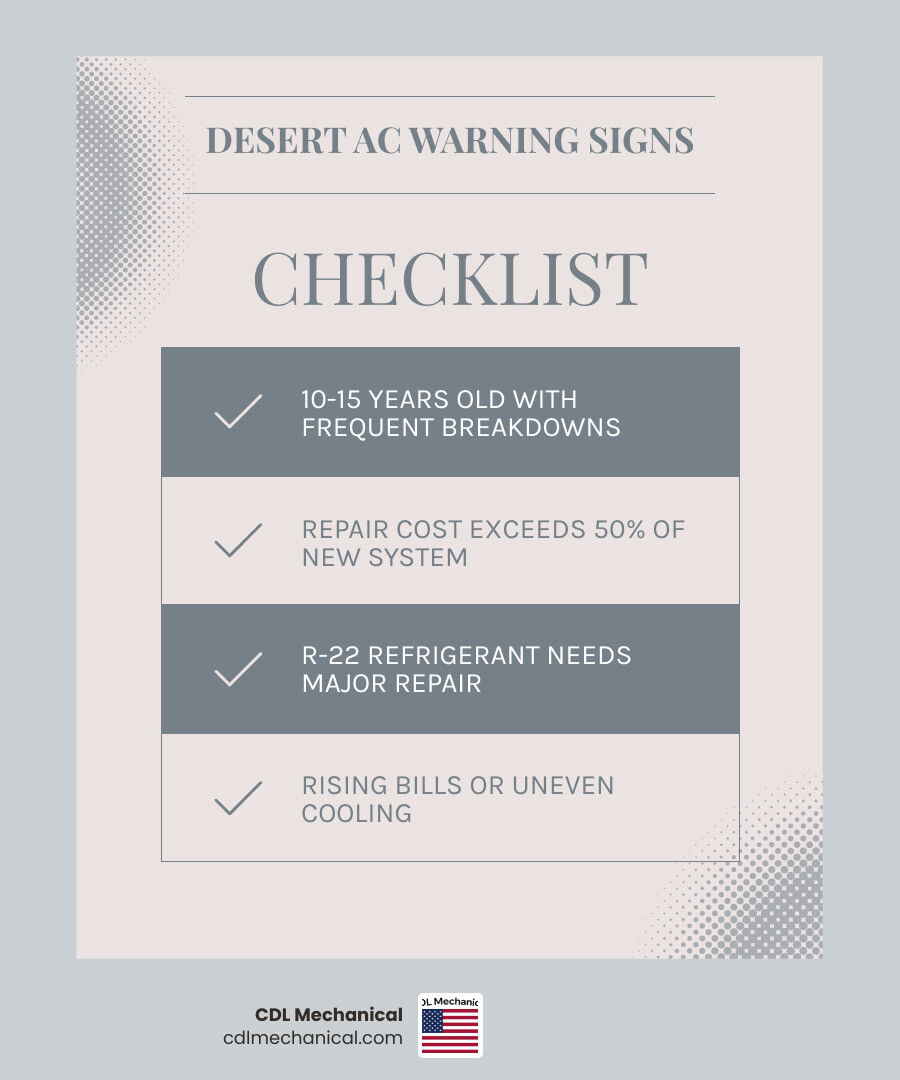
Replace your desert AC when any of the following apply:
- The system is 10 to 15 years old and showing signs of trouble
- A repair estimate fails the $5,000 Rule (system age × repair cost exceeds $5,000)
- A single repair exceeds 50% of the cost of a new system
- The unit uses R-22 refrigerant and needs a major fix
- You are seeing rising energy bills, uneven cooling, or repeated breakdowns
In milder climates, a well-maintained AC can run for 15 to 20 years. In the Phoenix metro area, that window shrinks significantly. Desert compressors can run 2,000 to 2,700 hours per year — compared to around 800 hours in cooler regions — and the combination of extreme heat, blowing dust, and thermal cycling accelerates wear on every major component. When summer temperatures routinely push past 110°F in Glendale, a failing AC is not just an inconvenience. It is a genuine safety concern.
This guide walks you through the real signs your system is reaching the end of its life, the financial frameworks that make the repair-or-replace decision clear, and how to time a replacement so you are not scrambling in July.
I am Joshua Michael Bartlett, founder of CDL Mechanical and an HVAC professional with over 20 years of hands-on experience — including years of working in the extreme desert conditions of Arizona where knowing when to replace your ac in the desert can mean the difference between comfort and crisis. Whether your system is showing early warning signs or you just want to plan ahead, this guide gives you the honest, practical answers you need.
The Brutal Desert Climate vs. Your Air Conditioner
To understand why air conditioners age so rapidly in places like Glendale, Peoria, and Goodyear, we have to look at what they endure. The Sonoran Desert is beautiful, but it is an absolute war zone for mechanical equipment.
First, there is the sheer volume of heat. When outdoor temperatures hover around 115°F, the temperature on a sun-exposed roof or alongside a west-facing wall can easily exceed 130°F. Your air conditioner has to work twice as hard just to reject heat from your home into an environment that is already boiling.
This leads to a phenomenon called thermal cycling. During a typical summer day, the metal components in your outdoor condenser expand under the blistering sun. At night, while it still stays warm, the temperature drops enough to cause those metals to contract. This constant expansion and contraction puts incredible physical stress on electrical connections, copper coils, and solder joints, eventually leading to refrigerant leaks and electrical failures.
Additionally, our desert environment is incredibly dusty. Dust storms and haboobs carry fine silt that penetrates the outdoor condenser coils, acting like an insulating blanket. If these coils are not cleaned regularly, the compressor has to run hotter and longer to cool your home, leading to premature compressor burnout.
Finally, we cannot forget about monsoon season. While the desert is dry most of the year, the sudden influx of humidity in July and August forces your AC to tackle a massive latent heat load. The system must work overtime to strip moisture out of the air before it can even begin to lower the indoor temperature. If you want a deep dive into how these factors combine to age your system, check out our guide on How Long Does an AC Last in the Desert?
The Lifespan Reality: When Should You Replace Your AC in the Desert?
If you search the internet for “how long does an AC last,” you will constantly see a national average of 15 to 20 years. In the Phoenix metro area, relying on that estimate is a recipe for a mid-July disaster.
The real desert lifespan of a central air conditioner is typically 10 to 14 years, and units that are neglected can fail as early as year 8.
Why the massive discrepancy? It all comes down to annual runtime. In moderate climates, an air conditioner might run for 500 to 1,000 hours per year. In the West Valley, our cooling season stretches from late March through October, with some systems logging 2,000 to 2,700 hours of run time annually. Essentially, a 10-year-old AC in Glendale has logged the equivalent wear and tear of a 25-year-old system in the Pacific Northwest!
To protect your home and prepare for the inevitable, you have to understand how local weather patterns dictate your system’s survival. Read our survival guide on West Valley Weather: A Survival Guide for Your AC to see how you can help your unit beat the odds.
Crucial Signs for When Should You Replace Your AC in the Desert
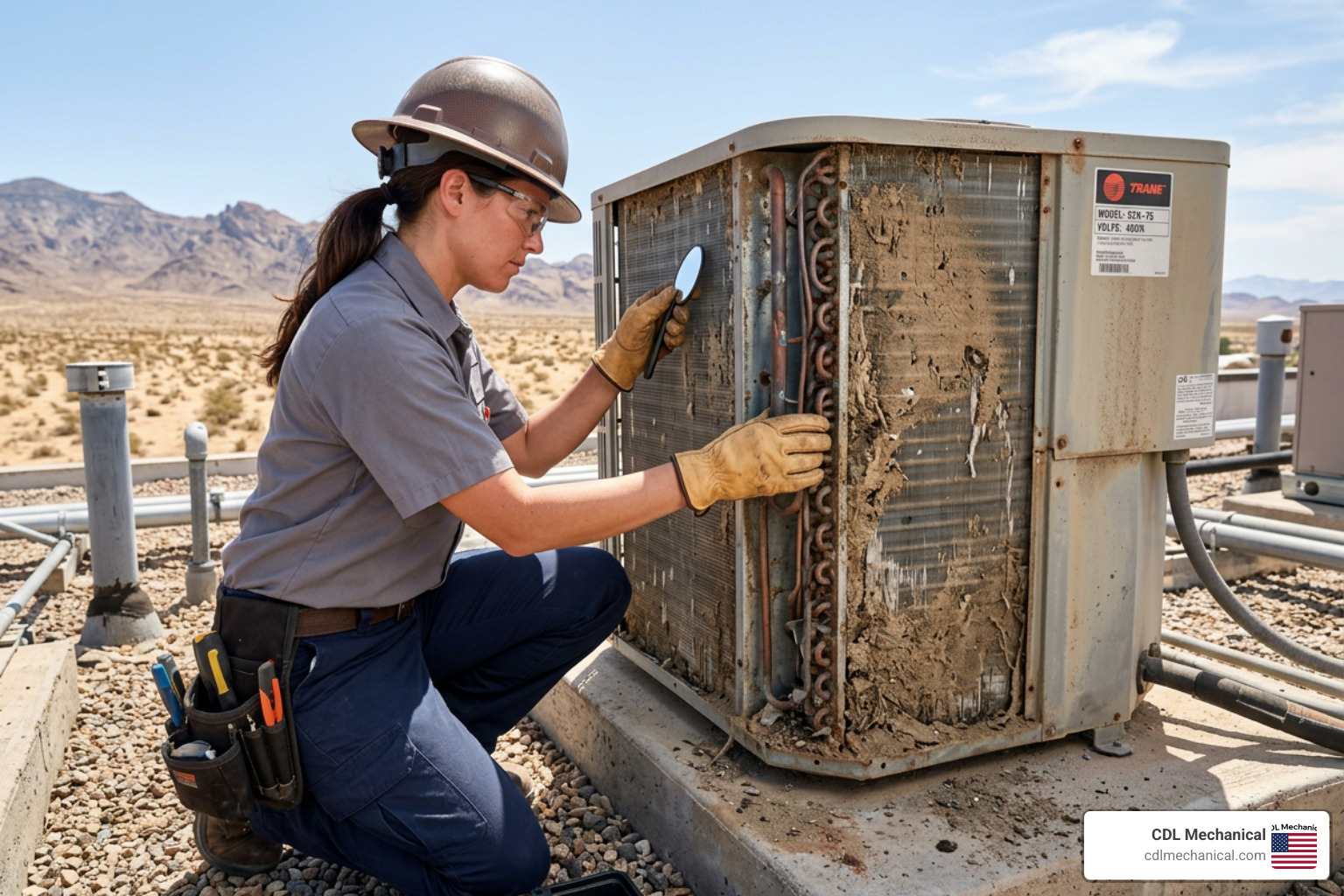
Your air conditioner rarely dies completely without warning. Usually, it will send out several distress signals. Recognizing these signs early can save you from a middle-of-the-night emergency call when it is 110°F outside.
- Weak Airflow: If you stand under your registers and only feel a faint whisper of air, your blower motor may be failing, or your evaporator coil could be severely restricted.
- Warm Air: If your system is blowing warm or lukewarm air, it could indicate a failed compressor, a bad capacitor, or a severe refrigerant leak.
- Frequent Breakdowns: If you find yourself calling us for repairs multiple times a season to replace contactors, fan motors, or capacitors, your system is trying to tell you it is ready to retire.
- Rising Utility Bills: Have your summer electric bills steadily climbed over the last two to three years, even though your usage habits haven’t changed? As compressors and motors age, they lose efficiency and draw more power to deliver the same amount of cooling.
If you suspect your system is on its last legs, keep a close eye on these symptoms. For a detailed breakdown of the red alerts, read our article on Warning Signs Your AC Could Fail During a Heat Wave.
Air Quality and Humidity Issues
Your air conditioner does more than just cool the air; it is also your home’s primary dehumidifier and air filtration system.
In the desert, high outdoor dust levels mean your system’s indoor evaporator coil and ductwork are constantly fighting dust accumulation. As the system ages, its ability to manage latent heat (removing moisture from the air) declines. During monsoon season, an inefficient or oversized system will fail to remove humidity properly, leaving your home feeling sticky, warm, and uncomfortable.
Furthermore, a failing system can struggle to circulate air through high-efficiency filters, leading to a buildup of indoor allergens, dust mites, and dander. If you are noticing a musty odor or a sudden increase in dust around your home, your AC may no longer be up to the task. Learn more about protecting your indoor air environment in our Residential AC Replacement in Phoenix: A Homeowner’s Survival Guide.
The R-22 Refrigerant Phase-Out
If your air conditioner was installed before 2010, there is a very high probability that it operates on R-22 refrigerant (commonly known as Freon). Because R-22 is an ozone-depleting substance, the EPA completely phased out its production and import.
As a result, the remaining supply of R-22 is extremely scarce and incredibly expensive. If your older system develops a refrigerant leak, recharging it can cost a small fortune. Furthermore, finding replacement parts for these legacy systems is becoming nearly impossible.
If your R-22 system experiences a major component failure — such as a compressor burnout or a leaking evaporator coil — investing in a repair is simply pouring good money after bad. Upgrading to a modern, environmentally friendly system is almost always the smarter, more cost-effective move. For help deciding if your older unit can survive, read our Can Your Old AC Make It Another Summer? Repair vs. Replace Mini Guide.
The Repair vs. Replace Dilemma: Smart Decision Frameworks
When your air conditioner breaks down, you are faced with a classic dilemma: do you patch it up one more time, or do you invest in a brand-new system?
To make an unbiased, logical decision, you need to look past the immediate repair quote and evaluate the long-term financial trade-offs. A cheap repair today might seem appealing, but if that system breaks down again next month, or continues to waste energy, you haven’t actually saved any money.
We always recommend looking at three primary factors:
- The age of the system: Is it approaching the 10-to-15-year mark?
- The frequency of repairs: How many times have we visited your home in the last two years?
- The overall operating efficiency: Are your utility bills skyrocketing?
For a comprehensive guide on how to weigh these factors, read To Fix or to Flip: Your HVAC Repair vs. Replacement Cost Guide.
Using Financial Formulas to Decide When Should You Replace Your AC in the Desert
Fortunately, you don’t have to rely on guesswork. The HVAC industry uses two trusted mathematical formulas to help homeowners make the right choice: the 50% Rule and the $5,000 Rule.
The 50% Rule
This rule is simple: if the cost of a single repair estimate exceeds 50% of the value of a brand-new AC system, you should replace the unit. Spending half the cost of a new, warrantied system on an old, out-of-warranty unit that will likely break down again soon is rarely a wise investment.
The $5,000 Rule
This is a highly reliable scoring system tailored to system age and wear. To use it, multiply the age of your AC system (in years) by the estimated repair cost (in dollars).
- If the result is under $5,000, repair the system.
- If the result is over $5,000, it is time to replace it.
Let’s look at a couple of real-world examples:
- Scenario A: You have a 12-year-old system that needs a major repair estimate of $600. $$\text{12 years} \times \$600 = \$7,200$$ Because \$7,200 is well over the \$5,000 threshold, the formula strongly recommends replacement.
- Scenario B: You have a 5-year-old system that needs a $400 repair. $$\text{5 years} \times \$400 = \$2,000$$ Since the score is only \$2,000, repairing the unit is the obvious and smart choice.
Using these concrete formulas takes the emotion out of the decision and protects your wallet. For more help navigating this choice, check out The HVAC Crossroads: When to Patch It Up and When to Move On.
Maximizing Efficiency: SEER2 and Environmental Factors
When you decide to replace your air conditioner, you aren’t just buying reliability — you are also purchasing a massive upgrade in energy efficiency.
Air conditioner efficiency is measured by the Seasonal Energy Efficiency Ratio (SEER), which was recently updated to a stricter testing standard known as SEER2. As of 2023, the Department of Energy requires all new residential AC systems installed in Arizona to meet a minimum efficiency standard of 14.3 SEER2 (equivalent to roughly 15 SEER under the old rating system).
Older systems installed in Glendale homes 10 to 12 years ago often have ratings of 10 SEER or lower. Because SEER ratings are linear, upgrading from an old 10 SEER unit to a high-efficiency 18 SEER2 system can reduce your cooling energy consumption by 20% to 50%. In the heat of an Arizona summer, that translates to massive monthly savings on your utility bills.
| System Generation | Typical SEER / SEER2 Rating | Relative Energy Consumption | Estimated Annual Cooling Savings |
|---|---|---|---|
| Older System (Pre-2015) | 10 SEER | 100% (Baseline) | $0 (Baseline) |
| Modern Standard | 14.3 SEER2 (approx. 15 SEER) | 67% | Up to 20% – 30% Savings |
| High Efficiency | 18+ SEER2 | 50% or less | Up to 40% – 50% Savings |
Understanding these ratings is key to choosing a system that fits both your comfort needs and your budget. To learn more about how these ratings are calculated, read Understanding SEER Ratings and Their Importance.
Timing Your Replacement for Maximum Value
Most homeowners wait until their air conditioner completely dies in the middle of summer before they think about replacement. This is the worst possible time to buy.
When temperatures hit 115°F in July, local HVAC companies are flooded with emergency repair calls. You may have to wait days in a scorching house just to get a technician out, and you won’t have the time to research your options, compare equipment, or look for deals.
The smartest time to replace your AC in the desert is during the shoulder seasons:
- Spring (March to May): Before the extreme heat sets in.
- Autumn (October to November): Once the summer rush has cooled down.
By planning a proactive replacement during these months, you can schedule the installation at your convenience, avoid emergency wait times, and take full advantage of seasonal rebates and incentives. To explore the active programs in our area, take a look at The Ultimate Guide to Arizona Energy Rebates for HVAC Upgrades.
Frequently Asked Questions about Desert AC Replacement
How long does an AC unit typically last in the Arizona desert?
Due to the extreme heat, constant thermal stress, and high runtime hours (often exceeding 2,500 hours per year), an air conditioner in the Arizona desert typically lasts 10 to 14 years. This is significantly shorter than the national average of 15 to 20 years. Regular professional maintenance is crucial to helping your system reach the double-digit mark. For more details, see our guide on How Long Does an AC Last in the Desert?.
Should I replace my AC and furnace at the same time?
Yes, in most cases, we highly recommend replacing both units together. Your air conditioner and furnace share the same indoor blower motor and air handler. HVAC systems are designed as matched systems; pairing a brand-new, high-efficiency outdoor condenser with an old, inefficient indoor blower coil can prevent the system from reaching its rated SEER2 efficiency and may void the manufacturer’s warranty. If you live in Peoria or nearby areas, read our Homeowner’s Guide: Navigating AC Replacement in Peoria to learn more about matched system benefits.
Are there rebates available for upgrading to a high-efficiency AC in Arizona?
Absolutely! Local Arizona utility providers offer excellent rebates for homeowners who upgrade to qualifying high-efficiency SEER2 systems or energy-efficient heat pumps. Additionally, federal tax incentives can help offset the cost of upgrading your home comfort system. To learn how to maximize these savings, check out our guide on How to Get Paid for Upgrading to a Heat Pump in Arizona.
Conclusion
Deciding when should you replace your ac in the desert is all about balancing safety, comfort, and long-term financial smarts. While parting with an old system can feel like a major step, upgrading to a modern, high-efficiency system protects your family from dangerous summer breakdowns and immediately lowers your monthly energy bills.
At CDL Mechanical, we are proud to be a family-owned HVAC company based right here in Glendale, AZ. We treat our customers like family, which means we will always give you an honest, pressure-free assessment of your system. We won’t push you into a replacement if a simple, reliable repair can safely buy you a few more years of comfort, but if it is time to upgrade, we will help you find the perfect system for your home and budget.
Don’t wait for a summer heatwave to make the decision for you. Schedule your professional AC evaluation with CDL Mechanical today, and let us keep your home safe and cool all year long!