
Why How a Maintenance Plan Extends Equipment Life Matters More in Glendale, AZ
How a maintenance plan extends equipment life comes down to one simple idea: consistent, scheduled care prevents the small problems that quietly grow into expensive failures. In Glendale, AZ, where summer temperatures regularly push past 110°F and your AC runs nearly non-stop for months at a time, that idea isn’t just good practice — it’s essential.
Here is a quick answer before we go deeper:
A maintenance plan extends equipment life by:
- Catching small problems early — before they strain major components like compressors and motors
- Reducing friction and heat buildup — through regular lubrication, cleaning, and airflow checks
- Preventing cumulative damage — the kind that builds silently when maintenance is skipped
- Keeping the system running efficiently — so it isn’t working harder than it needs to
- Protecting your manufacturer warranty — which often requires documented professional service
- Extending useful lifespan by 20–30% — well-maintained systems routinely outlast neglected ones by a decade or more
The difference between a system that lasts 10 years and one that lasts 20 often has nothing to do with the brand or the installation. It has everything to do with what happened — or didn’t happen — in between.
Research consistently backs this up. Preventive maintenance programs can reduce overall maintenance costs by 25%, cut unplanned downtime by up to 40%, and extend equipment lifespan by 20–30%. For Glendale homeowners running their AC hard through a six-month cooling season, those numbers translate directly into real comfort and real savings.
I’m Joshua Michael Bartlett, founder of CDL Mechanical and a Glendale HVAC professional with over 20 years of hands-on experience — and I’ve seen how a maintenance plan extends equipment life for families and businesses across the greater Phoenix area. In this guide, I’ll walk you through everything you need to know to protect your system and get the most out of every year it runs.
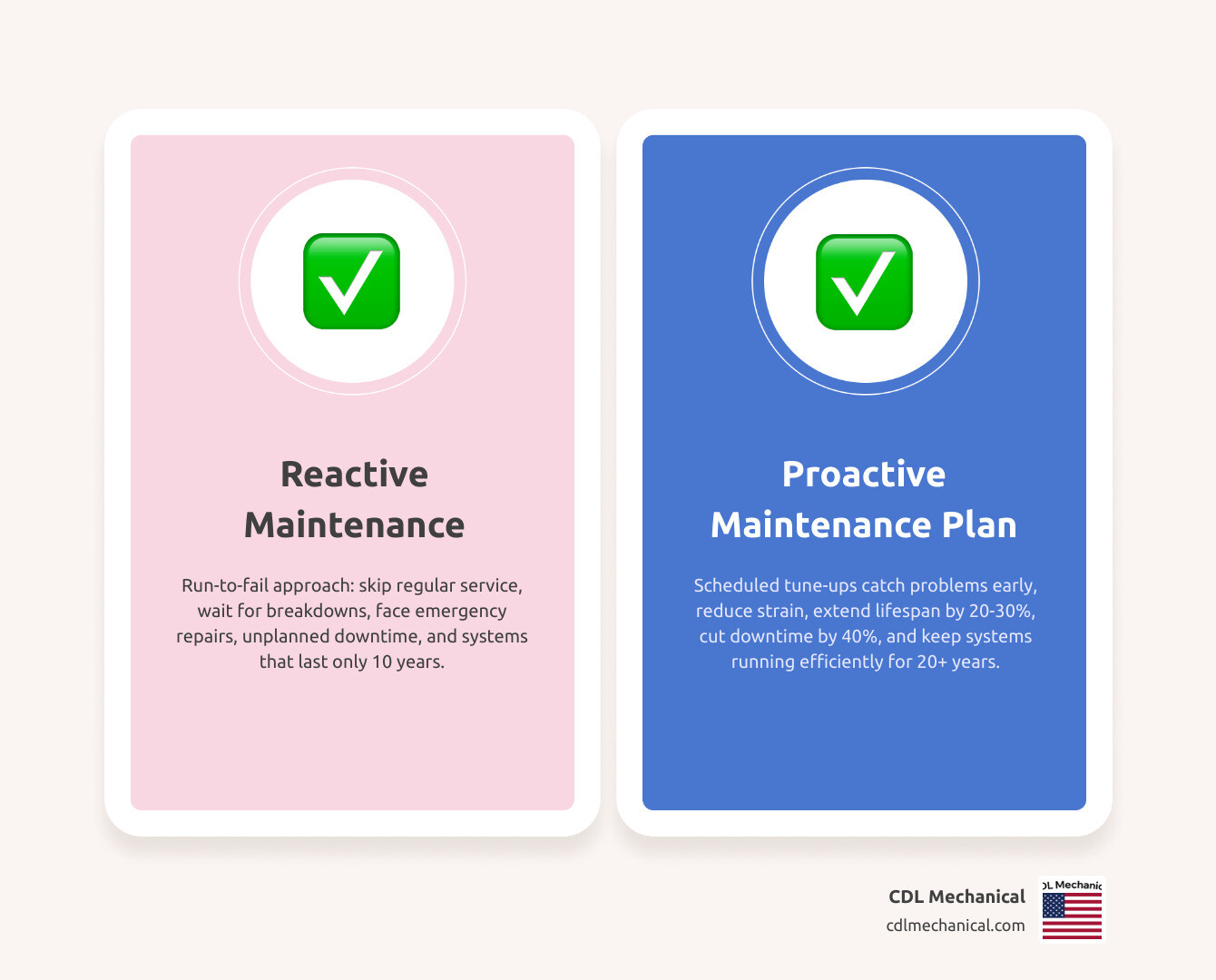
Proactive vs. Reactive Care: The Lifespan Gap
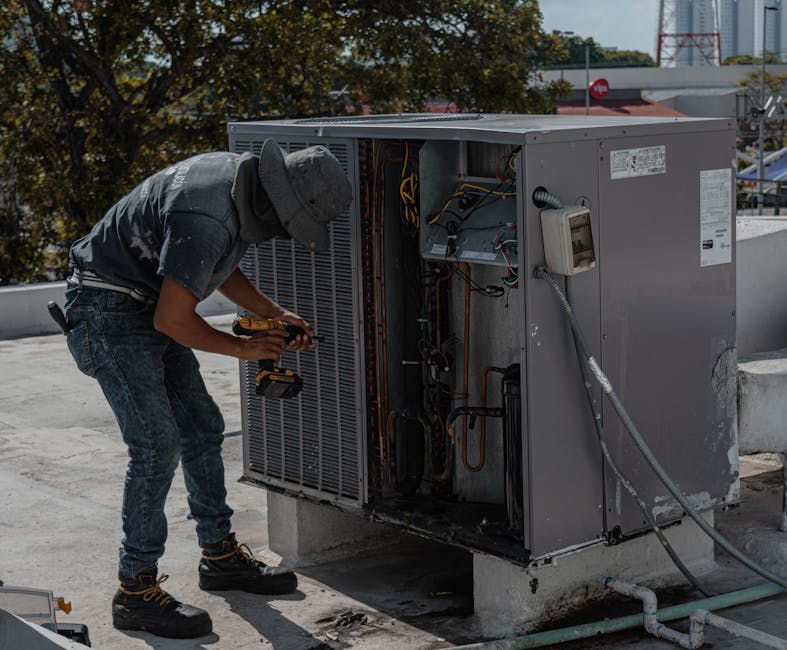
When it comes to caring for your home’s heating and cooling systems, there are two distinct paths you can take: reactive maintenance or proactive maintenance.
Reactive maintenance is the classic “run-to-fail” approach. This is the “if it ain’t broke, don’t fix it” mindset. Homeowners who operate this way only call an HVAC technician when the house is hot, the unit is blowing warm air, or a strange grinding noise is echoing through the vents.
The problem with run-to-fail is that it ignores cumulative neglect. While your air conditioner might seem to be running fine, tiny issues like a slightly low refrigerant charge, a dirty condenser coil, or a degrading capacitor are forcing the system to work twice as hard to cool your home. This extra strain doesn’t just raise your monthly utility bills; it knocks years off the system’s total lifespan.
Furthermore, reactive maintenance almost always leads to unexpected, catastrophic failures during the hottest weeks of the summer. Emergency repairs during a July heatwave in Peoria or Surprise can be incredibly stressful, leaving you stranded in a dangerous, overheated house while waiting for an available technician.
Proactive maintenance, on the other hand, is the cornerstone of a structured Maintenance Plan. Instead of waiting for a total system shutdown, proactive care involves regularly scheduled inspections, cleaning, and calibrations. By treating your HVAC system like an investment that requires routine upkeep, you prevent the stressful “wait until it breaks” cycle and replace it with planned, predictable care. To understand why this shift is so critical, it helps to look at Why Your HVAC System Craves a Service Agreement.
| Feature | Reactive Maintenance (Run-to-Fail) | Proactive Maintenance Plan |
|---|---|---|
| System Lifespan | Significantly shortened (typically 8–12 years) | Maximized to full design potential (15–20+ years) |
| Downtime | High; unexpected failures during peak summer heat | Minimal; scheduled during mild off-season months |
| Efficiency | Drops continuously as dirt and wear accumulate | Maintained at peak performance levels |
| Repair Frequency | High; minor issues cascade into major component failures | Low; early detection prevents secondary damage |
| Warranty Status | Frequently voided due to lack of professional service records | Fully protected with documented maintenance history |
How a Maintenance Plan Extends Equipment Life Through Early Detection
How a maintenance plan extends equipment life is rooted in the science of early detection. Every major mechanical failure starts as a minor, imperceptible issue. Think of your HVAC system like a professional athlete: if they run a marathon with a minor, untreated ankle sprain, they will eventually ruin their knee, hip, and lower back.
In an air conditioner, a small issue like a clogged air filter or a dirty outdoor coil restricts airflow. This restriction forces the blower motor and the compressor to run hotter and longer to achieve the same indoor temperature. Over time, this thermal stress degrades the motor windings and breaks down the compressor’s internal lubricants. What started as a simple dust buildup can easily cascade into a seized compressor — the heart of your AC system.
By scheduling routine tune-ups, a professional technician can spot these early warning signs. We check electrical contacts for pitting, measure capacitor ratings to ensure they are within factory specifications, and clean key heat-exchange surfaces. Making these minor adjustments and catching component wear early relieves the unnecessary system strain that would otherwise lead to premature failure. If you want to dive deeper into how these small checks yield massive results, read about the 5 Benefits of Routine AC Maintenance.
The Core Pillars of an Effective HVAC Maintenance Plan
An effective maintenance plan isn’t just a quick look-over; it is a systematic, multi-point process designed to address the physical and environmental threats your system faces. In the Phoenix West Valley — from Glendale and Goodyear to Buckeye and Sun City — our unique desert climate introduces specific challenges that require targeted maintenance actions.
An expert-level maintenance plan focuses on several core pillars:
- Coil Cleaning: Your AC works by transferring heat. The indoor evaporator coil absorbs heat from your home’s air, and the outdoor condenser coil releases that heat into the environment. If these coils are coated in dust, pet dander, or desert grit, they act as an insulating blanket. This prevents efficient heat transfer, forcing the system to run longer cycles and consume more energy.
- Lubrication: Moving parts like fan motors and bearings experience constant friction. Proper lubrication reduces this friction, preventing heat buildup and mechanical wear. In fact, over-lubrication or under-lubrication accounts for roughly 40% of preventable bearing failures in rotating mechanical equipment.
- Electrical Connections: Extreme heat causes wires and terminals to expand and contract, which can loosen electrical connections over time. Loose connections increase electrical resistance, leading to burnt wires, failed contactors, and damaged control boards. Tightening these connections and measuring voltage and amperage draw is a critical safety and longevity measure.
- Airflow Optimization: Your system needs to breathe. We inspect blower wheels, clear condensate drain lines to prevent damaging water overflows, and ensure ductwork connections are secure.
- Environmental Protection: Glendale dust storms (haboobs) and seasonal monsoons send massive amounts of fine dust, sand, and debris swirling through the air. This grit quickly settles inside your outdoor condenser unit. Without regular cleaning, this debris can clog the drain ports, corrode the aluminum fins, and accelerate wear on the fan blades.
To make sure your system is ready to face the transition into our intense summers, we always recommend following a structured Spring AC Tune-Up Checklist.
How a Maintenance Plan Extends Equipment Life on a Day-to-Day Basis
On a daily basis, your air conditioner is fighting a battle against friction, heat, and dust. When these three elements are left unchecked, they act as silent killers.
Consider a simple component like a fan belt or a motor bearing. If a bearing is dry or misaligned, the resulting friction creates localized heat. This heat thins out any remaining lubricant and degrades the surrounding metal components. A shaft misalignment of just 0.005 inches can reduce bearing life by up to 50%!
As dust accumulates on the blower motor, it acts as an insulator, trapping heat inside the motor casing. Since electrical resistance increases as temperature rises, a hot motor draws more electrical current, running less efficiently and wearing out its internal insulation much faster.
During our extreme summer heat, when outdoor temperatures stay above 100°F even after the sun goes down, your system has very little opportunity to cool off naturally. A structured maintenance plan ensures that your equipment has the friction reduction and heat dissipation capabilities it needs to survive these brutal operating conditions. Learn more about protecting your system during peak summer by reading How to Extend the Life of Your AC in Extreme Heat.
Determining the Right Service Frequency for Glendale HVAC Systems
One of the most common questions we get from homeowners in Glendale, Avondale, and Litchfield Park is: How often does my system actually need to be serviced?
The answer depends on your system type, its age, and our local climate. In milder parts of the country, a single annual visit might suffice. However, in the Arizona desert, our climate demands a more strategic approach.
For standard split systems and package units, we recommend a biannual schedule:
- Spring AC Tune-Up: This visit focuses entirely on the cooling side of your system. We clean the condenser coils, check refrigerant levels, test the compressor’s starting capabilities, and ensure the system is prepared to handle the relentless summer heat.
- Fall Heating Check: While our winters are mild, we still experience chilly desert nights. A fall visit ensures your furnace or heat pump is operating safely, checking for issues like cracked heat exchangers (which can leak dangerous carbon monoxide) or failed heating elements.
For heat pumps — which provide both heating and cooling and run almost year-round in our region — this biannual schedule is non-negotiable. Because these systems do double duty, they accumulate operating hours twice as fast as single-season equipment. To find the perfect schedule for your specific home, check out The Ultimate Guide to HVAC Service Frequency.
Homeowner Best Practices and Thermostat Operation
While professional service is the foundation of equipment longevity, there are several critical best practices that homeowners should perform between scheduled visits. Think of this as the daily dental hygiene that supports your twice-a-year professional cleanings.
- Filter Replacement: This is the single most important task you can do. A dirty filter restricts airflow, starves the system of air, and causes the indoor coil to freeze up. During the peak summer months, check your filters every 30 days. If you have pets or suffer from allergies, you may need to replace them monthly.
- Keep the Outdoor Unit Clear: Ensure there is at least a two-foot clearance around your outdoor condenser unit. Trim back desert landscaping, bushes, and weeds, and clear away windblown trash or leaves that can block airflow.
- Thermostat Settings: Avoid drastic temperature swings. Setting your thermostat to an ultra-low temperature won’t cool your house any faster; it simply forces the system to run longer, continuous cycles.
- Upgrade to a Smart Thermostat: Smart thermostats allow you to program schedules that match your daily routine, reducing unnecessary wear and tear when you are away from home. They also prevent short-cycling (the rapid turning on and off of your system), which is incredibly hard on the compressor.
For a complete breakdown of everyday care tips, read our guide on HVAC Maintenance 101 for Every Homeowner.
Leveraging Smart Technology and Digital Tools for Asset Longevity
The world of HVAC maintenance has evolved far beyond basic manual gauges and paper checklists. Today, we leverage advanced digital tools and smart technology to bring unprecedented precision to equipment care.
One of the most exciting advancements is the integration of IoT (Internet of Things) sensors and smart diagnostic tools. These sensors can monitor critical system parameters — such as temperature splits, refrigerant pressures, and electrical current draw — in real time. By analyzing this data, modern diagnostic software can detect incredibly subtle deviations from baseline performance long before a human eye or ear would notice a problem.
For example, if a blower motor’s electrical draw increases by just a fraction of an amp over several weeks, the software flags this trend. This allow us to schedule a proactive visit to lubricate a dry bearing or replace a failing capacitor before the motor burns out completely. This shift from time-based maintenance (servicing on a calendar schedule) to condition-based maintenance (servicing based on actual system health data) adds a layer of precision that can extend equipment life by an additional 20–40%.
While some homeowners and facility managers express initial hesitation or technology resistance due to the learning curve of smart systems, the long-term benefits are undeniable. Transitioning to a digital maintenance strategy replaces guesswork with clear, actionable data, ensuring your comfort system gets exactly the care it needs, exactly when it needs it.
How a Maintenance Plan Extends Equipment Life: The Financial and Operational Metrics
If you are a numbers-minded homeowner or business owner, you want to see the proof in the data. Investing in a maintenance plan isn’t just about peace of mind; it is a highly cost-effective financial decision.
Let’s look at the key metrics that demonstrate the return on investment (ROI) of a structured maintenance plan:
- Preventive Maintenance Compliance: Keeping your maintenance visits on schedule is the strongest predictor of system longevity. Every 10% drop in scheduled maintenance compliance correlates to an 8–12% reduction in the system’s useful life.
- Energy Efficiency: A clean, well-calibrated system operates at peak efficiency. Dirt accumulation on coils and restricted airflow can increase your energy consumption by 5% to 20% annually. Over the course of a long Arizona summer, those extra kilowatt-hours add up to a significant amount of wasted money.
- Repair Frequency: Statistics show that proactive maintenance programs typically cost only 25% to 30% of what you would spend fixing components after they break. By addressing small issues during scheduled visits, you avoid the premium labor rates and expedited shipping charges associated with emergency repairs.
- Lifespan Extension: On average, a neglected air conditioning system in our desert climate will fail completely in 8 to 12 years. With a consistent maintenance plan, that same system can easily run reliably for 15 to 20 years or more.
By tracking these performance baselines over time, you can clearly see how a modest commitment to routine care pays for itself many times over in lower utility bills and deferred replacement costs.
The HVAC Crossroads: Repair vs. Replacement Decisions
Even with the best maintenance plan, every air conditioner eventually reaches the end of its useful life. When a major component fails on an older system, you find yourself at an HVAC crossroads: Should you patch it up one more time, or is it time to move on?
To make a smart, objective decision, we recommend looking at the Total Cost of Ownership (TCO) and applying a few standard industry guidelines:
- The 50% Rule: If the cost of a single repair exceeds 50% of the system’s total replacement value, replacement is almost always the wiser choice.
- The Rule of 5,000: Multiply the age of your system in years by the cost of the repair. If the result is over $5,000, it is generally more cost-effective to invest that money into a new, highly efficient system.
- System Age and Refrigerant: If your system is over 12–15 years old and uses R-22 refrigerant (which has been phased out and is incredibly expensive to source), continuing to patch up leaks is a losing financial battle.
- Efficiency Gains: Modern air conditioners are vastly more efficient than systems built a decade ago. Upgrading to a high-efficiency unit can slash your cooling bills immediately, helping the new system pay for itself over time.
To help you navigate this complex decision, we have put together three comprehensive resources:
- Read The HVAC Crossroads: When to Patch It Up and When to Move On for a strategic overview of this dilemma.
- Check out To Fix or to Flip: Your HVAC Repair vs. Replacement Cost Guide for a detailed breakdown of the numbers.
- Discover the long-term financial benefits of modern technology in Counting the Coins Saved by High Efficiency Equipment.
Frequently Asked Questions About HVAC Longevity
What are the most common signs of HVAC wear that should not be ignored?
You should never ignore changes in how your system sounds, smells, or performs. Keep an eye and ear out for these early warning signs:
- Strange Noises: Squealing, grinding, rattling, or thumping sounds usually point to failing motor bearings, loose fan blades, or a degrading compressor.
- Weak Airflow: If the air coming from your registers feels weak or warm, you could be dealing with a clogged filter, a failing blower motor, or restricted ductwork.
- Short-Cycling: When your system turns on and off rapidly without completing a full cooling cycle, it puts immense stress on the compressor and electrical components.
- Rising Energy Bills: A sudden, unexplained spike in your monthly utility bill means your system is working much harder than it should have to, indicating internal wear or a refrigerant leak.
Can skipping scheduled maintenance void my manufacturer warranty?
Yes, absolutely. This is one of the most overlooked aspects of HVAC ownership. Almost all major equipment manufacturers (such as Trane, Carrier, and Lennox) explicitly state in their warranty terms that the warranty is only valid if the system receives regular, professional maintenance.
If your compressor fails five years into its ten-year warranty, the manufacturer will likely require proof of service before shipping a replacement part. Without documented maintenance records from a licensed professional, they have the right to deny your claim, leaving you responsible for the entire cost of the repair. A structured maintenance plan provides the professional documentation you need to keep your warranty fully protected.
Conclusion
At CDL Mechanical, we believe that keeping your home comfortable in the extreme Arizona heat shouldn’t be a source of stress. As a family-owned HVAC company based right here in Glendale, AZ, we treat our customers like family. We bring honest, dependable comfort, and deep local expertise to every home we service across the greater Phoenix area — from Tempe and Chandler to Peoria and Surprise.
Investing in a professional maintenance plan is the single best step you can take to protect your comfort, lower your monthly bills, and ensure your heating and cooling system enjoys a long, healthy life.
Ready to experience the peace of mind that comes with expert, proactive care? Explore our comprehensive Maintenance Plan today, or give us a call to schedule your seasonal tune-up. Let our family take care of yours!