
Why the West Valley Desert Climate Is So Hard on Your HVAC System
How the west valley desert climate affects your hvac comes down to a few brutal realities that every Glendale homeowner should understand:
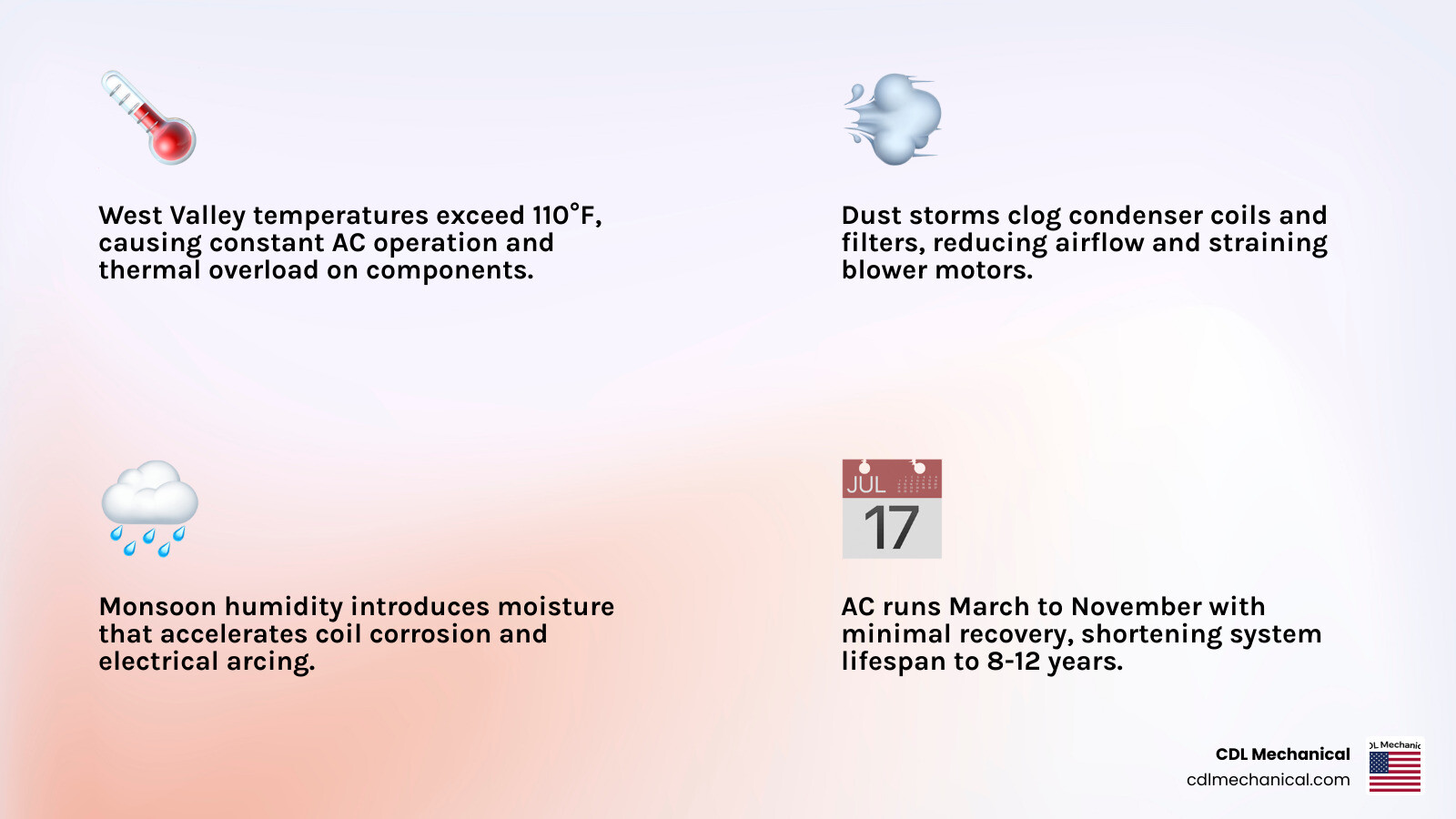
- Extreme heat — Temperatures regularly exceed 110°F, forcing your AC to run almost constantly and pushing components toward thermal overload
- Dust and haboobs — Fine desert particles clog condenser coils and air filters far faster than in other climates, starving your system of airflow
- Monsoon season — Sudden humidity and rain introduce moisture that accelerates corrosion and electrical damage
- Extended operating seasons — West Valley AC systems run hard from March through November, leaving almost no recovery time between cooling seasons
- Accelerated wear — Without consistent maintenance, systems that should last 15 years can fail in as few as 8 to 12
The result? Higher energy bills, more frequent breakdowns, and a shorter system lifespan than homeowners in cooler parts of the country ever deal with.
If your AC is struggling to keep up — or you want to make sure it doesn’t — you’re in the right place. This guide walks through exactly what the desert does to your HVAC system and what you can do about it.
I’m Joshua Michael Bartlett, owner of CDL Mechanical, and with over 20 years in the HVAC trade — including years serving West Valley homeowners through punishing Arizona summers — I’ve seen how the west valley desert climate affects your hvac in ways that generic maintenance advice simply doesn’t account for. Let’s get into it.
How the West Valley desert climate affects your HVAC performance
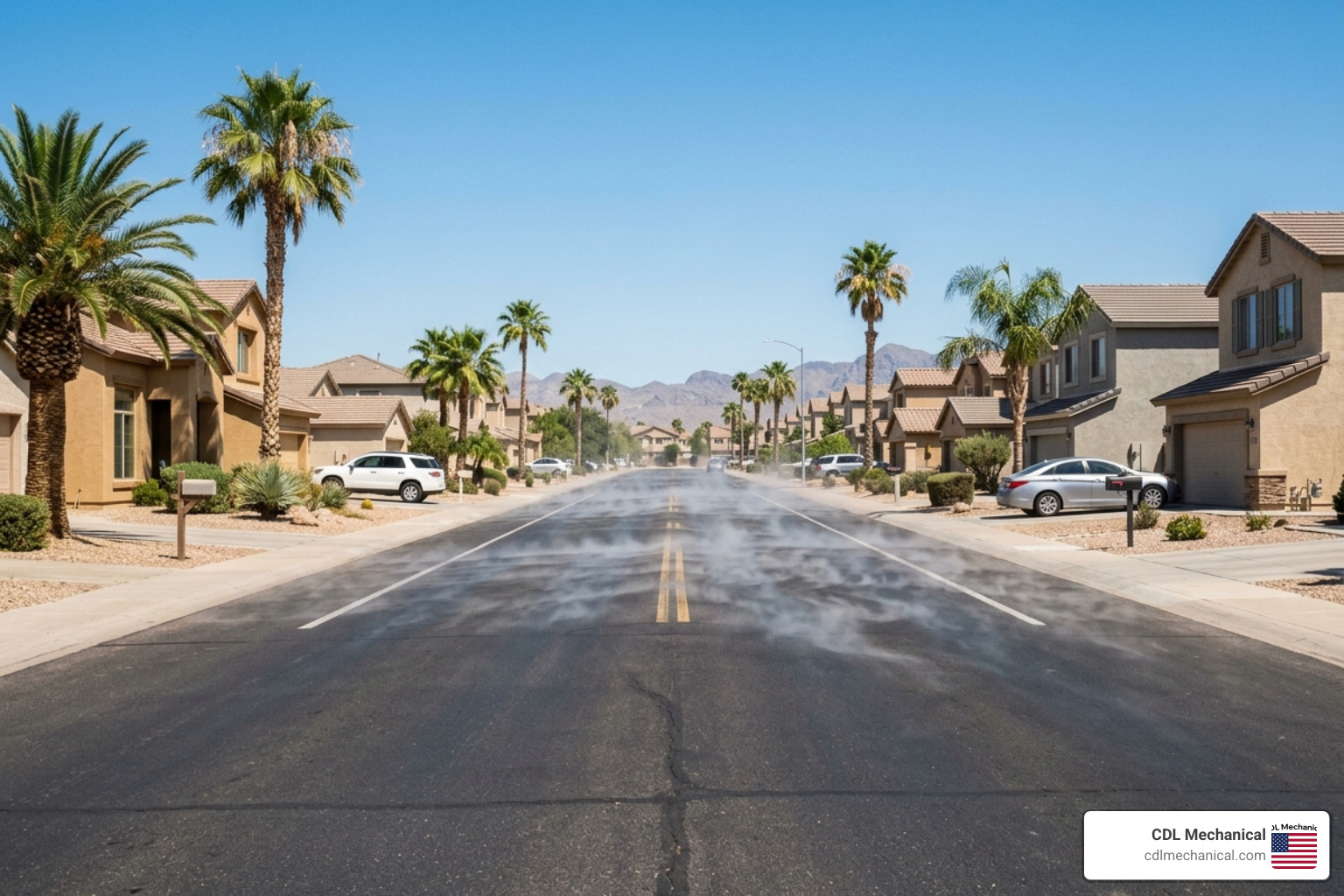
Living in the West Valley during April 2026, we are already seeing the early signs of a scorching summer. When the outdoor temperature hits 115°F, your air conditioner isn’t just a luxury; it’s a survival tool. However, the sheer physics of the desert makes cooling your home an uphill battle.
Most HVAC systems are designed to handle a 20°F temperature differential. This means if it’s 95°F outside, your system can comfortably keep your home at 75°F. But in the West Valley, we regularly ask our units to bridge a 40°F or even 50°F gap. This creates exponential power spikes. For every degree the temperature rises above 95°F, the energy required to cool your home doesn’t just increase linearly—it jumps significantly. In fact, energy consumption for cooling can increase by 50-100% when the mercury climbs from 95°F to 115°F.
One of the most common issues we see is “short cycling.” This happens when your unit turns on and off rapidly. While you might think frequent starts are normal, they actually use the most power and put the most strain on the motor. If you’re noticing that your home isn’t cooling evenly, you might need to look into How To Fix Hot And Cold Spots At Home to ensure your system isn’t working harder than it needs to.
Thermal stress: How the West Valley desert climate affects your HVAC components
The internal components of your HVAC system are under constant siege from the heat. The “heart” of your system—the compressor—is particularly vulnerable. When it’s 110°F outside, the air around your outdoor unit is likely even hotter, especially if it’s sitting on a rock bed or near a south-facing wall. This leads to thermal overload, where the compressor simply gets too hot to function.
Capacitors are another frequent casualty. These small, cylindrical components provide the “jolt” of electricity needed to start your motors. In the desert heat, they can literally bulge and pop, leaving you with a fan that won’t spin or a compressor that won’t kick on. We often hear from homeowners who are No More Shivering In The Kitchen And Sweating In Bed because their system has lost its ability to regulate temperature due to these component failures. Low humidity also plays a role here, as it can cause rubber seals and belts to dry out and crack, leading to refrigerant leaks that are difficult to track down.
Filtration needs: How the West Valley desert climate affects your HVAC airflow
Airflow is the lifeblood of your HVAC system. In the West Valley, our air is filled with fine dust, pollen, and particulates that you won’t find in the Midwest or the Coast. This dust creates high “static pressure,” which is essentially the resistance your blower motor has to fight against to move air through your home.
When your air filter gets clogged—which happens much faster here—your blower motor has to work twice as hard to pull air through. This leads to overheating and can eventually burn out the motor entirely. Many homeowners try to solve this by constantly adjusting their settings, but we recommend you Stop Playing Musical Chairs With Your Thermostat and instead focus on maintaining a clean filtration system. Using a filter with the wrong MERV rating can actually make the problem worse by restricting airflow too much, so finding that “Goldilocks” balance is key for desert survival.
The “Triple Threat”: Heat, Dust, and Monsoons
In the West Valley, we don’t just deal with heat; we deal with the “Triple Threat” of extreme temperatures, haboobs, and monsoons. Each of these elements attacks your HVAC system in a different way.
Dust storms, or haboobs, are perhaps the most visually dramatic challenge. These storms dump incredible amounts of fine silt into your outdoor condenser unit. This dust coats the aluminum fins of your coils, acting like a thermal blanket. Instead of releasing heat into the air, your unit traps it, causing the compressor to run hotter and longer. This is a major reason why many struggle with How To Keep Your Desert Mansion Cool On Every Floor; if the outdoor unit can’t breathe, the indoor air will never reach the desired temperature.
Then comes the monsoon season. While the rain is a welcome break from the heat, the spike in humidity is a nightmare for AC units. High humidity makes the air feel hotter, forcing your system to run longer cycles to dehumidify the space. Furthermore, the combination of moisture and desert minerals can lead to corrosion on your coils. We always recommend looking for systems with corrosion-resistant coils to combat this.
Don’t forget the desert critters! Scorpions, spiders, and even small rodents love the shade and moisture found inside an HVAC cabinet. We’ve seen chewed wiring and clogged drainage pipes caused by pests seeking refuge from the sun. Installing wire mesh or using specific pest deterrents can save you from a very weird (and expensive) repair bill.
Efficiency and Longevity in the Arizona Heat
The harsh reality is that an HVAC system in Phoenix Az simply won’t last as long as one in a milder climate. Nationally, you might expect 15 years out of a unit. In the West Valley, 8 to 12 years is the standard if you aren’t meticulous about maintenance.
Neglected systems lose about 5% of their efficiency every single year. In a climate where HVAC operation accounts for 50-70% of your total energy bill during the summer, that 5% adds up fast. By year three, a neglected unit is operating at only 85% capacity while consuming more power than ever.
| Feature | Standard HVAC System | Desert-Optimized System |
|---|---|---|
| Expected Lifespan | 10-15 Years | 8-12 Years (Due to extreme use) |
| Energy Efficiency | Standard SEER2 | High SEER2 (18+) + High EER2 |
| Compressor Type | Single-Stage | Variable-Speed or Two-Stage |
| Coil Protection | Standard Copper/Aluminum | Corrosion-Resistant Coating |
| Maintenance Need | Annual | Bi-Annual (Spring & Fall) |
We can’t stress enough Why Regular Heat Pump Service In Phoenix Is A Total Lifesaver. Heat pumps are incredibly popular here because they handle both our hot summers and our chilly winter nights efficiently, but they require expert calibration to handle the 110°F+ peaks without failing.
Desert-Ready Features for New Installations
If you are looking to replace your unit in 2026, you shouldn’t just buy the first model you see. You need a system built for the desert. The gold standard today is the variable-speed compressor. Unlike traditional units that are either “all the way on” or “all the way off,” variable-speed units can ramp up or down to meet the exact cooling demand. This prevents short cycling and keeps your home at a rock-steady temperature.
Proper sizing is also critical. Many people think “bigger is better,” but an oversized unit will cool the house too fast, shut off before it removes the humidity, and then kick back on a few minutes later. This wastes 20-30% more energy. We perform detailed Manual J load calculations that take into account your square footage, insulation levels, and even which way your windows face.
If you are searching for Heat Pump Service Near Me In Phoenix Az, make sure you ask about smart thermostat integration. A Popular Thermostat Control For Summer To Save Money allows you to pre-cool your home during off-peak energy hours and adjust the temperature remotely, so you aren’t paying to chill an empty house while you’re at work in Glendale or Peoria.
Maintenance Strategies for Extreme Weather
To keep your system running through a West Valley summer, you need a proactive strategy. Waiting for the system to break in July is a recipe for a very sweaty, very unhappy week.
- Bi-Annual Tune-Ups: You should have your system inspected in the spring (before the heat hits) and the fall (before the winter chill). Our Spring Ac Tune Up Checklist includes checking refrigerant levels, tightening electrical connections, and cleaning the “blanket” of dust off your coils.
- Monthly Filter Changes: During peak dust season, a “90-day filter” is usually a “30-day filter.” Check them every month. Replacing a dirty filter can reduce your energy use by 5-15%.
- Duct Sealing: In many West Valley homes, ductwork runs through attics that can reach 130°F. If your ducts have leaks, you are sucking in that super-heated, dusty air and blowing it into your living room. Sealing these leaks is one of those New Year Lower Bills Simple Hvac Tweaks To Cut Winter Energy Costs that pays for itself almost immediately.
- Clear the Perimeter: Keep at least two feet of clear space around your outdoor unit. Trim back desert broom or bougainvillea that might be blocking airflow.
- Surge Protection: Monsoon lightning and grid strain can cause power surges that fry expensive control boards. A dedicated HVAC surge protector is a smart investment.
Frequently Asked Questions
How long does an AC unit typically last in the West Valley?
In the West Valley, the average lifespan of an AC unit is 8 to 12 years. While the national average is closer to 15 years, our extreme heat cycles and the sheer number of hours the system must run each year cause parts to wear out faster. Regular bi-annual maintenance is the only way to push that lifespan toward the 12-year mark.
Why are my energy bills so high during the summer?
During peak summer months in cities like Surprise or Goodyear, your HVAC system can account for 50-70% of your total energy bill. When the temperature hits 115°F, your system struggles with “thermal gain”—the heat entering through your walls and windows—meaning it has to run almost continuously. If your system is neglected or improperly sized, it loses efficiency, forcing it to draw even more power to do the same amount of cooling.
How often should I change my air filters in Glendale?
We recommend inspecting your air filters every 30 days. Because of the high dust content in the West Valley and the frequency of haboobs, filters clog much faster here than in other regions. Using a MERV 8 to 11 filter is usually the sweet spot for residential homes; it catches the desert dust without putting too much strain on your blower motor.
Conclusion
Understanding how the west valley desert climate affects your hvac is the first step toward a cooler, more affordable summer. The heat, dust, and monsoons are relentless, but with the right equipment and a solid maintenance plan, your system can stand up to the challenge.
At CDL Mechanical, we’re a family-owned team based right here in Glendale, AZ. We live in this heat too, so we know exactly what it takes to keep a home comfortable when the sidewalk starts to melt. We treat every customer like family, providing the honest, expert service you need to navigate our unique climate.
Whether you need a pre-summer tune-up or a complete system replacement, we’re here to help. We are proud to be known as The Valleys Finest Professional Heat Pump Service Technicians In Phoenix, serving our neighbors in Phoenix Az and across the entire West Valley. Don’t wait for the next record-breaking heatwave—give us a call today and let’s make sure your AC is ready for the long desert summer ahead.