
Why Scorching Desert Attics Are Silently Destroying Your Ductwork in Glendale, AZ
Ductwork in desert attics challenges and solutions is one of the most urgent — and most overlooked — home comfort issues facing Glendale homeowners. While your AC unit gets all the attention, the ducts hidden in your attic are quietly battling temperatures that can exceed 160°F in summer. That extreme heat, combined with abrasive desert dust, hungry pests, and daily temperature swings, creates a perfect storm of energy waste and system failure.
Here is a quick overview of the core challenges and solutions:
| Challenge | What It Causes | Solution |
|---|---|---|
| Attic heat (up to 160°F+) | Heat gain in ducts; cooled air arrives warm | Radiant barriers; buried or encapsulated ducts |
| Duct leakage (20–40% air loss) | Wasted energy; uneven room temperatures | Mastic sealing; professional pressure testing |
| Silica dust infiltration | Blower motor wear; coil insulation; compressor failure | High-MERV filters; professional coil cleaning |
| Flexible duct kinks and twists | Restricted airflow; longer cooling cycles | Proper support; duct replacement or straightening |
| Desert pests (pack rats, roof rats) | Torn vapor barriers; disconnected joints | Pest exclusion; duct inspection and repair |
| Insufficient R-values | Thermal loss through duct walls | R-8 minimum; buried ducts achieve effective R-25 |
| Vented attic placement | 10–30% energy penalty | Conditioned attic; soffits; interior duct placement |
The result for many Glendale families is an AC system that runs constantly but never quite wins — rooms that stay stuffy, energy bills that keep climbing, and a comfort system that is working far harder than it should.
I’m Joshua Michael Bartlett, founder of CDL Mechanical and an HVAC professional with over 20 years of hands-on experience tackling ductwork in desert attics challenges and solutions in the greater Phoenix area. In this guide, I’ll walk you through exactly what is happening inside your attic and what you can do about it.
Why Desert Attics are the Ultimate Challenge for Ductwork
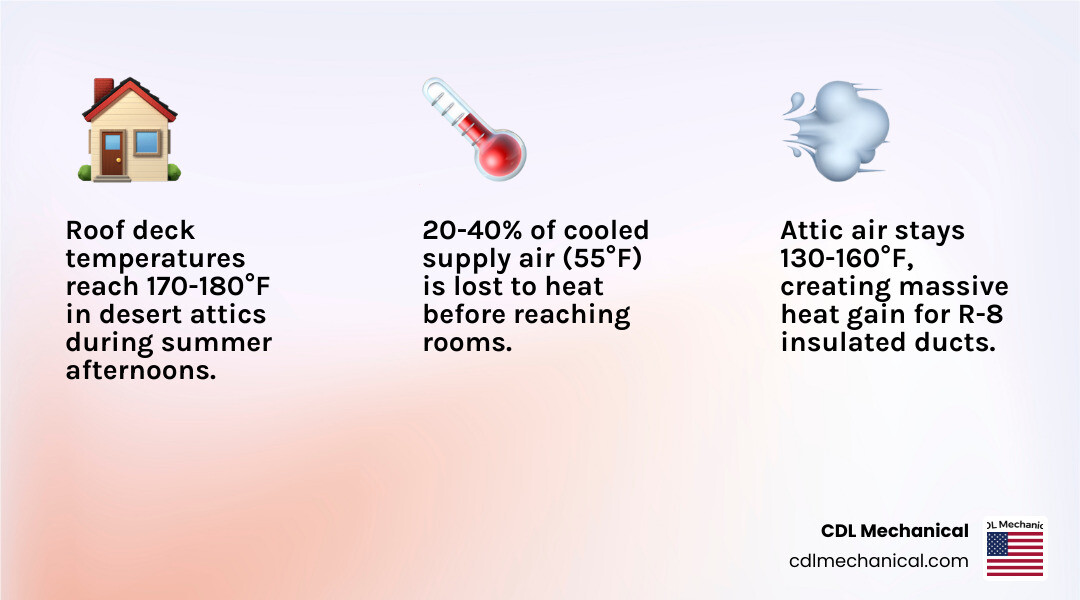
In the HVAC world, there is a common saying: the attic is the worst possible place to put a cooling system. In Glendale and surrounding areas like Peoria and Sun City, this isn’t just an opinion—it’s a physical reality. During a typical July afternoon, while the outdoor air might be 115°F, the underside of your roof deck (especially with asphalt shingles) can soar to between 170°F and 180°F.
This creates a massive temperature differential. Your AC is trying to push 55°F air through a “pipe” that is sitting in a 160°F oven. Even with standard R-8 insulation—which is the current mandate in Phoenix—the heat gain is staggering. Thermal radiation from the roof deck transfers energy directly to the duct surface, warming the air before it ever reaches your bedroom. This is why many homeowners find that their AC runs for hours, but the air coming out of the vents feels lukewarm. For more information on how we address these issues, explore our Ductwork Services.
Addressing Ductwork in Desert Attics Challenges and Solutions with Radiant Barriers
One of the most effective ways to shield your ducts from this “broiler” effect is the installation of radiant barriers. These are typically highly reflective foil sheets applied to the underside of the roof rafters. Unlike traditional insulation that slows down heat conduction, radiant barriers reflect the sun’s infrared energy back out through the roof.
By installing a radiant barrier, you can drop the attic temperature by 30°F or more. This significantly reduces the cooling load on your ductwork. When the “environment” around the ducts is cooler, the R-8 insulation can actually do its job effectively. This is a key step in how to keep your desert mansion cool on every floor, as it addresses the heat at the source.
Hidden Airflow Restrictions in Flexible Ducts
Most modern homes in Surprise and Goodyear use flexible ductwork. While cost-effective and easy to install, “flex” duct is incredibly sensitive. Think of it like a garden hose: if there is a kink or a sharp twist, the water flow stops. In your attic, a flex duct that is sagged over a ceiling joist or twisted to fit into a tight corner creates massive static pressure.
These hidden restrictions force your blower motor to work harder, leading to premature wear and higher electricity bills. Airflow velocity drops, meaning the cooled air doesn’t have enough “push” to reach the far corners of your home. Professional Air Balancing is often required to identify these “dead zones” and ensure the air is distributed exactly where it’s needed.
Ductwork in Desert Attics Challenges and Solutions: Managing Leakage and Dust
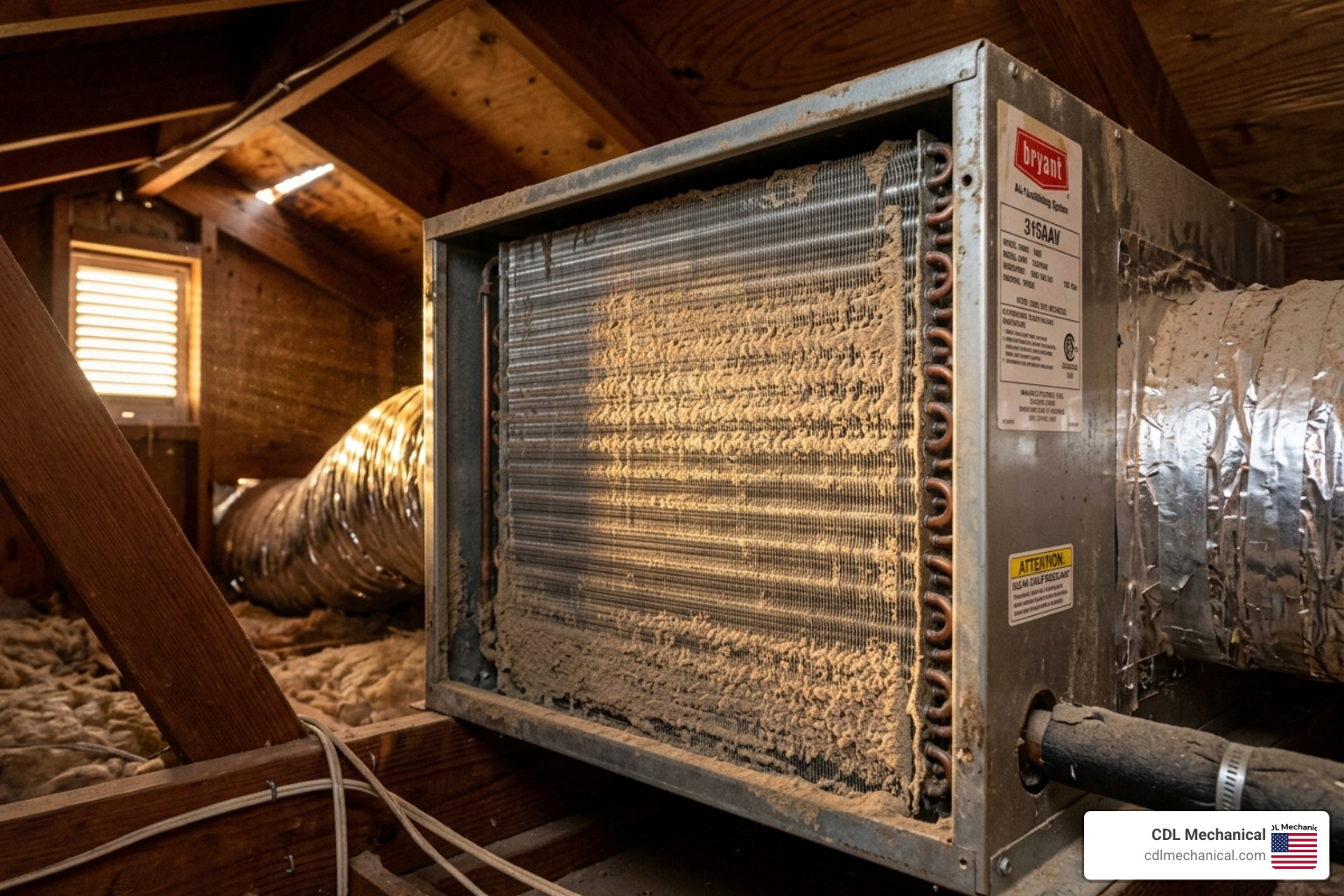
Duct leakage is the “silent thief” of the Arizona desert. On average, 20% to 30% of the air you pay to cool is lost through cracks, holes, and poor connections in the attic. In some older homes in Phoenix or Tempe, that loss can hit 40%. This isn’t just a comfort issue; it’s a massive energy penalty. When your supply ducts leak, you are literally paying to air condition your attic.
Worse yet is the “return-side” leak. If your return ducts have holes, they act like a vacuum, sucking in 150°F air and fine silica dust from the attic directly into your breathing air. This bypasses your filter and coats your system’s internal components in a layer of abrasive desert grime. Learn more about this by demystifying the air balancing process for homeowners.
The Impact of Desert Pests on Airflow Integrity
In areas like Cave Creek or Buckeye, we frequently encounter “uninvited guests” in the attic. Pack rats and roof rats love the soft fiberglass insulation and plastic vapor barriers of flexible ductwork. They don’t just nest in it; they often chew through the outer jacket to reach the cool air inside during the day.
Once a rodent breaches the vapor barrier, the insulation becomes compromised and can begin to “sweat” or fall away. This leads to disconnected joints and massive air leaks. If you’ve noticed a sudden “shivering in the kitchen and sweating in bed” scenario, it might be time to check for pest damage. You can find more tips on no more shivering in the kitchen and sweating in bed to see how we restore balance.
Mechanical Strain from Silica Infiltration
Desert dust isn’t like the lint you find in other states. Sonoran Desert dust is heavily composed of silica—tiny, sharp mineral fragments. When this dust leaks into your ducts, it acts like sandpaper on your blower motor’s bearings.
Furthermore, dust that settles on your evaporator coil acts as an insulator. Instead of the refrigerant absorbing heat from your home’s air, it has to fight through a layer of dirt. This forces the compressor to run longer and hotter, which is the leading cause of “dead” AC units in the middle of a July heatwave. Solving these issues is a major part of how to fix hot and cold spots at home.
High-Performance Strategies: Buried and Encapsulated Ducts
If we can’t move the ducts out of the attic, we can change the attic’s rules. “Burying” ductwork involves placing the ducts directly on the ceiling drywall and covering them with a mountain of blown-in insulation (usually fiberglass or cellulose).
While an exposed duct only has an R-8 rating, a buried duct can achieve an effective R-25 value. This provides a nearly threefold reduction in thermal losses. However, this must be done correctly. In a desert environment, simply throwing insulation over a duct can lead to “sweating” if the duct surface temperature reaches the dew point. For high-performance installations, we often recommend our specialized Ductwork Services.
Optimizing Ductwork in Desert Attics Challenges and Solutions through Proper R-Values
Building codes have evolved significantly. While older homes might only have R-4 or R-6 duct insulation, the 2018 International Energy Conservation Code (IECC) and local Phoenix amendments have pushed for higher standards. For optimal performance in the Valley, we recommend attic floor insulation levels of R-49 to R-60.
High R-values help combat “thermal bridging,” where heat travels through the wooden framing of your home and bypasses the insulation. Keeping your ducts deeply buried under a thick, consistent blanket of insulation ensures that the air leaving your AC unit at 55°F actually arrives at your vent at 57°F, rather than 65°F. This is another essential strategy for how to fix hot and cold spots at home.
Preventing Duct Sweating in Buried Systems
The biggest risk with buried ducts is condensation. When very cold air moves through a duct buried in insulation, the outer surface of that duct can get very cold. If humid air (especially during our monsoon season) reaches that cold surface, it turns into water.
To prevent this, we use an “encapsulation” technique. This involves spraying a layer of closed-cell polyurethane foam over the ductwork before burying it in “fluffy” insulation. The closed-cell foam acts as a vapor barrier, ensuring that moisture never reaches the cold duct surface. This prevents mold growth and protects your ceiling drywall from water damage.
Structural Alternatives to Traditional Attic Placement
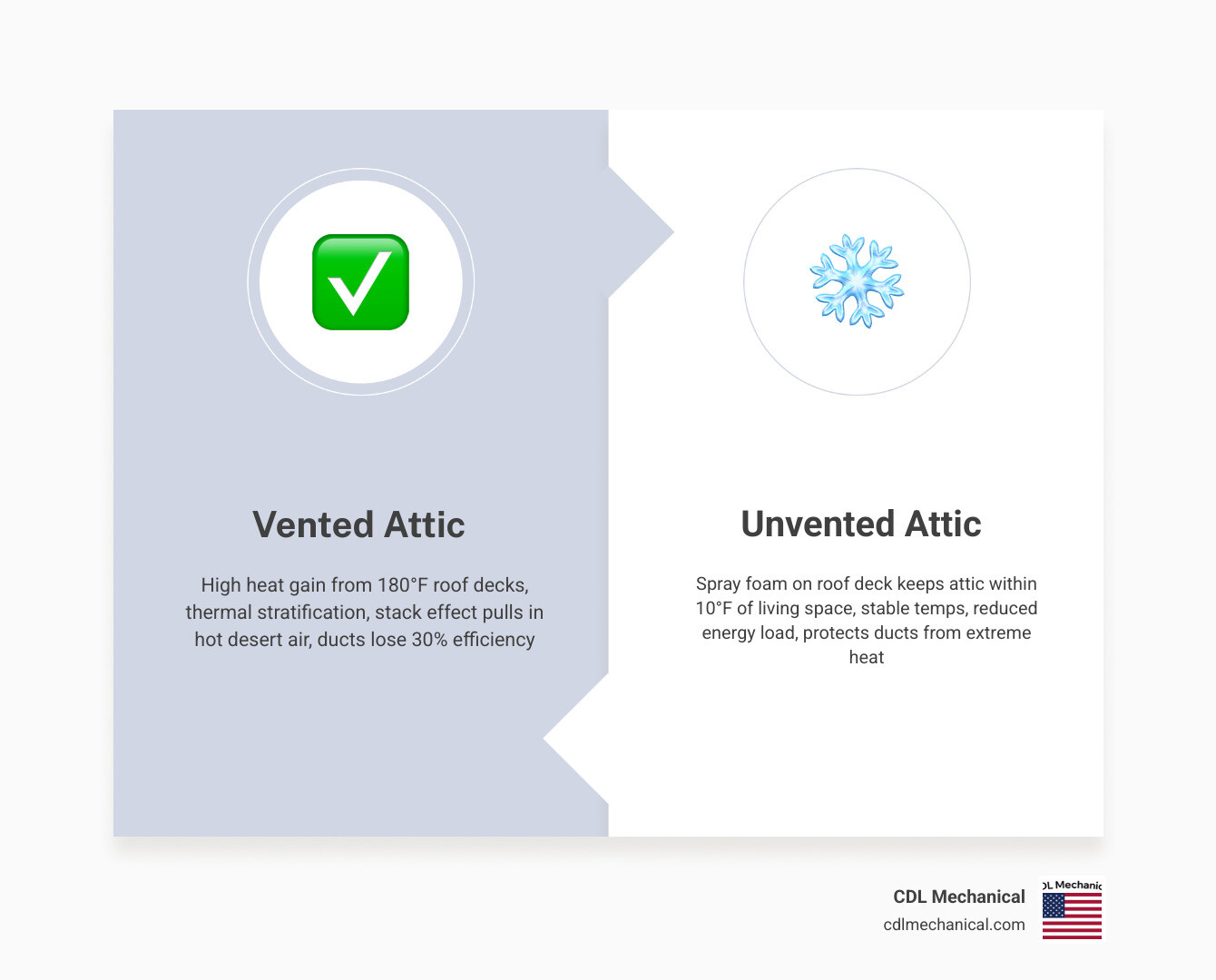
For new construction or major renovations in Glendale and Scottsdale, the best “solution” for ductwork in desert attics challenges and solutions is to stop putting ducts in vented attics altogether. By moving the thermal boundary of the house from the ceiling to the roofline, we create a conditioned attic space.
Vented vs. Unvented Attic Performance
In a traditional vented attic, the goal is to use airflow to “flush out” heat. However, this often fails when the outdoor air is 110°F. In an unvented (conditioned) attic, we apply spray foam insulation directly to the underside of the roof deck.
This brings the attic into the “envelope” of the house. In these homes, the attic temperature usually stays within 10 to 15 degrees of the living room temperature. This completely eliminates the 160°F environment, allowing the HVAC system to operate at peak efficiency. This is a premium strategy used in how to keep your desert mansion cool on every floor.
Moving Ducts into Conditioned Space
Another architectural solution is the use of dropped soffits or bulkheads. Instead of running ducts through the attic, we build “chases” inside the living space—often above hallways or along the perimeter of rooms.
Moving ducts into the conditioned space eliminates the energy penalty of the attic entirely. Research shows this can reduce the total cooling load of a desert home by 10% to 15%. While it requires careful coordination with framers and architects, it is the “gold standard” for long-term comfort and efficiency.
Frequently Asked Questions about Ductwork in Desert Attics Challenges and Solutions
Why is my second floor always hotter than the first floor in the summer?
This is usually a “triple threat” of physics. Heat rises (thermal stratification), the second-floor ceiling is directly beneath a 160°F attic, and most multi-story homes have inadequate return air paths. Without a way to “suck” the hot air out of the upstairs rooms, the cool air from the vents simply can’t get in.
Can I bury my existing flexible ducts under more insulation?
You can, but it must be done with caution. If you have older R-4 or R-6 ducts, burying them without a proper vapor barrier can lead to condensation and mold during the monsoon season. It is always best to have a professional inspect the duct integrity and seal all leaks with mastic before adding insulation.
How does desert dust actually damage my HVAC system?
Desert dust contains silica, which is highly abrasive. It wears down the mechanical bearings in your blower motor and coats your evaporator coils. A dirty coil can’t absorb heat effectively, which forces your AC to run longer. Over time, this “insulation by dirt” can lead to compressor overheating and total system failure.
Conclusion
At CDL Mechanical, we know that living in the West Valley means your HVAC system is your lifeline. Whether you are in Glendale, Peoria, or Surprise, your ductwork is the heart of that system. Neglecting the ductwork in desert attics challenges and solutions discussed today is like trying to run a marathon while breathing through a straw—it’s exhausting, inefficient, and eventually, something is going to break.
We are a family-owned team that treats every home like our own. We don’t just look at the AC unit; we look at the whole “thermal envelope” of your home to ensure you are getting the comfort you pay for. If you are tired of high bills and hot rooms, we are here to help.
Ready to take control of your home’s comfort? Contact us today for expert Ductwork Services and let’s get your system running the way it was meant to.