
The Simple Answer to How Often Should You Change Your HVAC Air Filter
How often should you change your HVAC air filter depends on a few key factors, but here is a quick reference to get you started:
| Household Situation | Recommended Replacement Frequency |
|---|---|
| Standard home, no pets, no allergies | Every 90 days |
| Home with one pet | Every 60 days |
| Home with multiple pets or allergies | Every 20-45 days |
| Allergy or asthma sufferers | Every 20-45 days |
| Vacation or low-occupancy home | Every 9-12 months |
| 1-inch fiberglass filter | Every 30 days or less |
| 1-inch pleated filter | Every 30-90 days |
| 4-5 inch media filter | Every 6-12 months |
| Glendale, AZ during peak summer or monsoon season | Check monthly, replace as needed |
Most homeowners do not think about their air filter until something goes wrong — a spike in the energy bill, weak airflow from the vents, or dust settling on furniture faster than it should. Here in Glendale, AZ, that problem hits harder than in most parts of the country. The desert heat runs your system harder, the blowing sand and construction dust load up your filter faster, and skipping a filter change can mean real trouble for your comfort and your equipment — especially in the middle of a Phoenix Valley summer.
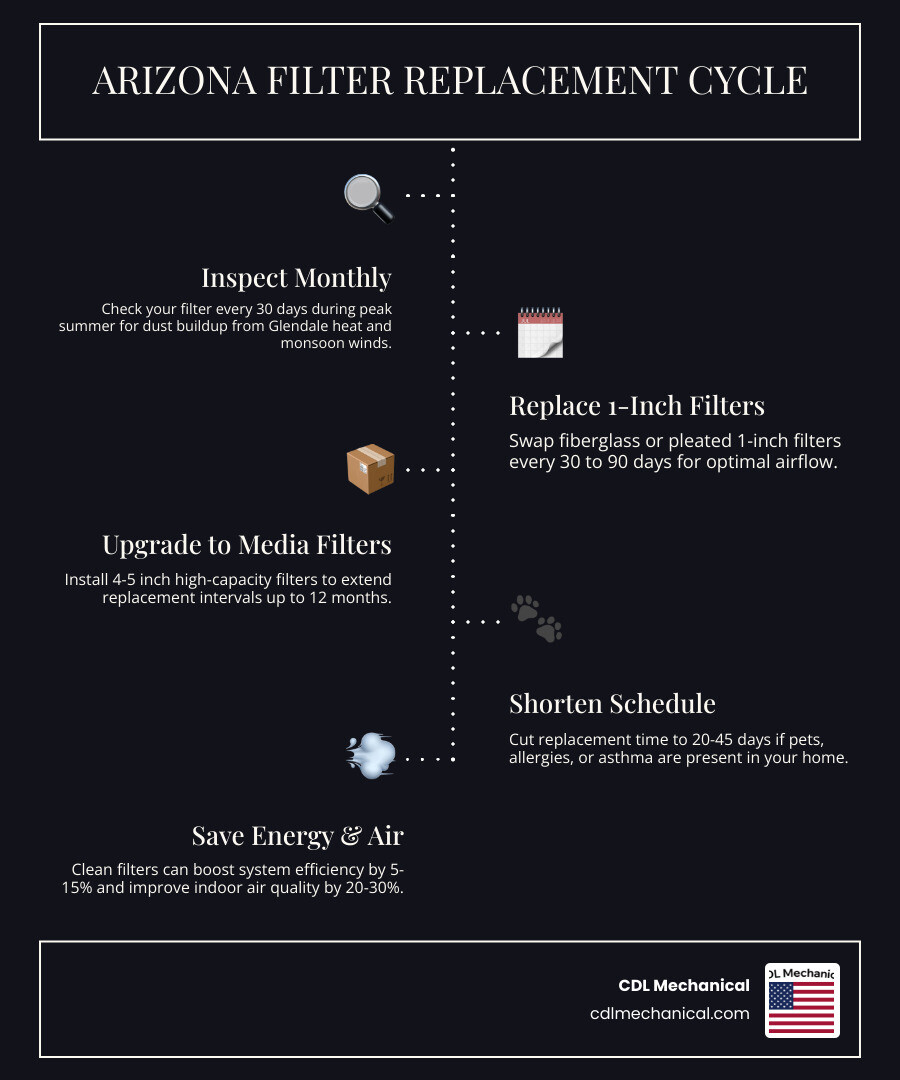
The good news is that staying on top of filter changes is one of the simplest and most impactful things you can do for your home. According to the U.S. Department of Energy, replacing a dirty, clogged filter can improve your system’s efficiency by 5 to 15 percent and boost indoor air quality by 20 to 30 percent. That is not a small deal when your AC is running 10 to 15 hours a day in the Arizona heat.
I’m Joshua Michael Bartlett, founder of CDL Mechanical and an HVAC professional with over 20 years of hands-on experience in the trade — and one of the most common questions I hear from Glendale homeowners is exactly how often should you change your HVAC air filter for their specific home and climate. In the sections below, I will walk you through everything you need to know to make the right call for your household.
How Often Should You Change Your HVAC Air Filter?

In the HVAC world, we often talk about the “90-day rule.” For a standard home with high-quality pleated filters and no pets, changing your filter every three months is usually sufficient. However, Glendale is not exactly a “standard” environment. Between May and September, our air conditioners are essentially running a marathon every single day.
When your system runs for 12 to 15 hours a day to fight off 110-degree temperatures, it is processing a massive volume of air. More air through the system means more dust, pollen, and debris hitting that filter. This is why Air Conditioning Maintenance is so critical in the Valley. During these peak months, we recommend checking your filter every 30 days. You might not need to swap it every time, but you don’t want to be caught with a clogged unit when a monsoon dust storm rolls through and adds a layer of silt to your return vents.
General Guidelines for How Often Should You Change Your HVAC Air Filter
The material of your filter plays a huge role in its lifespan.
- Fiberglass Filters: These are the thin, blue, or white “see-through” filters. They are primarily designed to keep large debris out of your motor, not to clean your air. Because they have very little surface area, they clog quickly. You should replace these every 30 days—if not sooner.
- Pleated Filters: These are the most common residential filters. The folds (pleats) provide more surface area to trap particles. Depending on the thickness, these can last anywhere from 60 to 90 days.
- High-Capacity Media Filters: These are the heavy hitters, often 4 to 5 inches thick. Because they have so much surface area, they can often go 6 to 12 months before needing a replacement.
Knowing your filter type is the first step in Don’t Let the Dust Settle on Your AC Performance.
Environmental Factors in Glendale and the Phoenix Valley
Living in the desert means dealing with unique air quality challenges. In the Phoenix Valley, we deal with “haboobs” (massive dust storms), constant construction as our cities grow, and seasonal pollen from desert flora. Even wildfire smoke from neighboring states can settle in our valley, clogging filters in as little as two weeks.
When the outdoor air quality drops, your HVAC filter is the only thing standing between those pollutants and your lungs. Understanding How HVAC Filters Affect Indoor Air Quality is essential for desert dwellers. If you’ve recently experienced a heavy dust storm or there is active construction on your block, it is time to peek at that filter regardless of what the calendar says.
Understanding Filter Types and Replacement Schedules
Not all filters are created equal. Using the wrong size or thickness can actually harm your system by restricting airflow.
| Filter Thickness | Typical Lifespan | Best For |
|---|---|---|
| 1-Inch Fiberglass | 30 Days | Protecting the unit only (not air quality) |
| 1-Inch Pleated | 30-90 Days | Standard homes, moderate filtration |
| 4-Inch Media | 6 Months | High-efficiency systems, allergy relief |
| 5-Inch Media | 9-12 Months | Maximum surface area, long-term use |
Choosing the Right MERV Rating for Your System
MERV stands for Minimum Efficiency Reporting Value. It is a scale from 1 to 16 for residential systems. While it might seem like a higher number is always better, that isn’t always the case. A very high MERV filter (like a 13 or 14) is so dense that it can act like a wall, making it harder for your blower motor to pull air through. This creates “static pressure” that can lead to expensive motor failures.
For most Glendale homes, a MERV 8 to 11 is the “sweet spot.” It provides 5 Benefits of Good Indoor Air Quality by trapping dust, mold spores, and pet dander without suffocating your AC unit.
How Often Should You Change Your HVAC Air Filter with Pets and Allergies?
If you have a golden retriever that sheds like it’s his job, or if you suffer from seasonal allergies, the 90-day rule goes out the window. Pet hair and dander are heavy and sticky; they coat filter fibers quickly, reducing the filter’s ability to catch smaller particles like pollen.
For households with pets or allergy sufferers, we recommend a 20 to 45-day replacement cycle. This ensures that your home remains a sanctuary from triggers and is a key part of the 5 Benefits of Routine AC Maintenance.
Signs Your Filter Needs Immediate Attention
Sometimes you don’t need a calendar to tell you it’s time for a change—your house and your system will tell you.
The Light Test and Visual Cues
The “Light Test” is the most reliable DIY method to check your filter’s health. Take your filter out and hold it up to a bright light source or a flashlight. If the light shines through clearly, the filter still has life. If the light is blocked or looks very dim, the fibers are saturated with dust and it needs to be replaced. Other visual cues include gray or black discoloration and visible “fuzz” or pet hair on the surface.
Performance Red Flags in Arizona Cooling Systems
If you notice any of the following, check your filter immediately:
- Short Cycling: Your AC turns on and off frequently.
- Frozen Coils: Restricted airflow causes the temperature of the evaporator coil to drop below freezing, leading to ice buildup.
- Dusty Surfaces: If you dust your coffee table and it’s covered again in two days, your filter is likely bypassed or full.
- Rising Bills: A clogged filter makes your motor work harder, which shows up on your electric bill. Regular Air Conditioning Maintenance can prevent these issues.
Consequences of Neglecting Filter Maintenance
It might seem like “just a filter,” but neglecting it is the leading cause of HVAC system failure.
Impact on System Efficiency and Energy Bills
When a filter is clogged, your blower motor has to work overtime to pull air through. This doesn’t just waste energy; it creates heat. Over time, this extra strain can burn out the motor or cause the entire system to overheat and shut down. A clean filter can save you 5-15% on energy—in May 2026, with energy prices where they are, that’s real money back in your pocket. This is one of the primary 5 Benefits of Routine AC Maintenance.
Protecting Your HVAC Investment
A new HVAC system in Glendale is a significant investment. A dirty filter allows dust to bypass the filtration and settle directly on the internal components, like the evaporator coil. Once that coil gets “carpeted” in dust, it can’t exchange heat properly. Cleaning a coil is a much more intensive (and expensive) job than simply sliding in a new $20 filter. By staying proactive, you can Don’t Let the Dust Settle on Your AC Performance.
Frequently Asked Questions
How often should you change your HVAC air filter during a Glendale summer?
During our peak heat months, we recommend checking your filter every 30 days. Because the system runs so frequently, it accumulates dust much faster than it does in the winter. Most homes will need a fresh filter every 30 to 60 days during the summer.
Can I vacuum a disposable filter to make it last longer?
No. Vacuuming a disposable filter can actually damage the delicate fibers and create small holes that allow dust to pass straight into your AC system. It’s always better to replace a disposable filter than to try and clean it.
Does a larger home require more frequent filter changes?
Yes. Larger homes have more air volume circulating through the system. If you have a large home with multiple return vents, those filters are processing a lot of “traffic.” We recommend checking filters in larger homes every 30 to 45 days.
Conclusion
At CDL Mechanical, we are a family-owned business that treats our Glendale neighbors like our own kin. We know how stressful it can be when the AC struggles during a heatwave. Staying on top of your filter replacement is the easiest way to ensure your family stays cool and breathes clean air.
If you are unsure which filter is right for your system, or if you’ve noticed your AC isn’t performing quite like it used to, give us a call. We are here to help you navigate the complexities of How HVAC Filters Affect Indoor Air Quality and keep your home running efficiently all year long. Stay cool, Glendale!