
Why Choosing the Best AC Replacement in Glendale Matters
AC replacement best in Glendale, AZ means selecting a cooling system that can handle triple-digit summers, monsoon dust, and years of continuous operation without breaking down when you need it most. In Glendale’s desert climate, your air conditioner runs harder and longer than almost anywhere else in the country, making the choice of replacement unit and installer critical to your home’s comfort and energy bills.
Top characteristics of the best AC replacement services in Glendale:
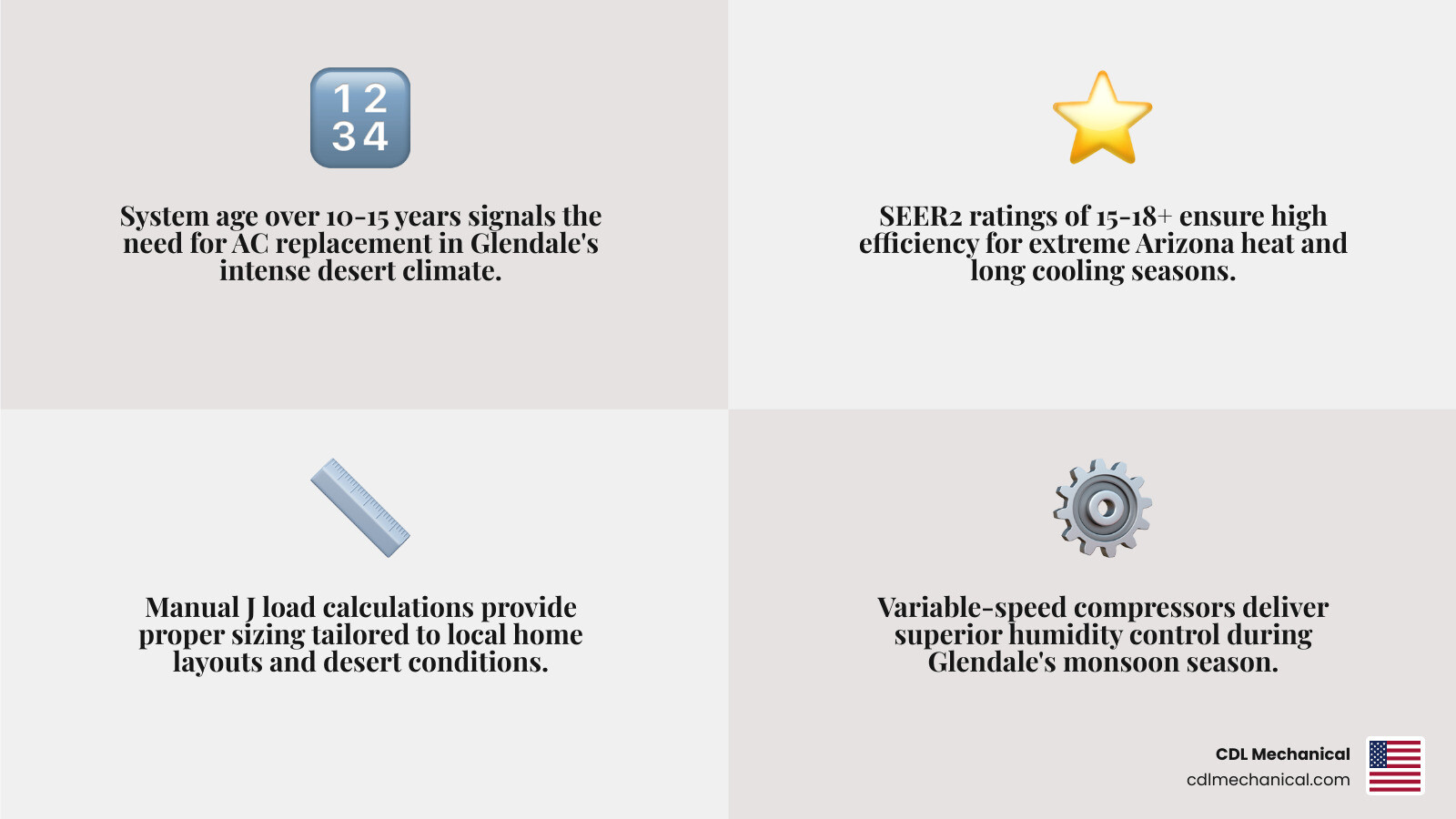
- Proper sizing through Manual J load calculations specific to Arizona homes
- High SEER2 ratings (15–18+) designed for extreme heat and long cooling seasons
- Licensed contractors experienced with Glendale permits and desert installation challenges
- Comprehensive warranties on parts and labor, backed by ongoing maintenance plans
- Variable-speed technology for better humidity control during monsoon season
When your AC is over 10–15 years old, uses outdated R-22 refrigerant, or can’t keep up during heat waves, replacement often costs less long-term than repeated repairs. Learn when to recognize the signs you need professional air conditioner repair or explore comprehensive AC services custom to Arizona’s unique demands.
The right AC replacement delivers lower energy bills, quieter operation, improved indoor air quality, and consistent cooling even when outdoor temperatures exceed 115°F. Glendale homeowners also benefit from smart thermostat compatibility, better dehumidification during monsoons, and systems engineered to handle the dust and sun exposure that accelerate wear on outdoor condensers.
I’m Joshua Michael Bartlett, founder of CDL Mechanical, and over my 20+ years in the HVAC trade I’ve guided countless homeowners through the process of ac replacement best in Glendale, AZ, ensuring they get systems properly sized for desert heat and installed with the care their families deserve. At CDL Mechanical, we treat every home like our own because we’re not just in the business of cooling—we’re in the business of taking care of people.
When to Consider the Best AC Replacement in Glendale, AZ
Living in the “Antique Capital of Arizona” is wonderful for shopping, but you definitely don’t want an antique cooling system when July rolls around. Knowing exactly when to pull the trigger on a new unit can save you from an “AC emergency” where you’re stuck in a 100-degree house waiting for a miracle.
In Glendale, the average lifespan of an HVAC unit is typically 12 to 15 years. This is notably lower than the national average of 15 to 20 years because our systems work overtime. If your unit was installed back when the Valley Metro Rail extension was just a distant dream, it’s likely time to look at ac replacement best in Glendale, AZ.
One of the biggest “red flags” is the type of refrigerant your system uses. If your unit is older than 10–15 years, it likely runs on R-22 (Freon). This refrigerant has been phased out, making repairs involving leaks incredibly expensive. Beyond the chemical makeup, mechanical wear is a major factor. The intense Arizona sun and monsoon dust act like sandpaper on outdoor condensers. If you find yourself frequently searching for professional air conditioner repair just to get through the week, you are likely throwing good money after a bad system.
Rising energy bills are another silent indicator. About 50% of your home’s energy costs result from heating and cooling. As units age, they lose efficiency, meaning you pay more for less comfort. If your bills are climbing while your comfort is dipping, it’s time to explore expert AC services.
Identifying Signs Your AC Needs Replacement Best in Glendale, AZ
Sometimes the signs aren’t just on your utility bill; they are audible and physical.
- Loud Noises: Grinding, squealing, or banging sounds often indicate a failing compressor or motor.
- Weak Airflow: If your vents feel like they are just “sighing” rather than blowing, your system is struggling.
- Humidity Spikes: A primary job of your AC is to remove moisture. If your home feels “sticky” during the monsoon season, your unit is failing.
- Short Cycling: This is when the unit turns on and off rapidly. It’s a major energy waster and a sign of imminent failure.
- Inconsistent Temperatures: If the kitchen is a sauna while the bedroom is a walk-in freezer, your system can no longer balance the load.
Understanding the benefits of timely AC repair can help you limp along for a season, but eventually, the mechanical toll of Glendale’s heat makes replacement the only logical path forward.
Top-Rated Cooling Systems for the Arizona Desert
Not all air conditioners are created equal, especially when they have to face a Glendale summer. When we talk about ac replacement best in Glendale, AZ, we are looking for systems that offer durability and high performance.
Central Air Conditioning: This remains the gold standard for most Glendale homes. Modern central units are significantly quieter and more efficient than those from even a decade ago. Heat Pumps: These are becoming incredibly popular in Arizona. Because our winters are relatively mild but still require some heating, a heat pump provides a highly efficient, all-in-one solution for year-round comfort. Ductless Mini-Splits: Perfect for room additions, converted garages, or homes with “hot spots” that the main system can’t reach.
System Comparison Table
| System Type | Best Use Case | Efficiency (SEER2) |
|---|---|---|
| Central AC | Whole-home cooling with existing ducts | 15 – 20+ |
| Heat Pump | All-electric heating and cooling | 16 – 22+ |
| Ductless Mini-Split | Targeted cooling for specific zones | 18 – 30+ |
| Variable-Speed | Maximum comfort and humidity control | 18 – 25+ |
Variable-speed compressors are a game-changer for desert dwellers. Unlike older “single-stage” units that are either 100% on or 100% off, variable-speed systems can throttle down to 30% or 40% capacity. This allows them to run longer at a lower speed, which provides superior dehumidification and keeps temperatures within half a degree of your setting. For a deep dive, check out our guide to air conditioning installation.
Maximizing Efficiency with AC Replacement Best in Glendale, AZ
Upgrading from an older 8–10 SEER unit to a modern 15–18+ SEER2 system can reduce your cooling energy use significantly. In a place like Glendale, where the AC might run for 12 hours a day, those savings add up fast.
When we perform AC installation in Litchfield Park or AC installation in Goodyear, we always emphasize smart thermostat compatibility. A smart thermostat learns your schedule and adjusts temperatures to save money while you’re at Arrowhead Towne Center or cheering on the Cardinals, then cools the house back down before you walk through the door.
The Professional Installation Process and Local Standards
The most expensive, high-tech AC unit in the world will perform poorly if it is installed incorrectly. In fact, the “best” replacement is defined as much by the installation quality as the brand on the box.
We start every project with a Manual J Load Calculation. This isn’t a “rule of thumb” based on square footage. We look at your insulation levels, window orientation, roof type, and even the number of people living in the home. An oversized unit will “short cycle,” leading to high bills and early failure, while an undersized unit will never reach your target temperature on a 115-degree day.
Evaluation of the ductwork is equally critical. If we hook up a high-efficiency 18 SEER2 unit to leaky, undersized ducts, you’ll lose 20-30% of your cooling before it ever reaches your living room. During the HVAC installation process, we check for static pressure and seal leaks to ensure every bit of cold air goes where it belongs.
We also handle all local Glendale permits. This isn’t just paperwork; it’s a safety requirement that ensures your electrical and mechanical systems meet city codes. Furthermore, we take special precautions for “monsoon protection,” ensuring outdoor units are properly leveled and secured against high winds and dust buildup. For more local specifics, see our Glendale and Luke AFB installation handbook.
Ensuring Long-Term Performance and Warranty Protection
A successful installation ends with a “commissioning” phase. We don’t just flip the switch and leave. We test the refrigerant charge, verify airflow at the registers, and calibrate the thermostat. This ensures the unit is operating exactly as the manufacturer intended, which is vital for protecting your warranty.
Most top-tier systems come with 10-year parts warranties, but these often require professional installation and proof of regular maintenance to stay valid. This is why the importance of AC maintenance cannot be overstated. We also provide clear documentation and service area details so you know exactly who to call for your annual tune-ups.
Frequently Asked Questions about Glendale AC Replacement
How long does a new AC unit last in the Glendale desert?
While the national average is higher, Glendale residents should expect 12-15 years of reliable service. The extreme heat causes the compressor and fan motors to work harder than in cooler climates. However, with consistent maintenance—like cleaning the coils after monsoon season—some well-built systems can push toward the 20-year mark. Our Peoria AC replacement professionals often see that units receiving biannual tune-ups last 30% longer than neglected ones.
Is it better to repair or replace my ductwork during an AC upgrade?
In many cases, a thorough cleaning and sealing are sufficient. However, if your ducts are undersized for the new high-efficiency blower or if they are severely deteriorated, replacement is a smart investment. Leaky ducts are a major source of energy waste. When finding AC installation deals, always ask for a duct inspection to ensure your new unit isn’t fighting against your own house.
What is the best time of year to replace an AC in Glendale?
The “shoulder seasons”—spring (March/April) and fall (October/November)—are ideal. During these months, the demand for emergency repairs is lower, allowing for more flexible scheduling. Replacing your unit in the spring ensures you are ready before the first “heat dome” hits, while a fall installation prevents your aging heater from failing during a desert cold snap. Check out our tips for AC installation in Avondale for more timing advice.
Conclusion
At CDL Mechanical, we understand that ac replacement best in Glendale, AZ is more than just a home improvement project—it’s an investment in your family’s safety and comfort. As a family-owned business, we don’t have sales quotas or “commission-only” technicians. Our goal is to provide the same honest, high-quality service we would want for our own parents or neighbors.
We take pride in our deep roots in the Glendale community. From the historic homes near downtown to the newer builds near the stadium, we know the local architecture and the specific cooling challenges each home faces. Whether you need a high-efficiency heat pump, a rugged central AC system, or a targeted mini-split, we bring the expertise and the “treat you like family” attitude to every job.
Don’t wait for your old unit to leave you stranded in the heat. Schedule your expert HVAC services in Glendale, AZ with CDL Mechanical today, and experience the peace of mind that comes with a professionally installed, desert-ready cooling system.