
What is Air Balancing and Why Does Your HVAC Need It?
To understand what does air balancing involve, we first need to look at how air moves through your home. Your air conditioner doesn’t just “dump” cold air into the house; it relies on a delicate balance of pressure and volume. This is known as airflow distribution. When a system is properly balanced, it achieves a state of “temperature homeostasis,” where every room reaches the desired temperature at roughly the same time.
In HVAC, we follow specific standards to ensure comfort. As of April 2026, a common industry benchmark is that a balanced system should provide approximately one ton of system capacity for every 400 to 500 square feet of conditioned space. If you have a 3-ton unit, for example, it should be moving about 1,200 cubic feet per minute (CFM) of total airflow.
Why is this necessary? To understand the “why,” it helps to know How Does Central Heating And Cooling Work. Your system pulls warm air out of your rooms, cools it over a coil, and pushes it back in. If the ductwork is poorly designed or the dampers are set incorrectly, the rooms closest to the indoor unit get a “windstorm” of cold air, while the master bedroom at the end of the hall gets a pathetic breeze. A variation of just 2 degrees or more between rooms is a clear signal that your system is struggling with an imbalance.
Common Signs Your Glendale Home Needs an Air Balance Test

Living in the Valley, we can’t afford to have an inefficient AC. If you’re wondering if your home is a candidate for this service, keep an eye (and ear) out for these common symptoms:
- Hot and Cold Spots: This is the most obvious sign. If your kitchen is a walk-in freezer but your home office feels like a sauna, you have a distribution problem. Learning How To Fix Hot And Cold Spots At Home often starts with a professional balance test.
- Whistling Vents: If your registers are making a high-pitched whistling sound, it usually means there is too much air pressure trying to squeeze through a small opening.
- Rattling Ductwork: High static pressure can cause ducts to vibrate or “boom” when the fan starts or stops.
- High Energy Consumption: When one room stays hot, your thermostat keeps the AC running to try and cool it down. This wastes electricity and puts unnecessary miles on your compressor.
- Weak Airflow: If you hold your hand up to a vent and can barely feel a draft, the air is likely being “stolen” by other vents earlier in the duct run.
What Does Air Balancing Involve? A Step-by-Step Guide
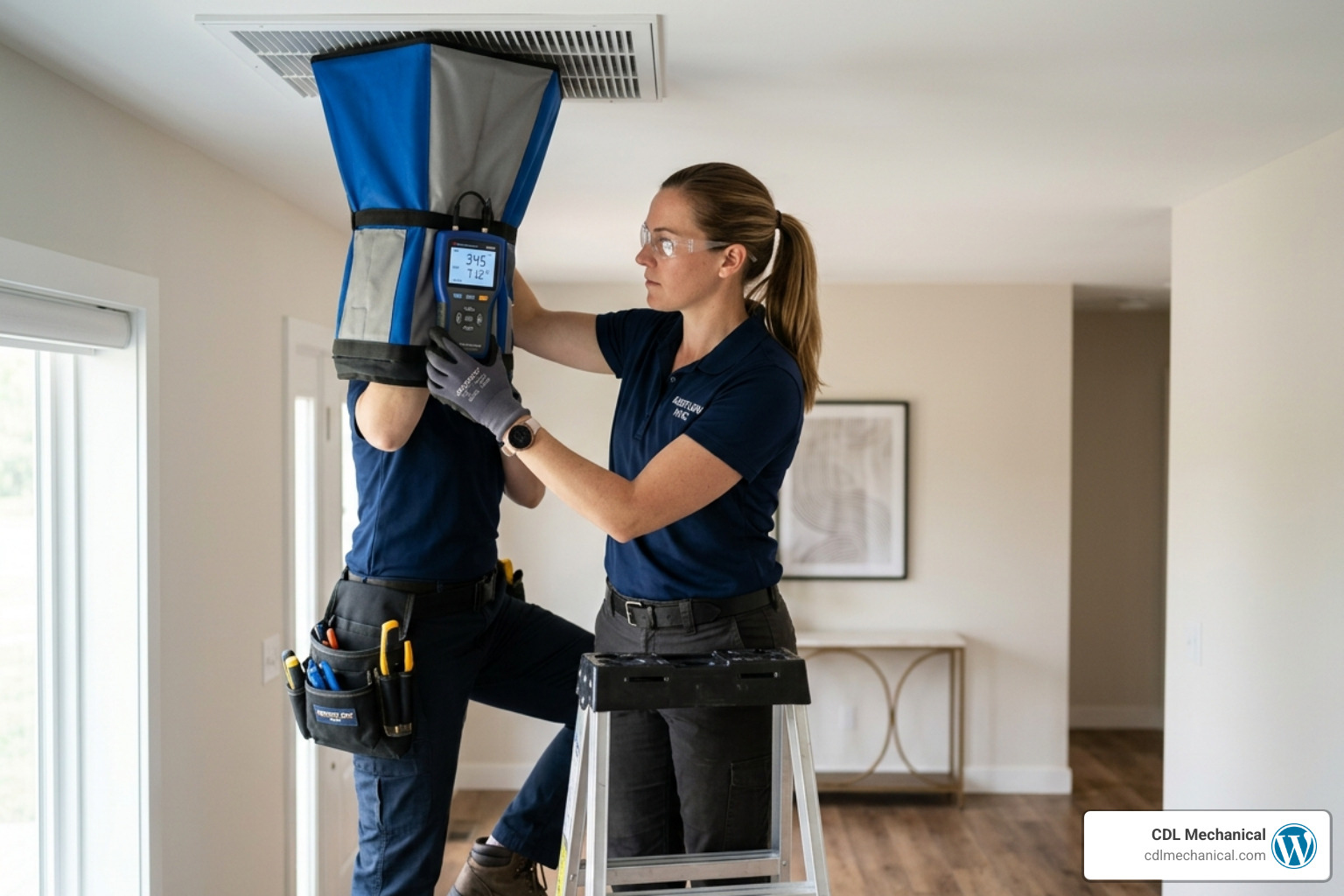
When we perform Air Balancing for a neighbor in Glendale or Peoria, we don’t just guess. It is a scientific process that involves several technical phases.
First, we perform a load calculation. We look at the square footage of each room, the number of windows, and the direction the room faces (west-facing rooms in Arizona need a lot more air!). This tells us exactly how many CFM each room should receive.
Next, we move into the actual testing phase. Our goal is typically to secure an even airflow of about 300 CFM from every vent register in the house, though this varies based on the room size. For a standard 3-ton unit, we verify that the system is producing its required 1,200 CFM before we start tweaking individual rooms.
Measuring Performance: What does air balancing involve for testing?
Professional balancing requires tools that go far beyond a simple thermometer. Here is the technical toolkit we use to get the job done:
- Manometers: These measure static pressure. We check the Total External Static Pressure (TESP) to see if your fan is working against too much resistance.
- Anemometers and Capture Hoods: A capture hood (or balometer) fits over your vent and gives us a digital readout of exactly how much air is exiting the duct.
- Hygrometers: These measure humidity and temperature. In our dry climate, managing the “temperature rise” (the difference between the air going in and the air coming out) is vital for efficiency.
- Return Air Evaluation: Balancing isn’t just about the “supply” vents. We must ensure the “return” vents are pulling enough air back to the system to maintain neutral pressure.
System Adjustments: What does air balancing involve for your ductwork?
Once we have the data, the “balancing” begins. This is where we physically alter how the air moves through your ductwork.
- Manual Dampers: Most modern duct systems have metal handles on the “branch” lines near the main plenum. We adjust these to “choke down” air to rooms that are too cold and force more air to the “starved” rooms.
- Blower Fan Speed: Sometimes the solution is adjusting the tap on the blower motor to increase or decrease the total volume of air the system moves.
- Register Louvers: While not as effective as duct dampers, we can fine-tune the registers in each room to direct air away from corners and toward the center of the living space.
- Plenum Sizing: In some cases, we find that the “trunk” of the system is undersized, requiring a more permanent modification to the ductwork to allow for proper flow.
The Benefits of a Balanced HVAC System in the Arizona Desert
The climate in areas like Surprise and Goodyear is unforgiving. A balanced system isn’t just a luxury; it’s a necessity for your wallet and your health. According to the Department of Energy, a typical home can lose a massive amount of its cooling efficiency through ductwork issues—balancing helps reclaim that lost energy.
| Feature | Unbalanced System | Balanced System |
|---|---|---|
| Temperature Variance | 5°F to 10°F between rooms | Within 2°F across the home |
| Energy Bills | High (due to long cycle times) | Optimized (shorter, efficient cycles) |
| Equipment Life | Shortened (system overworks) | Extended (runs at design specs) |
| Air Quality | High dust and humidity pockets | Consistent filtration and circulation |
| Noise Level | Whistling or banging ducts | Quiet, whisper-smooth operation |
By April 2026, energy standards have become even stricter. A balanced system ensures you aren’t paying for “ghost cooling”—air that is trapped in your attic or basement instead of cooling your living room. Proper balancing also assists with humidity control; by ensuring air moves across the cooling coil at the right speed, the system can effectively strip moisture from the air, making 80 degrees feel like 75.
DIY vs. Professional Air Balancing: When to Call the Experts
Can you do some of this yourself? Absolutely. We always encourage our customers to take small steps to improve their own comfort. You can start by ensuring no furniture or heavy drapes are blocking your return or supply vents. You can also try adjusting the small levers on your floor or ceiling registers.
However, there is a limit to DIY. Closing too many vents can actually damage your system. It increases static pressure, which can cause your evaporator coil to freeze into a block of ice or lead to a premature motor failure.
Professional diagnostics are necessary when:
- Simple vent adjustments don’t fix the hot spots.
- You hear loud noises coming from the walls when the AC runs.
- Your energy bills are rising despite regular maintenance.
- You’ve recently added a room or renovated your home.
At CDL Mechanical, we use specialized calibration tools that provide a level of precision you just can’t get with a “paper test” or a hand-held thermometer. We treat your home like our own, ensuring the math adds up so your family stays cool.
Frequently Asked Questions about Air Balancing
How often should I have my air balanced in Glendale?
Ideally, a system should be balanced when it is first installed. However, homes settle, ducts can develop leaks, and insulation can degrade. We recommend a professional air balance check every 5 to 7 years, or immediately after any major home renovation or HVAC equipment replacement.
Can furniture placement affect my home’s air balance?
Yes! If you place a large sofa over a floor vent or a bookshelf in front of a return air grille, you disrupt the “loop” of airflow. This causes the pressure to back up in the system, leading to the same symptoms as a clogged duct. Always keep at least 18 inches of clear space around your vents.
Does air balancing help reduce dust and allergens?
It certainly does. An imbalanced system often creates “negative pressure” in certain rooms, which can actually pull dusty air from your attic or crawlspace through tiny cracks in the ceiling or floor. By balancing the pressure, we ensure the air stays in the “clean loop” of your filtration system.
Conclusion
Optimizing your home comfort in the Glendale climate is a challenge, but it’s one we tackle every day. Understanding what does air balancing involve helps you see your HVAC system as a complete network rather than just a box that blows cold air. When your airflow is reliable and your pressures are set correctly, you’ll enjoy a home that is quieter, cleaner, and significantly cheaper to cool.
If you’re tired of playing “thermostat wars” or dealing with a bedroom that feels like the Sahara, it might be time for a professional touch. For expert Air Balancing Services that treat you like family, the team at CDL Mechanical is here to help you find your home’s perfect harmony.