
Why Finding the Best Air Filter for Your Home Matters More Than You Think
Finding the best air filter for your home is one of the simplest upgrades you can make for your family’s health and comfort — especially in Glendale, AZ, where desert dust, pollen from mesquite trees and Bermuda grass, and seasonal monsoon moisture make indoor air quality a genuine daily concern.
Here is a quick-reference guide to help you choose:
| Need | Recommended MERV Rating | Filter Type |
|---|---|---|
| Basic dust control | MERV 6-8 | Pleated or fiberglass |
| Allergies and pollen | MERV 10-12 | Pleated or electrostatic |
| Pet dander and odors | MERV 11-13 | Pleated with activated carbon |
| Wildfire smoke or fine particles | MERV 13 | High-efficiency pleated |
| Hospital-grade filtration | MERV 14+ | Media filter (professional install) |
Most Glendale homeowners land in the MERV 8 to MERV 13 range — effective enough to capture common desert contaminants without putting unnecessary strain on their HVAC systems.
Here is something that surprises most people: the air inside your home can carry two to five times more pollutants than the air outside. That stat comes from the EPA, and it hits differently when you consider how much time we spend indoors — especially during Glendale’s brutal summer months when windows and doors stay shut for weeks at a time.
The right air filter does not just protect your family. It also protects your HVAC system by keeping dust and debris out of your blower motor, coils, and ductwork. A clogged or wrong-rated filter can do the opposite — restricting airflow, raising energy bills, and shortening equipment life.
The good news is that choosing the right filter does not have to be complicated. Once you understand the rating systems, filter types, and your household’s specific needs, the decision becomes pretty clear.
I’m Joshua Michael Bartlett, founder of CDL Mechanical, and with over 20 years in the HVAC trade across the greater Phoenix area, I’ve helped hundreds of Glendale homeowners figure out the best air filter for your home and the right filtration setup to match their system, their budget, and the unique demands of Arizona’s desert climate. This guide pulls from that hands-on experience to give you straight, practical answers.
Decoding MERV, FPR, and MPR Rating Systems
When you walk down the aisle of a home improvement store in Peoria or Scottsdale, you are greeted by a confusing wall of numbers. Some filters use MERV, others use FPR, and some use MPR. Understanding these is the first step in finding the best air filter for your home.
MERV (Minimum Efficiency Reporting Value)
The MERV rating is the industry standard developed by the American Society of Heating, Refrigeration and Air Conditioner Engineers (ASHRAE). It scales from 1 to 20.
- MERV 1-4: Basic filtration, mostly capturing large particles like carpet fibers and lint.
- MERV 6-8: The sweet spot for most residential homes. ASHRAE recommends at least a MERV 6.
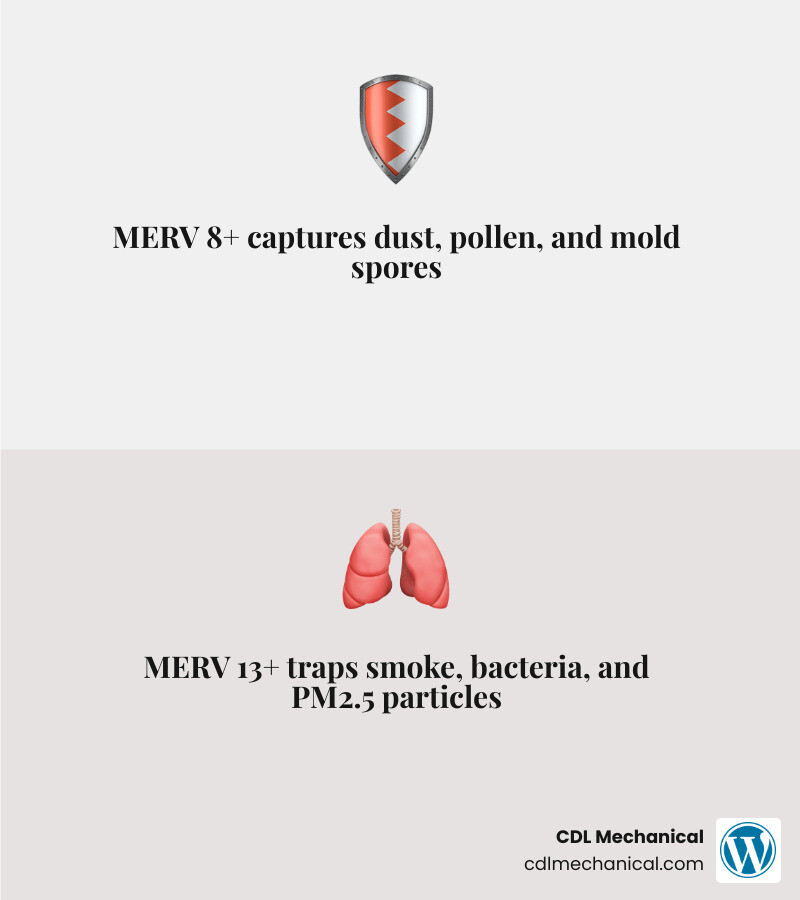
- MERV 11-13: High-efficiency residential filters that capture smaller particles like pet dander, mold spores, and some bacteria.
- MERV 14-20: Typically reserved for hospitals and cleanrooms.
FPR (Filter Performance Rating)
This is a proprietary system used by The Home Depot. It ranks filters on a scale of 1 to 12. The rating is determined by three factors:
- 60 percent: Ability to capture large particles.
- 30 percent: Ability to capture small particles.
- 10 percent: Weight gain caused by the filtration process over the filter’s lifetime.
For comparison, an FPR 10 is roughly equivalent to a MERV 20 in terms of particle capture strength.
MPR (Microparticle Performance Rating)
Used by 3M (Filtrete), this system focuses on the filter’s ability to capture particles smaller than 1 micron. The higher the MPR, the better the filter is at trapping microscopic pollutants like smoke and viruses.
| MERV Rating | FPR Equivalent | MPR Equivalent | Best Use Case |
|---|---|---|---|
| MERV 8 | FPR 5 | MPR 600 | General home use |
| MERV 11 | FPR 7 | MPR 1000-1200 | Better for pets/allergies |
| MERV 13 | FPR 10 | MPR 1500-1900 | Best for smoke/fine dust |
Understanding How HVAC Filters Affect Indoor Air Quality is essential because choosing a rating that is too high for your specific equipment can actually lead to system issues.
Choosing the best air filter for your home Based on Your Needs
Not every home in Surprise or Goodyear needs the same level of filtration. We always ask our customers: “What are you trying to keep out of your lungs?”
If you live in a newer build in Buckeye with tight seals, your needs differ from someone in an older Scottsdale home with more air infiltration. Many homeowners are shocked to learn that their indoor environment might be more polluted than the dusty streets outside. You can read more about this in our guide: Is Your Home’s Air Quality Worse Than Outside?.
Improving your filtration offers 5 Benefits of Good Indoor Air Quality, including better sleep, reduced odors, and protection for your expensive HVAC components.
Selecting the best air filter for your home to Combat Allergies
For our neighbors dealing with the “Arizona Itch” during pollen season, a standard fiberglass filter won’t cut it. To trap pollen, mold spores, and dust mites, you should look for a filter with a MERV 11 or MERV 13 rating.
High-efficiency pleated filters are excellent for this. If you have severe respiratory issues, you might even consider a HEPA-grade filter, which can remove at least 99.97% of particulate matter as small as 0.3 microns. However, true HEPA filters usually require a specialized housing because they are too thick for standard 1-inch slots. Learn more about local solutions for Indoor Air Quality Glendale AZ.
Finding the best air filter for your home with Pets
Living with pets in the desert means dealing with two things: dander and odors. Standard filters trap hair, but they don’t do much for the “dog smell.”
For pet owners, we recommend filters that include a layer of activated carbon. Carbon works through a process called adsorption, where odors and VOCs (Volatile Organic Compounds) stick to the surface of the carbon. A MERV 11 or 13 pleated filter with carbon is often the best air filter for your home if you have furry family members. If the HVAC filter isn’t enough, adding a standalone Air Purifier to the rooms where your pets spend the most time can make a massive difference.
Selecting the Right Size and Filter Type for Your HVAC
One of the most common mistakes we see during service calls in Sun City or Avondale is a filter that doesn’t fit quite right. If there is a gap, the air will take the path of least resistance, bypassing the filter entirely and dumping dust directly onto your AC coils.
Nominal vs. Actual Size
When you look at a filter, you’ll see the Nominal Size (e.g., 20x25x1). This is the rounded-up number used for marketing. The Actual Size is usually about 1/4 to 1/2 inch smaller. Always check the fine print on the filter frame to ensure you are getting the exact fit your system requires.
Common Filter Types
- Fiberglass/Polyester: These are the thin, blue, or white see-through filters. They are “good” for protecting the equipment from large debris but do almost nothing for your air quality.
- Pleated Filters: These have a folded “accordion” look, which increases the surface area. This allows them to trap more particles without instantly choking off your airflow.
- Electrostatic Filters: These use self-charging fibers to attract particles like a magnet. They are superior for capturing small particles.
- Washable Filters: While they seem eco-friendly, they often have low MERV ratings and can grow mold if you don’t let them dry completely before reinstalling.
Proper filter selection is a core part of Air Conditioning Maintenance.
Thick vs. Thin Filters
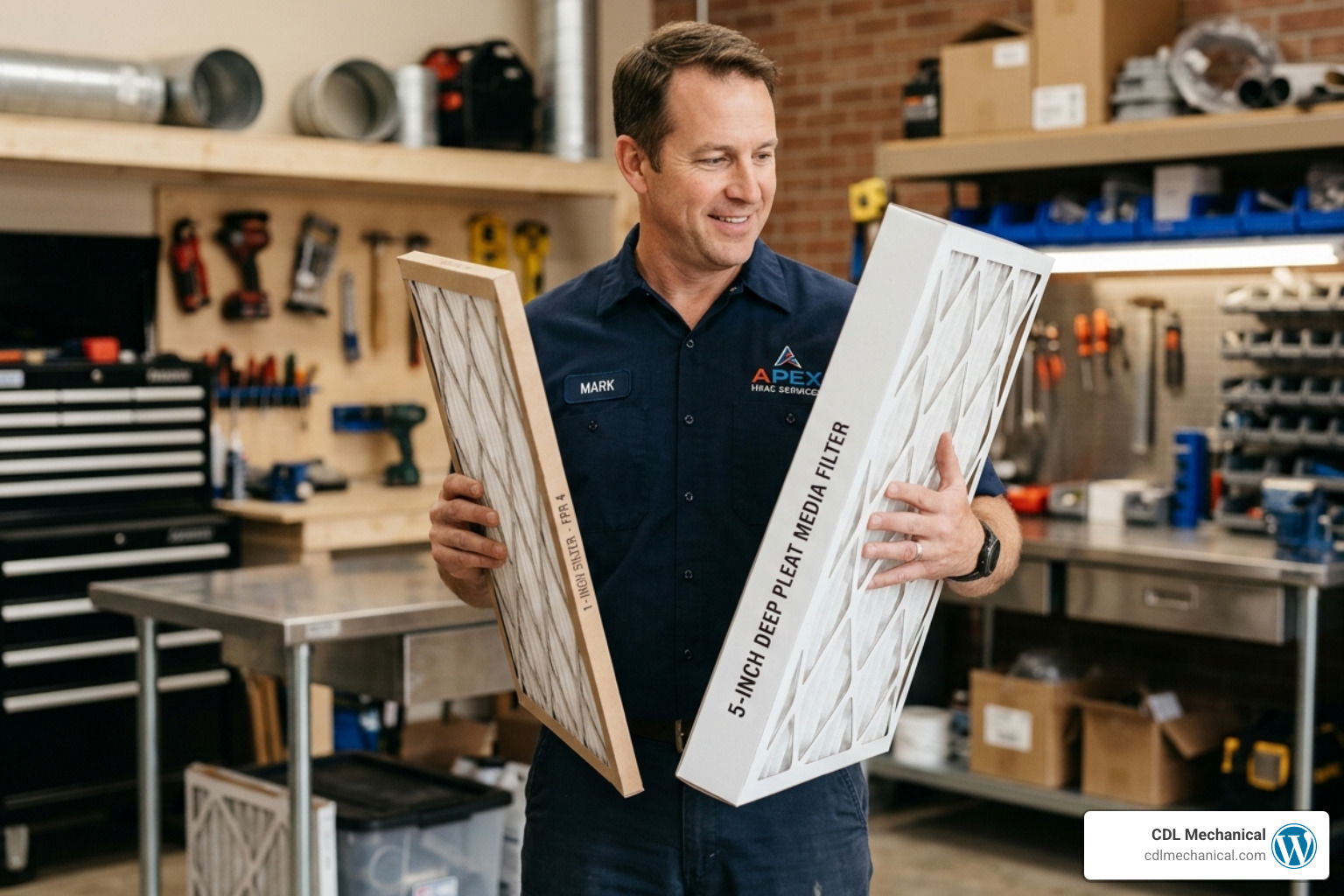
Most homes are built for 1-inch filters, but some modern systems use 4-inch or 5-inch “media filters.”
- 1-inch filters: Need to be changed frequently (every 30-90 days).
- Thick filters (4-5 inches): These have massive surface areas. They filter better, last longer (up to a year), and actually provide better airflow because they don’t clog as quickly.
If your system currently uses 1-inch filters, you might need a professional to retrofit a media cabinet to accommodate the thicker versions. Understanding How Does Central Heating and Cooling Work? can help you visualize why airflow is so critical to this process.
Maintenance Tips for Glendale’s Desert Climate
In April 2026, we are already seeing the typical spring dust start to kick up. Glendale’s climate is particularly hard on air filters. While the “90-day rule” is a good general guideline, Arizona homeowners often need to be more proactive.
The Monsoon and Dust Storm Factor
During our monsoon season, a single “Haboob” (dust storm) can dump enough fine silt into your return air to clog a brand-new filter in a single afternoon. If you’ve recently experienced a major dust storm, check your filter immediately.
Seasonal Checklists
- Summer: Your AC runs almost 24/7. Check the filter every 30 days.
- Spring/Fall: Ideal times for a Spring AC Tune-Up Checklist and to swap in a fresh filter before the heavy usage begins.
- Winter: Even when the heat is on, Furnace Maintenance requires a clean filter to prevent the system from overheating.
A dirty filter is the #1 cause of “short-cycling,” where your system turns on and off rapidly. This wastes energy and wears out your compressor.
Frequently Asked Questions About Home Air Filtration
Can a high-MERV filter damage my HVAC system?
This is a great question we hear in Tempe and Mesa all the time. The answer is: Yes, if your system isn’t designed for it.
High-MERV filters (like MERV 13 and up) are denser. This creates “static pressure,” meaning your blower motor has to work much harder to pull air through the filter. If the resistance is too high, it can lead to:
- Reduced airflow (uneven heating/cooling).
- Frozen evaporator coils.
- A burnt-out blower motor.
If you want high-level filtration but have a standard system, we often recommend sticking to a high-quality MERV 8 or 11 and changing it more often, or upgrading to a 4-inch media cabinet. Regular 5 Benefits of Routine AC Maintenance includes checking your system’s static pressure to ensure your filter choice is safe.
How do HVAC filters compare to standalone air purifiers?
HVAC filters provide “whole-home” coverage because they treat all the air circulating through your ducts. However, they only work when the fan is running.
Standalone air purifiers are great for “targeted” filtration in a specific room, like a bedroom or nursery.
- HVAC Filter: Best for dust and system protection.
- Air Purifier: Best for localized smoke, VOCs, and viruses.
- UV Lights: These are installed inside your ductwork to kill bacteria and mold that filters might miss.
What are the best filters for wildfire smoke?
With wildfire seasons becoming more intense, many of our neighbors in Cave Creek and New River are concerned about fine particulate matter (PM2.5). For smoke, you need at least a MERV 13 filter.
If you find yourself constantly worried about outside pollutants, Is Indoor Air Quality Testing Worth It? is a question worth exploring. We can help you measure exactly what is in your air and find a solution that fits.
Conclusion
Finding the best air filter for your home is about balancing air purity with the mechanical health of your HVAC system. Whether you are in Glendale, Phoenix, or Surprise, the goal is the same: breathing clean air without sending your energy bills through the roof.
At CDL Mechanical, we are a family-owned company that treats your home like our own. We know the specific challenges of the Glendale desert — from the fine silt of a dust storm to the persistent pollen of our local trees. We are here to help you navigate these choices and keep your home a comfortable sanctuary.
If you are ready to breathe easier, Improve your home’s air quality today by reaching out to us. Whether you need a simple maintenance check or a full indoor air quality overhaul, our expert team is just a call away. We serve the entire valley, including Litchfield Park, Goodyear, and Paradise Valley, ensuring every family we visit enjoys the dependable comfort they deserve.