
Understanding the Central AC vs Ductless Mini Split Comparison
When we look at the central ac vs ductless mini split comparison, we are essentially looking at two different philosophies of home comfort. Both systems rely on the same scientific principles of refrigeration—using an outdoor condenser unit to release heat and an indoor evaporator coil to absorb it—but the delivery methods are worlds apart.
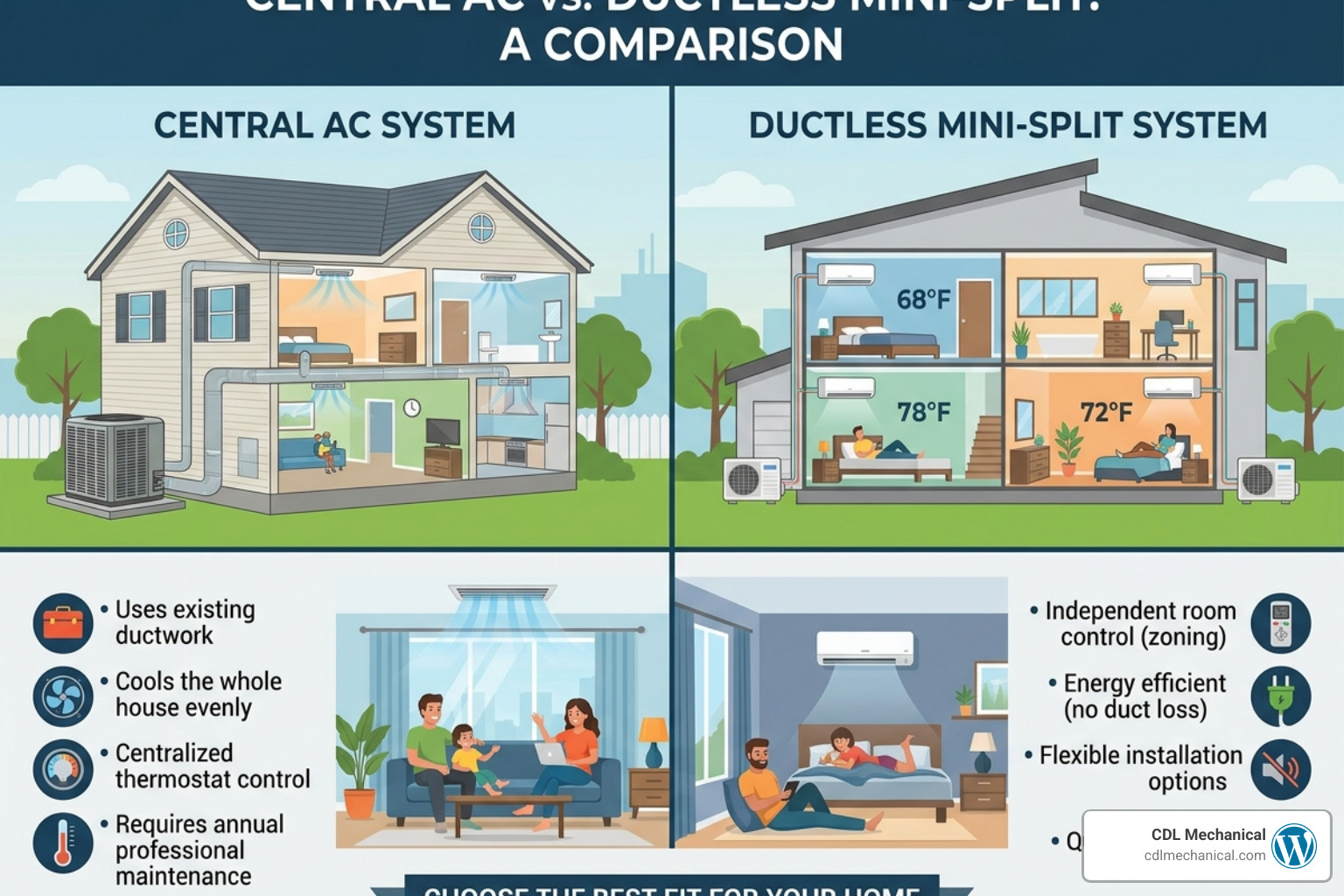
Central air conditioning is a “whole-house” solution. It uses a large, central air handler (usually tucked away in an attic or closet) to push chilled air through a network of large metal or flexible tubes known as ductwork. This system is designed to create a uniform temperature throughout every room connected to those ducts. To understand the deeper mechanics, you can read more about how does central heating and cooling work on our detailed guide.
On the other hand, mini split ductless units skip the “middleman” of ducts entirely. Instead of one giant fan pushing air through the whole house, these systems use small, sleek indoor units mounted directly on the walls or ceilings of individual rooms. These units are connected to the outdoor compressor by thin refrigerant lines, a power cable, and a condensate drain line, all of which pass through a small, three-inch hole in the exterior wall.
Operational Differences in a Central AC vs Ductless Mini Split Comparison
The operational heart of the central ac vs ductless mini split comparison lies in how they manage airflow. In a central system, the air handler must be powerful enough to overcome the resistance of dozens of feet of ducting. This often results in a “blast” of air when the system kicks on. Because there is usually only one thermostat located in a central hallway, the system keeps running until that specific spot reaches the target temperature, often leaving bedrooms too cold or kitchens too warm.
Ductless systems, such as those we install for ductless AC in Goodyear, AZ, operate with much more finesse. Each indoor head has its own sensor and its own remote or smart controller. This allows for “point-of-use” cooling. If you aren’t using the guest room, you don’t have to cool it. This granular control is a game-changer for Arizona families who want to stop wasting energy on empty square footage.
Efficiency Factors in a Central AC vs Ductless Mini Split Comparison
Efficiency is where the gap between these two technologies really widens. Most traditional central AC units use single-stage or two-stage compressors—they are either “all the way on” or “all the way off.” This leads to frequent cycling and temperature swings.
Modern ductless systems almost exclusively use “inverter” technology. Think of an inverter like a dimmer switch for a light bulb, whereas a traditional AC is just an on/off switch. An inverter-driven compressor can ramp up or down to the exact speed needed to maintain a steady temperature. This prevents the energy-heavy “startup” surge and keeps your home at a rock-steady comfort level. When deciding which mini split is best for your Phoenix home, the high SEER2 ratings (often reaching 30 or higher) made possible by this technology are a primary consideration.
Energy Efficiency and 2026 Performance Standards
As we move through April 2026, efficiency isn’t just a buzzword—it’s a legal requirement. The Department of Energy’s SEER2 (Seasonal Energy Efficiency Ratio 2) standards are now the benchmark for all new installations. These standards are designed to reflect real-world external static pressure, providing a more accurate picture of how a system will perform in your Glendale or Peoria home.
Ductless mini-splits are the undisputed champions of the SEER2 arena. While a high-end central AC might reach a 21 SEER2 rating, top-tier ductless systems are frequently hitting 38+ SEER2. For homeowners in our service areas like Surprise or Sun City, this translates directly into lower monthly utility bills, especially during our triple-digit summer months. You can find more details in our best mini split ductless guide for Avondale, AZ.
Impact of Ductwork on System Performance
One of the biggest “hidden” drains on your wallet is your ductwork. Research shows that typical duct systems lose about 25% to 30% of their cooling energy through leaks, poor insulation, or “thermal bypass” (where the cool air in the duct is heated up by the hot attic air before it reaches your vent).
In the central ac vs ductless mini split comparison, the mini-split wins by default here because it eliminates the ducts entirely. By delivering 100% of the conditioned air directly into the living space, you aren’t paying to cool your attic or the spaces between your walls.
Heat Pump Technology and Year-Round Comfort
While we focus on cooling in the Phoenix valley, we do have those chilly winter mornings. Most modern mini-splits are actually heat pumps. Unlike a furnace that burns fuel to create heat, a heat pump uses thermal transfer to move heat from the outside air into your home.
Even when it’s 40 degrees outside, there is still heat energy available. These systems are incredibly efficient for our mild Arizona winters. When comparing a heat pump vs gas furnace vs electric furnace, the dual-purpose nature of a mini-split heat pump often makes it the most logical choice for year-round comfort in places like Litchfield Park or Buckeye.
Installation Flexibility and Zoning Capabilities
Installation is where the “physical” reality of your home comes into play. If you live in an older home in Phoenix that was built without ducts, or if you’ve added a new room, the central ac vs ductless mini split comparison becomes very simple.
Installing new ductwork in an existing home is a massive undertaking. It involves cutting into ceilings, losing closet space to “bulkheads,” and significant drywall repair. In some cases, adding ductwork can add up to $18,000 to the total project cost. A ductless system, like the ones we provide for ductless AC in Litchfield Park, AZ, requires only a small hole for the refrigerant lines, making the process much faster and less invasive.
Customizing Comfort for Specific Home Layouts
We often see “problem rooms” in Glendale—the bedroom above the garage that’s always five degrees hotter, or the converted sunroom that the central AC just can’t keep up with. These are the perfect scenarios for a mini-split.
Historic homes also benefit immensely. You can preserve the architectural integrity of a classic home while enjoying 2026-level cooling technology. If you are looking for expert help with mini split ductless in Glendale, AZ, we can show you how these units can be tucked away discreetly without ruining your home’s aesthetic.
Advantages of Independent Zone Control
Zoning is perhaps the greatest luxury of a ductless system. In a central system, everyone in the house has to agree on one temperature. With a multi-zone mini-split, Mom can have her home office at 72 degrees while the kids keep their playroom at 75.
This isn’t just about comfort; it’s about the “Bluetooth speaker” vs. “whole-home audio” analogy. You wouldn’t turn on every speaker in the house just to listen to music in the kitchen. Why cool every room in the house just to sleep in one bedroom? Following the ultimate checklist for hiring a mini split ductless company in Avondale, AZ will help ensure your zoning is set up correctly for maximum savings.
Aesthetics, Noise Levels, and Indoor Air Quality
A common concern in the central ac vs ductless mini split comparison is the look of the units. Central AC is “invisible” because the vents are flush with the ceiling or floor. However, ductless design has come a long way. Beyond the standard wall-mount, there are floor-mounted units that look like heaters and ceiling cassettes that disappear into the ceiling grid.
Noise is another major factor. Central AC systems often have a noticeable “whoosh” of air and the sound of the metal ducts expanding and contracting. Ductless indoor units are whisper-quiet, typically operating between 19 and 26 decibels. For context, a quiet library is about 30 decibels. This makes them ideal for bedrooms and home offices. For more on this, check out our guide: don’t sweat it: professional ductless services for Phoenix residents.
Maintenance Requirements for Peak Performance
Both systems require love to keep running in the desert.
- Central AC: You need to change your filters every 30–90 days, keep the outdoor unit clear of debris, and have the ducts professionally cleaned every few years.
- Ductless: The filters are usually permanent and washable. You simply pop them out, rinse them in the sink, dry them, and put them back every 2–4 weeks.
Because mini-splits are so efficient, they can sometimes harbor microbial growth on the coils if they aren’t cleaned. We recommend a professional deep clean once a year to keep the air fresh. Our team provides mini split ductless services in Peoria, AZ to handle exactly this type of specialized maintenance.
Air Quality Benefits and Filtration Systems
Central AC generally wins on “robust” filtration. Because the fans are so powerful, they can pull air through high-MERV filters that trap tiny allergens, smoke, and viruses. They also integrate easily with whole-home humidifiers or UV air purifiers.
Ductless units have smaller filters. While they are great at catching dust and pet hair, they don’t move enough air volume to provide the same level of whole-home purification. However, because there are no ducts, you don’t have to worry about dust, mold, or “dead air” accumulating in hidden pipes. If air quality is your top priority, we can discuss air conditioning installation and replacement options that include advanced filtration for either system type.
Choosing the Right System for Your Arizona Home
When it comes down to the final decision in the central ac vs ductless mini split comparison, we look at the “Big Picture” of your home.
The Mini Split is likely better if:
- Your home has no existing ductwork.
- You are building an addition or converting a garage.
- You have “hot spots” that your central air can’t reach.
- You want the absolute highest energy efficiency possible.
- You want to control temperatures room-by-room.
Central AC is likely better if:
- You have high-quality, well-insulated existing ductwork.
- You have a very large home (over 2,500 sq. ft.) and want a lower upfront installation cost.
- You prefer the “invisible” look of vents.
- You want integrated whole-home air purification.
When Central AC is the Logical Choice
If you already have a duct system in good condition, replacing your old unit with a new, high-efficiency central AC is often the most cost-effective path. It’s a “drop-in” replacement that takes less time and doesn’t require mounting units on your walls. For large families in places like Chandler or Gilbert where every room is used simultaneously, the uniform cooling of central air is hard to beat. If your current system is failing, our air conditioning installation and replacement services can get you back to comfort quickly.
Making the Choice: Central AC vs Ductless Mini Split Comparison for Phoenix Residents
Many of our neighbors in Phoenix and Scottsdale are choosing a “Hybrid” approach. They keep their central AC for the main living areas but add a single-zone mini-split to the master bedroom or the home office. This allows them to turn the central AC way up at night (saving huge amounts of energy) while staying perfectly cool in the one room they are actually using. We specialize in these custom setups, providing the best mini split ductless solutions in Peoria, AZ.
Frequently Asked Questions
What is the typical lifespan of these cooling systems?
With professional maintenance, both systems are designed to last 15 to 20 years. In our harsh Arizona climate, the lifespan often depends on how hard the system has to work. Because ductless systems use inverter technology to avoid constant “hard starts,” they can sometimes outlast central units, with some reaching the 25-year mark if cared for properly.
Are there financial incentives for high-efficiency upgrades in 2026?
Yes! Under the Inflation Reduction Act, many high-efficiency heat pumps (including mini-splits) qualify for federal tax credits up to $2,000. Many local utility companies in the Phoenix area also offer rebates for installing ENERGY STAR-certified equipment. We always recommend checking the current DSIRE database or asking us for the latest local incentive updates during your consultation.
Can I use a mini split to supplement my existing central air?
Absolutely. This is one of the most popular requests we get at CDL Mechanical. Whether it’s a “nuisance room” that never gets cold enough or a new attic conversion, a mini-split can work alongside your central system to provide targeted comfort without the need to redesign your entire duct network.
Conclusion
At CDL Mechanical, we aren’t here to push one specific product. We are a family-owned company, and our goal is to treat your home like it’s our own. Whether the central ac vs ductless mini split comparison leads you toward a traditional whole-home system or a modern multi-zone setup, we have the expertise to ensure it’s installed perfectly for the Glendale heat.
Choosing a cooling system is a big investment in your family’s comfort and your home’s value. From Wickenburg to Tempe and everywhere in between, we are here to provide the dependable, expert service you deserve. If you’re still wondering how does central heating and cooling work for your specific floor plan, give us a call. We’ll help you find the cool, quiet, and efficient solution that fits your life perfectly.