
Why Every Glendale Homeowner Needs an HVAC Maintenance Checklist for Desert Extreme Heat
Following an HVAC maintenance checklist for desert extreme heat is one of the most important things you can do to protect your home comfort system in Glendale, AZ. Desert summers here are not just hot — they are relentless. Temperatures regularly climb past 110°F, and your AC runs nearly nonstop for months at a time.
Here is a quick-reference checklist to get you started:
Desert HVAC Maintenance Checklist (Quick Summary)
- Replace air filters every 30 days during cooling season (use MERV 8-11)
- Clear 2 feet of space around your outdoor condenser unit
- Rinse the outdoor coils gently with a garden hose after dust storms
- Check the condensate drain line for clogs every 3 months
- Test your thermostat for accurate readings and set to 78°F for efficiency
- Listen for warning signs — unusual noises, weak airflow, or rising energy bills
- Schedule a professional spring tune-up in March or April before peak heat
- Schedule a fall recovery check in October after the heavy cooling season ends
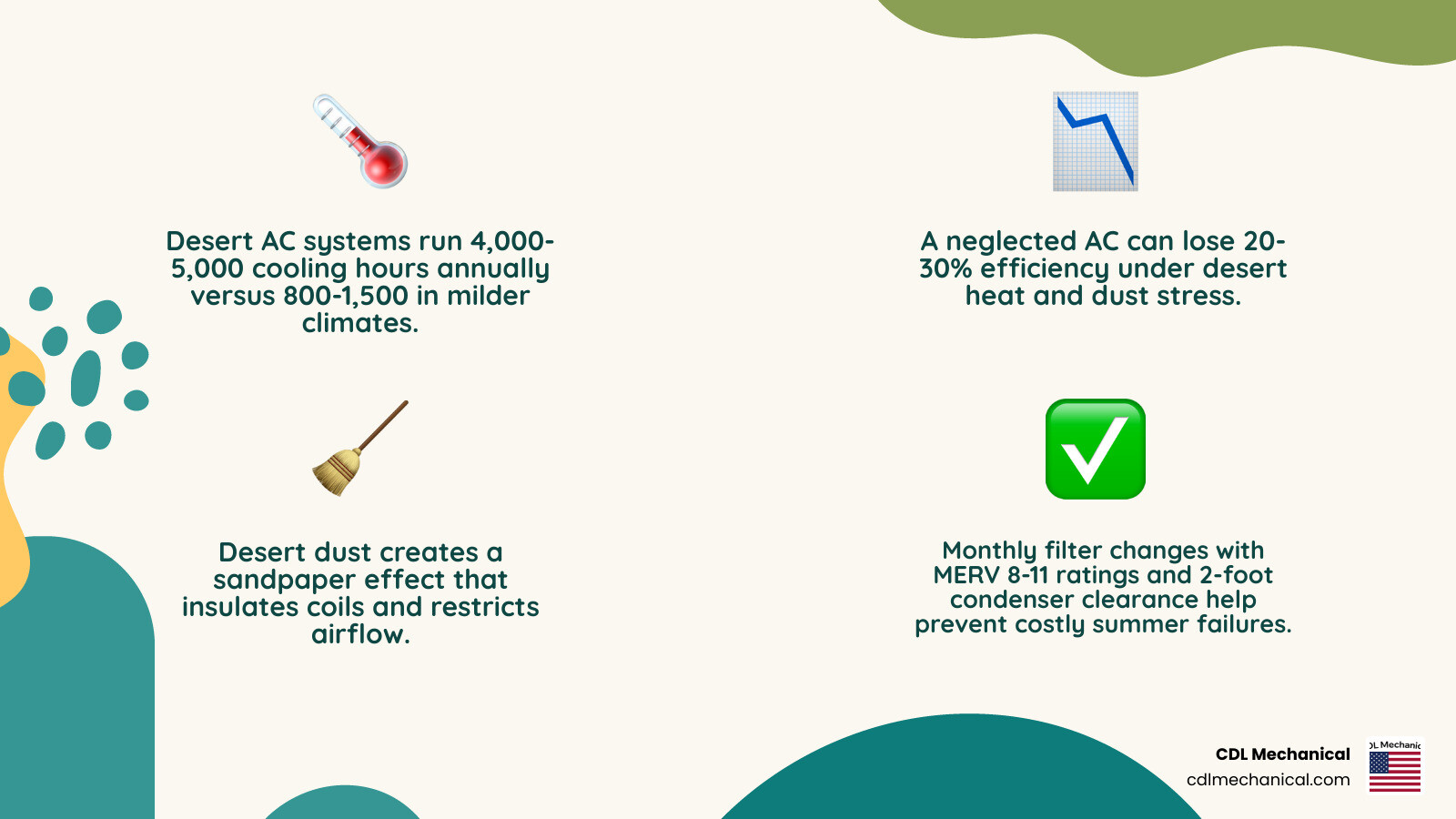
Unlike mild climates where an AC logs 800 to 1,500 cooling hours per year, desert systems in the Glendale area can rack up 4,000 to 5,000 hours annually. That is not a small difference — it is the difference between a system that lasts and one that fails on the hottest day of the year. A neglected AC can lose 20 to 30 percent of its efficiency in desert conditions, and that cost shows up directly on your energy bill.
I’m Joshua Michael Bartlett, founder of CDL Mechanical and an HVAC professional with over 20 years of hands-on experience — including working through the punishing heat seasons that make a proper HVAC maintenance checklist for desert extreme heat so critical for homeowners in our region. In the sections below, I’ll walk you through exactly what to do, when to do it, and why it matters for your system’s health and your family’s comfort.
Why Desert Climates Demand a Specialized HVAC Maintenance Checklist for Desert Extreme Heat
When you live in Glendale, Peoria, or Phoenix, your air conditioner is not a seasonal luxury; it is a critical survival tool. Standard, run-of-the-mill maintenance guides written for temperate East Coast climates simply do not hold up under the weight of an Arizona summer.
The primary reason is the sheer volume of work we demand from our cooling systems. Logging 4,000 to 5,000 cooling hours per year puts an incredible amount of stress on every motor, wire, and fan blade. For comparison, a system in a milder climate might take four to five years to reach the same operating hours that your Glendale AC racks up in a single year!
Without a dedicated maintenance plan, this intense workload triggers rapid system degradation. A neglected air conditioner in a desert environment can lose 0.5 to 1.0 SEER (Seasonal Energy Efficiency Ratio) points every single year. By year five, this steady drop-off translates to roughly 20% higher energy costs for the exact same amount of cooling.
To make matters worse, we also have to deal with unique environmental factors like extreme thermal cycling and airborne dust. To understand how to protect your system, it helps to read our West Valley Weather: A Survival Guide for Your AC and understand the two main “system killers” in our region: the sandpaper effect and intense thermal cycling.
The Sandpaper Effect of Desert Dust and Sand
Desert dust is not just unsightly; it is highly abrasive. Composed largely of fine silica, this dust acts like microscopic sandpaper on the moving parts of your air conditioner. When windstorms blow through the West Valley, they carry these tiny, sharp particles straight into your outdoor condenser unit.
As the dust accumulates, it coats the condenser coils, acting as a thick layer of insulation. Because your AC cools your home by releasing indoor heat through these outdoor coils, a blanket of dust traps the heat inside the system. This forces the compressor to work up to 30% harder to cool your home. The restricted airflow and added friction can lead to premature component failure. To learn more about keeping your system clean, check out our guide on how to Don’t Let the Dust Settle on Your AC Performance.
If left unchecked, this abrasive dust can drastically shorten your equipment’s lifespan. In fact, a neglected AC in our desert environment often fails completely between 8 and 12 years of service. However, with regular care, you can expect a much better outcome, as detailed in our resource on How Long Does an AC Last in the Desert?.
Thermal Cycling and Extreme Temperature Differentials
Another unique challenge of our desert climate is the extreme temperature differential. Most residential air conditioning systems are engineered to handle a temperature difference of 20 to 25 degrees between the indoor air and the outdoor environment. But when Glendale hits 115°F and you want your living room at a comfortable 75°F, you are asking your system to bridge a massive 40-degree gap.
This extreme workload leads to intense “thermal cycling.” During the hottest parts of the day, metals inside the system expand rapidly under high operating temperatures. At night, when temperatures drop, these components contract. This constant expansion and contraction puts immense physical stress on electrical connections, causing wires to loosen over time.
In fact, loose wires are responsible for nearly 60% of compressor failures in desert climates. Additionally, the electrical capacitors — which act like temporary batteries to help start your system’s motors — are highly sensitive to heat. When attic temperatures soar past 150°F, these capacitors are pushed to their absolute limits and are often the first parts to fail during a summer heatwave.
Essential Homeowner Maintenance Tasks for Arid Climates
While professional service is irreplaceable, homeowners play a vital role in keeping their systems running smoothly. By staying on top of a few simple DIY tasks, you can prevent minor issues from turning into major, mid-summer breakdowns.
To help you visualize the division of labor, here is a breakdown of what you can safely handle yourself versus what requires our professional touch:
| Maintenance Task | Homeowner (DIY) | Professional Technician | Frequency |
|---|---|---|---|
| Replace Air Filters | Yes | Yes | Every 30 days (peak season) |
| Clear Debris Around Outdoor Unit | Yes | Yes | Monthly |
| Gently Rinse Condenser Coils | Yes | Yes | Monthly / After dust storms |
| Check Thermostat Settings | Yes | Yes | Seasonally |
| Measure Refrigerant Levels | No | Yes | Bi-annually |
| Test Electrical & Capacitors | No | Yes | Bi-annually |
| Flush Condensate Drain Lines | No | Yes | Bi-annually |
| Deep-Clean Coils Chemically | No | Yes | Annually |
Monthly DIY Tasks on Your HVAC Maintenance Checklist for Desert Extreme Heat
If you want to keep your energy bills low and your home cool, consistency is key. Add these quick tasks to your monthly routine:
- Change Your Air Filter Every 30 Days: Fine desert dust clogs standard filters quickly. During the peak summer months (May through October), check and replace your filter every 30 days. We recommend using MERV 8 to 11 filters. These are strong enough to catch fine dust and pollen without restricting the airflow your system needs to breathe in our thin desert air.
- Maintain a 2-Foot Clearance: Walk outside and inspect your outdoor condenser unit. Ensure there are at least two feet of clear space around the entire unit. Trim back any bushes, weeds, or desert landscaping that could block airflow.
- Gently Rinse the Outdoor Coils: After a heavy wind or dust storm, turn off your AC at the thermostat. Take a garden hose and gently spray down the outdoor coils from top to bottom to wash away accumulated dust. Never use a pressure washer, as the high pressure will bend the delicate aluminum fins and permanently restrict airflow.
For a deeper dive into these basic steps, take a look at our HVAC Maintenance 101 for Every Homeowner guide.
Warning Signs Your Desert AC is Struggling
Even with the best DIY care, extreme heat can push a system to its limits. Keep an eye and ear out for these common warning signs that your air conditioner needs immediate attention:
- Weak or Warm Airflow: If the air blowing from your vents feels weak or barely cool, your system is struggling to transfer heat.
- Frequent Cycling: If your AC turns on and off every few minutes, it is overworking itself and wasting energy.
- A Sudden 20% Energy Spike: If your utility bill jumps significantly compared to the same month last year (and the outdoor temperatures are similar), your system has likely lost efficiency.
- Unusual Noises: Squealing, grinding, clicking, or banging noises are clear signs of mechanical or electrical strain.
- Ice on the Refrigerant Lines: Seeing ice build up on the outdoor copper lines or the indoor evaporator coil is a major red flag, often indicating restricted airflow or a refrigerant leak.
Addressing these signs early protects your system from major damage, as explained in our article on the 5 Benefits of Routine AC Maintenance.
Professional Services to Keep Your Desert AC Running Strong
While monthly DIY tasks are essential, they only cover about 60% of what keeps an air conditioner alive in the desert. The remaining 40% requires specialized diagnostic tools, safety training, and technical expertise.
When our professional technicians perform a tune-up, we look deep inside the system to catch hidden issues before they leave you stranded in triple-digit heat.
Professional Steps on Your HVAC Maintenance Checklist for Desert Extreme Heat
A professional desert tune-up is highly detailed. Here are the most critical steps we perform to safeguard your system:
- Refrigerant Charge Verification: We measure your system’s refrigerant levels to ensure they match the manufacturer’s exact specifications. This is incredibly important because a system that is just 10% low on refrigerant can lose 20% of its cooling capacity, forcing it to run longer and work much harder. If the level is low, we don’t just “top it off” — we locate and repair the leak to protect your compressor.
- Electrical Connection and Control Testing: We inspect and tighten every electrical wire. Since thermal cycling causes wires to loosen, keeping them tight prevents voltage drops and component failures. We also test your run capacitors and contactors to ensure they can handle the summer heat load.
- Coil Inspections: We inspect both the indoor evaporator coil and the outdoor condenser coil. If we find heavy dust or grime, we perform a deep clean to restore optimal heat transfer.
To prepare your system for the spring, you can review our comprehensive Spring AC Tune-Up Checklist.
The Importance of Bi-Annual Service in Glendale
In milder climates, an annual tune-up is usually enough. But in Glendale, Peoria, and the surrounding West Valley, bi-annual service is the gold standard.
We highly recommend scheduling a Spring Tune-Up (in March or April) to prepare your system for the upcoming summer heat, and a Fall Recovery Check (in October or November) to assess the wear and tear from the summer and prepare your system’s heating components for the cooler winter nights.
This twice-a-year schedule ensures that minor issues like a weakening capacitor or a tiny refrigerant leak are caught and resolved before they cause a total system breakdown. To learn more about setting up a regular schedule, read The Ultimate Guide to HVAC Service Frequency and discover Why Your HVAC System Craves a Service Agreement.
Frequently Asked Questions About Desert AC Care
How often should I change my AC filter in the desert?
During the peak cooling season (May through October), you should check your air filter every 30 days and replace it if it looks dirty. The heavy dust, windstorms, and pollen in our desert climate load filters two to three times faster than in more humid regions. We recommend using MERV 8 to 11 filters for the best balance of dust filtration and healthy airflow.
Can a neglected AC lose efficiency in extreme heat?
Yes, absolutely. A neglected AC system in a desert climate can lose 20% to 30% of its operating efficiency over time. Without regular maintenance, dust acts as an insulator on your coils, and loose electrical connections make motors work harder. This causes your system to run longer, leading to higher energy bills and a significantly shorter system lifespan.
What is the most common cause of AC failure in Glendale summers?
The most common cause of sudden mid-summer failure is capacitor or electrical component failure. When attic temperatures exceed 150°F, electrical components are subjected to extreme heat stress. This, combined with loose wiring caused by thermal cycling, accounts for the vast majority of emergency service calls during our hottest months.
Conclusion
Keeping your home cool and safe during a Glendale summer requires a proactive approach. By combining simple monthly DIY tasks with professional bi-annual tune-ups, you can protect your system from the harsh realities of desert extreme heat, lower your monthly energy bills, and extend your air conditioner’s lifespan up to 15 or even 20 years.
At CDL Mechanical, we are a family-owned HVAC company based right here in Glendale, AZ. We treat our customers like family, offering reliable, honest, and expert service to keep your home comfortable all year long. Whether you need to schedule your pre-summer tune-up or want to set up a worry-free maintenance plan, we are here to help.
Don’t wait for the heatwaves to arrive — contact us today to schedule your professional tune-up through our Glendale AC Maintenance Services page!