
The Desert Mold Paradox: Why Glendale Homeowners Need to Pay Attention
Understanding how your HVAC system prevents mold in desert extreme heat is more important than most Glendale homeowners realize — because the dry outdoor air outside your door tells only half the story. Here is a quick breakdown of what is actually happening inside your home:
How Your HVAC Prevents Mold in Desert Heat — At a Glance:
- Dehumidification — Your AC pulls moisture out of indoor air as it cools, keeping relative humidity in the safe 30–50% range recommended by the EPA.
- Condensate management — Moisture collected on the evaporator coils drains away through a condensate line, removing standing water before mold can take hold.
- Airflow circulation — Constant air movement prevents the stagnant, humid pockets where mold spores settle and colonize.
- Filtration — Quality filters trap mold spores before they can land on wet coil surfaces and grow.
- Temperature control — Maintaining consistent indoor temperatures reduces the cold surface condensation that gives mold its moisture source.
Most people assume mold is a problem only for rainy, humid climates — not for a place like Glendale, AZ, where summer temperatures regularly push past 110°F and the outdoor air feels bone dry. But here’s the thing: your home is not the outdoors. The moment your air conditioner kicks on, it creates a cool, moisture-rich microenvironment inside the system itself. Evaporator coils drop to temperatures between roughly 35°F and 50°F while the air around them holds humidity pulled from inside your home. Add in the fine, hygroscopic desert dust that coats everything — the kind that actually absorbs moisture — and you have a nutrient-rich, damp surface inside your HVAC unit that mold can colonize in as little as 48 hours. During Arizona’s monsoon season, from June through September, outdoor humidity can surge from a dry 10% to over 60% in just a few hours, pushing that risk even higher.
The good news is that a well-maintained HVAC system is your single most effective line of defense against indoor mold — if you know how to keep it working properly.
I’m Joshua Michael Bartlett, founder of CDL Mechanical and an HVAC professional with over 20 years of hands-on experience — including years working in the demanding desert heat of Arizona where understanding how your HVAC system prevents mold in desert extreme heat is not just useful knowledge, it is essential for protecting the homes and families we serve. In this guide, I’ll walk you through exactly what your system does to fight mold and the five practical steps that keep it doing that job all year long.
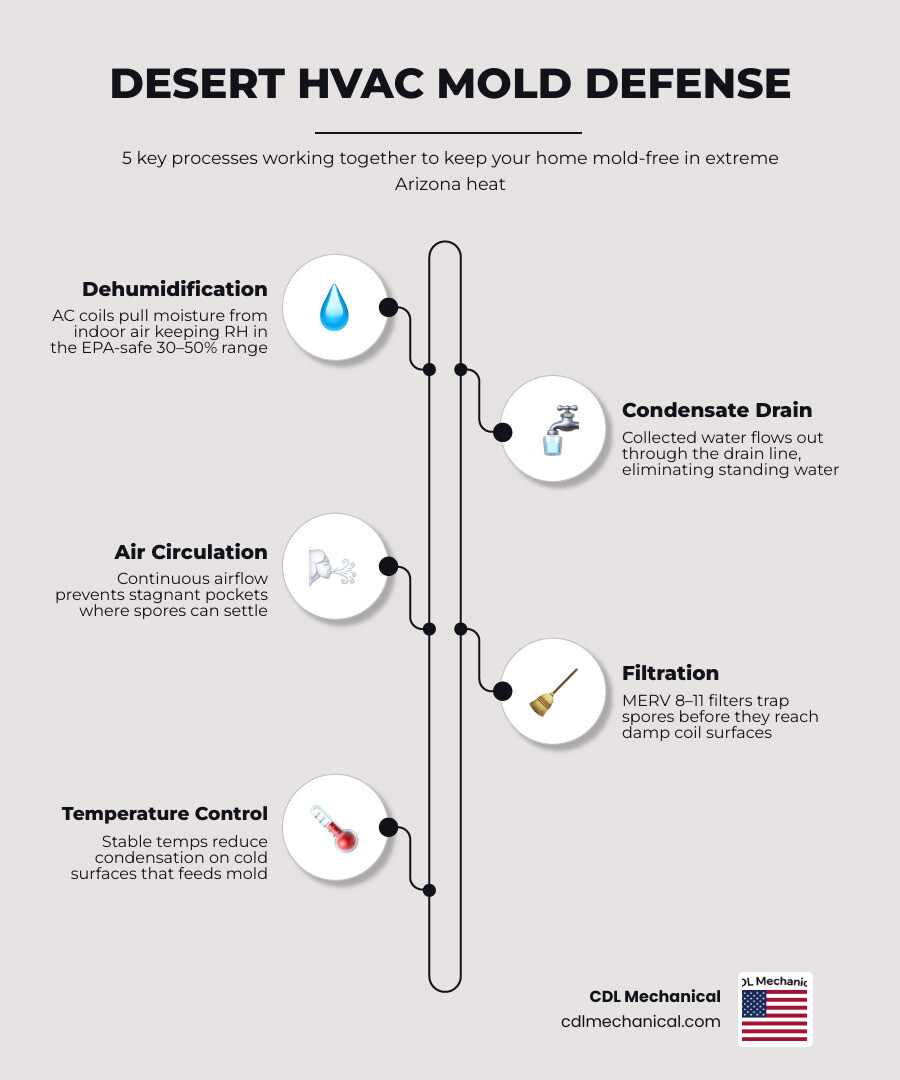
How Your HVAC System Prevents Mold in Desert Extreme Heat
In the middle of a May 2026 heatwave in Surprise or Peoria, your air conditioner is doing more than just lowering the thermostat. It is acting as a massive dehumidifier. While the Valley of the Sun isn’t known for humidity, the “latent load”—the moisture produced by breathing, cooking, showering, and even indoor plants—must be managed.
When warm air from your home is pulled over the cold evaporator coils, the temperature of that air drops below its “dew point.” This causes moisture to condense out of the air and turn into liquid water on the coils. This process is essential because there are 5 benefits of good indoor air quality, and keeping humidity low is at the top of that list. By removing this water, your HVAC system keeps the air dry enough that mold spores cannot find the moisture they need to “activate” and grow.
Understanding how your hvac system prevents mold in desert extreme heat through dehumidification
Most mold species require a relative humidity level of 70% or higher to actively grow and spread. In a Glendale home, your HVAC system aims to keep that level between 30% and 50%, which is the EPA-recommended standard for a healthy home.
The physics of this involves “vapor pressure.” In a hot desert, the air can actually hold a lot of water, even if it feels dry. When your AC runs, it creates a pressure differential that helps pull that moisture out. If you feel like your air is still a bit stuffy or you’re worried about lingering spores, installing an Air Purifier alongside your HVAC system can provide an extra layer of protection by capturing the spores that the dehumidification process doesn’t eliminate.
Why mold remains a risk in dry Glendale environments
You might wonder, “If it’s 115°F in Scottsdale, how can mold possibly survive?” The answer lies in microclimates. Mold doesn’t grow on your driveway; it grows in the dark, cool corners of your ductwork or on a damp evaporator coil.
Desert dust is particularly problematic because it is “hygroscopic,” meaning it acts like a sponge. When this dust settles on your AC components, it traps the condensation from the coils. This creates a damp, organic “soil” that is perfect for mold. Because mold can establish itself in as little as 48 hours, any lapse in system performance can lead to a problem. This is why many residents often ask, is your home’s air quality worse than outside? In the desert, the answer is often yes, specifically because of these hidden moisture traps inside the cooling system.
5 Essential Steps for Mold Prevention in the Desert
Preventing mold isn’t just about cleaning; it’s about engineering an environment where mold simply cannot survive. In places like Sun City and Goodyear, the extreme heat and sudden monsoon moisture require a proactive approach.

Step 1: Maintain a strict filter replacement schedule
In the Arizona desert, the standard “change every three months” rule doesn’t apply. Between the spring wind season and the summer haboobs, our air is filled with “caliche” dust—a mix of calcium carbonate and silica that is incredibly fine and abrasive.
We recommend checking your filters every 30 days during the peak of summer. Using a filter with a MERV rating between 8 and 11 is the “sweet spot” for desert homes. These are high-efficiency enough to trap particles as small as 0.3 microns (which includes most mold spores) without being so restrictive that they kill your airflow and cause your coils to freeze up. Understanding how HVAC filters affect indoor air quality is the first step in realizing that a clean filter is your system’s primary shield against mold-feeding dust.
Step 2: Clear the condensate drain line and pan
As your AC pulls gallons of water out of the air every day, that water has to go somewhere. It drips into a condensate pan and flows out of your house through a drain line. In the heat of a Tempe or Mesa summer, this warm, wet environment can quickly develop “algae slime” or biofilm.
If this line clogs, water backs up into the pan. Standing water is an open invitation for mold. We suggest:
- Flushing the line: Use a professional-grade treatment or a simple solution to clear out slime every three months.
- Checking the pan: Ensure there is no standing water or rust stains, which indicate the pan isn’t draining correctly.
- Secondary protection: Ensure your system has a secondary drain pan or a “float switch” that shuts the system off if a backup occurs, preventing a flood in your attic or closet.
Step 3: Maintenance tips and how your hvac system prevents mold in desert extreme heat year-round
Professional inspections are not a luxury in Arizona; they are a survival strategy for your equipment. An HVAC system in Glendale logs about 2,000 to 3,000 hours of run time a year—nearly triple the national average.
During a professional tune-up, a technician will perform deep coil cleaning. This removes the “cement-like” coating of dust and moisture that DIY hosing simply can’t reach. We also look for duct leaks. If your ducts are leaking in a hot attic, they can pull in 150°F air, causing “sweating” (condensation) on the outside of the ducts, which leads to mold in your insulation. Following the ultimate checklist for HVAC service frequency ensures your system is serviced twice a year—once before the summer heat and once before the winter chill.
Step 4: Install UV-C germicidal lights
If you want to move from “managing” mold to “eliminating” it, UV Lights are the answer. These lights are installed inside the air handler, usually right above the evaporator coil.
UV-C light works by scrambling the DNA of mold spores, bacteria, and viruses. When a spore passes through the light or sits on a surface bathed in it, it loses the ability to reproduce. This keeps your “wet” components—the coils and the drain pan—sterile. It’s an incredibly effective way to ensure that even if moisture is present, biological growth is impossible.
Step 5: Manage humidity during the Arizona monsoon
From June to September, the rules change. Outdoor humidity can jump from 10% to 60% in a matter of hours. This is when your HVAC system works the hardest because it has to handle the “latent load” (moisture) before it can effectively lower the “sensible” temperature (the number on the thermostat).
If your home feels “clammy” during a storm, it’s a sign your system is struggling to dehumidify. In modern, tightly sealed homes in areas like Buckeye or Waddell, a whole-home dehumidifier can be integrated into your HVAC system. This allows the system to pull moisture out of the air even when the cooling cycle isn’t running, keeping you well below that 50% mold-risk threshold.
The Impact of Desert Dust and Debris on System Health
Desert dust isn’t just “dirt.” In the Glendale and Phoenix area, it’s often composed of caliche and fine silts that become sticky when they meet the condensation on your AC coils. This creates a nutrient-rich “bio-mat” that feeds mold.
When your coils are coated in dust, they can’t transfer heat efficiently. This forces the system to run longer, creating more condensation and more opportunities for mold to grow. It’s a vicious cycle. Don’t let the dust settle on your AC performance—keeping those coils clean is as much about mold prevention as it is about saving money on your electric bill.
Identifying signs of mold in your cooling system
How do you know if you already have a problem? Desert homeowners should look for these specific red flags:
- Musty Odors: If you smell something like “old gym socks” or a “wet dog” when the AC first kicks on, you likely have “Dirty Sock Syndrome.” This is caused by bacteria and mold buildup on the evaporator coils.
- Visible Growth: Check your supply vents. If you see black or green “dust” that doesn’t wipe away easily, it could be mold colonizing the vent cover.
- Health Symptoms: If your allergies or asthma symptoms improve when you leave the house but flare up the moment you get home, your HVAC system’s air quality may be the culprit.
| Characteristic | Common Desert Dust | Mold Growth |
|---|---|---|
| Color | Light brown, tan, or gray | Black, dark green, or white spots |
| Texture | Gritty, dry, and powdery | Fuzzy, slimy, or “velvety” |
| Smell | Earthy or odorless | Musty, pungent, or “sour” |
| Reaction to Moisture | Becomes mud-like | Expands and colonizes |
Frequently Asked Questions about Desert HVAC Mold
Can a swamp cooler cause more mold than refrigerated air?
Yes. Evaporative coolers (swamp coolers) work by adding moisture to the air to cool it. While effective in very dry conditions, they can easily push indoor humidity above 60% or 70% if the house isn’t properly ventilated with open windows. In contrast, refrigerated air conditioning removes moisture, making it a much safer choice for mold prevention in Glendale.
What is the ideal indoor humidity for a home in Glendale, AZ?
We recommend aiming for 30% to 40% relative humidity. This is the “Goldilocks” zone for the desert. It is high enough to prevent dry skin, bloody noses, and cracked wood furniture, but low enough to ensure mold cannot survive. Once you cross the 50% mark, the risk of mold colonization increases significantly.
When should I call a professional for mold remediation?
If you see visible mold covering an area larger than 10 square feet (about the size of a standard bath towel), the EPA recommends professional remediation. However, when it comes to your HVAC system, you should call us if you notice a persistent musty smell or if you see any growth inside the air handler. Because the HVAC system distributes air to every room, a small mold problem in the ducts can quickly become a whole-home health issue.
Conclusion
At CDL Mechanical, we’ve spent years helping our neighbors in Glendale, Peoria, and across the West Valley stay cool and breathe clean air. We are a family-owned company, and we treat every home like it’s our own. We know that how your HVAC system prevents mold in desert extreme heat is about more than just mechanical parts—it’s about the health and comfort of your family.
Whether you need a routine tune-up to clear those condensate lines or you’re looking to upgrade your home’s defenses with a UV light system, we are here to help. Our expert technicians are ready to ensure your system is running at peak efficiency, keeping the heat out and the mold away. Breathe easier with advanced air purification solutions and give us a call today to schedule your seasonal maintenance. We serve the entire Phoenix metro area, from Surprise to Tempe, with the reliable, expert service you deserve.