
Your Utility Bills Are Telling You Something — Are You Listening?
How much does a high efficiency system save compared to what you’re running right now? Here’s the short answer:
| Upgrade Scenario | Estimated Annual Savings | Long-Term Savings Potential |
|---|---|---|
| 10 SEER → 16 SEER (cooling) | ~37% less energy for cooling | Significant over 15+ years |
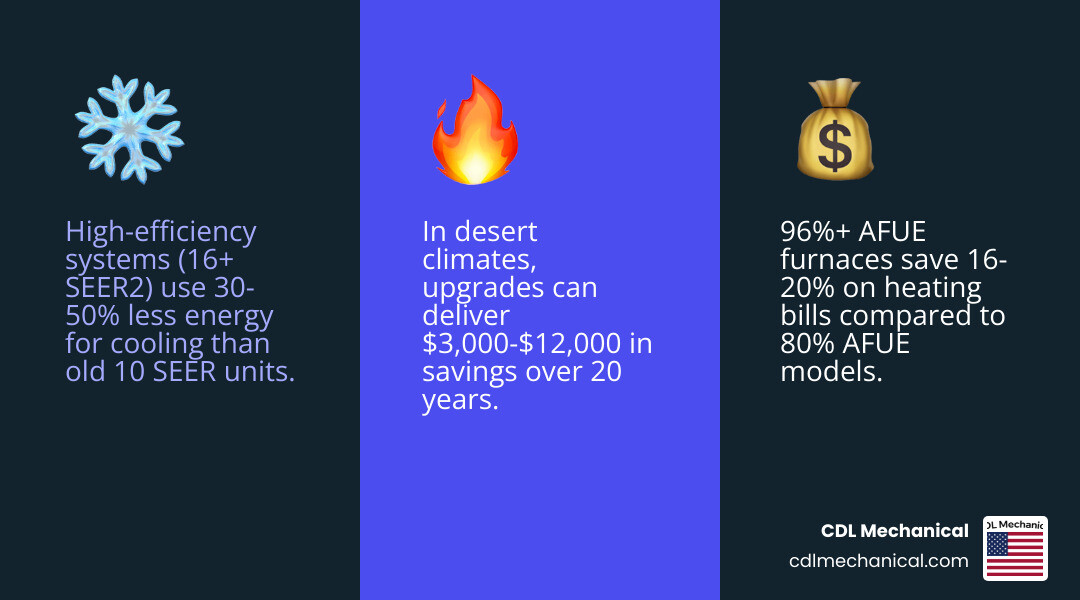
| 10 SEER → 18 SEER (cooling) | ~28–40% less energy for cooling | $3,000–$12,000 over 20 years |
| 80% → 96% AFUE (heating) | 16–20% less on heating costs | $2,000–$2,600 over 10 years |
| Old equipment (15–20 yrs) → modern high-efficiency | 30–50% reduction in total heating and cooling costs | Hundreds per year |
If your system is more than 10–15 years old, you are almost certainly leaving money on the table every single month — and here in Glendale, where summer temperatures regularly climb past 100°F and your air conditioner runs hard for the better part of the year, that adds up fast. The average household wastes $200–$400 annually on energy through outdated equipment and inefficiencies alone. A high-efficiency HVAC upgrade is one of the most direct ways to stop that bleed.
I’m Joshua Michael Bartlett, founder of CDL Mechanical and an HVAC professional with over 20 years of hands-on experience helping Glendale homeowners understand exactly how much does a high efficiency system save in real desert conditions. In the sections below, I’ll walk you through the numbers, the ratings, and the real-world factors that determine what you can actually expect to say.
Understanding High-Efficiency HVAC Ratings in May 2026
When we talk about HVAC efficiency, it often sounds like a bowl of alphabet soup. Between SEER2, AFUE, and HSPF2, it’s easy for a homeowner to get overwhelmed. However, these ratings are simply the “miles per gallon” for your home’s comfort system. Understanding them is the first step toward calculating how much does a high efficiency system save in your specific home.
As of May 2026, the Department of Energy standards have shifted, making it even more important to look at the “2” at the end of these acronyms (like SEER2). This indicates a more rigorous testing protocol that better reflects how a system actually performs when installed in a home like yours in Phoenix or Scottsdale.
Key Efficiency Benchmarks for 2026:
- Standard Efficiency: Typically 14.3 to 15 SEER2.
- High Efficiency: Systems rated 16 to 22+ SEER2.
- High-Efficiency Heating: Furnaces with 90% to 97% AFUE.
- ENERGY STAR Certified: Equipment that meets strict EPA criteria for energy reduction.
For a deeper dive into these numbers, you can check out our guide on Understanding Seer Ratings And Their Importance.
What do SEER2 and AFUE mean for your wallet?
Think of these ratings as a direct reflection of your utility bill. SEER2 (Seasonal Energy Efficiency Ratio) measures cooling efficiency. A higher number means the unit uses less electricity to produce the same amount of cold air. In our hot Arizona climate, the jump from an old 10 SEER unit to a 20 SEER2 unit can effectively cut your cooling electricity consumption in half.
AFUE (Annual Fuel Utilization Efficiency) applies to gas furnaces. If you have an 80% AFUE furnace, 20 cents of every dollar you spend on gas is literally going up the exhaust vent. A high-efficiency 97% AFUE furnace, however, returns 97 cents of every dollar as usable heat, wasting only 3 cents.
If you’re looking for The Secret To A Lean Mean Green Hvac Machine, it starts with choosing the right combination of these ratings for our specific desert environment.
How Much Does a High Efficiency System Save on Monthly Bills?

The question we hear most often at CDL Mechanical is: “Will this actually pay for itself?” The data suggests a resounding yes, especially for those of us living in the West Valley. High-efficiency systems (SEER 16+ and 96%+ AFUE) can cut heating and cooling bills by 30–50% compared to equipment that is 15–20 years old.
Annual Savings Comparison: SEER 10 vs. Modern Standards
| Current System | Upgrade To | Estimated Annual Cooling Savings |
|---|---|---|
| 10 SEER | 13 SEER | 23% |
| 10 SEER | 16 SEER | 37% |
| 14 SEER | 18 SEER | ~28% |
When you consider that cooling and heating account for nearly 43% of the average home’s utility bill, a 40% reduction in that specific category translates to hundreds of dollars back in your pocket every year.
How much does a high efficiency system save in the Arizona desert?
In Glendale, Peoria, and Surprise, our HVAC systems don’t just “run”—they run marathons. With over 300 sunny days a year and summer temperatures that can keep an AC unit running for 12+ hours a day, the efficiency of your system is amplified.
In milder climates, a high-efficiency system might save a homeowner $100 a year. But in the Phoenix metro area, where peak demand charges are high and the heat is relentless, those savings can easily triple or quadruple. Using the Best Thermostat Settings For Staying Cool Without Higher Power Bills in conjunction with a high-efficiency unit is the ultimate strategy for desert survival.
How much does a high efficiency system save compared to older units?
If you are running a 15-year-old “clunker,” you aren’t just paying for the energy it uses; you’re paying for the energy it wastes. Older 10 SEER units were the standard years ago, but by today’s metrics, they are energy hogs. Upgrading from a 10 SEER AC to a new high-efficiency system typically saves 20–40% on home cooling costs immediately.
Even in our shorter winters, an old 60% AFUE furnace is a major drain. Upgrading to an 80% AFUE unit can save 25% on heating costs, equating to over $7,500 in savings over 15 years. For more tips on cutting costs during the cooler months, see our advice on New Year Lower Bills Simple Hvac Tweaks To Cut Winter Energy Costs.
Key Factors That Impact Your Real-World Energy Savings
While the sticker on the side of the unit says one thing, your actual savings depend on the “health” of your entire home. You could buy the most efficient unit in the world, but if your home is “leaking” air, you won’t see the full ROI.
- Duct Integrity: In Glendale, many homes have ductwork running through attics that reach 140°F. If those ducts leak 20–30% of your air (which is common), your new unit has to work 30% harder.
- Home Insulation: Proper attic insulation keeps the heat out so your system doesn’t have to fight a losing battle.
- System Sizing: A system that is too large will “short cycle,” turning on and off rapidly, which wastes massive amounts of electricity. A “Manual J” load calculation is required to get the sizing right.
- Zoning: Sometimes, a Mini Split Will Save You More Money Than Central Air, especially if you only need to cool specific rooms like a home office or a master suite.
The role of variable-speed compressors and modulating furnaces
The “secret sauce” of modern high-efficiency equipment is variable-speed technology. Traditional HVAC systems are like a car that only has two speeds: stopped and 100 mph. They blast on at full power, overshoot the target temperature, and then shut off. This “hard start” consumes the most electricity and causes the most mechanical wear.
High-efficiency systems use variable-speed compressors that act like cruise control. They adjust their speed to match the cooling needs of the home exactly. If it’s only 90°F outside, the system might run at 40% capacity, using a fraction of the power while maintaining a perfectly steady temperature. This also provides superior humidity control, making 78°F feel much cooler and more comfortable than it would with a standard system.
Understanding these benefits is part of being a savvy consumer, especially when navigating The Arizona Homeowners Guide To Inflation Reduction Act Benefits.
Maximizing Your Investment with Rebates and Maintenance
The upfront price of a high-efficiency system is higher than a standard model, but in May 2026, there are more ways than ever to bridge that gap. We always encourage our neighbors in the West Valley to look at the “net cost” rather than the “sticker price.”
- Utility Rebates: Both APS and SRP offer significant rebates for homeowners who install high-efficiency heat pumps or AC units. You can learn How West Valley Homeowners Can Cash In On Aps Rebates by checking their current program requirements.
- Federal Tax Credits: Under the Inflation Reduction Act, you may be eligible for tax credits up to $2,000 for high-efficiency heat pumps.
- Manufacturer Incentives: Many brands offer seasonal rebates that can be stacked with utility offers.
We’ve made Applying For Arizona Energy Rebates Made Easy so you don’t have to spend hours hunting for paperwork.
How maintenance preserves your efficiency ratings
A high-efficiency system is a precision machine. To keep it saving you money, it needs regular care. If the coils are caked in desert dust or the refrigerant levels are slightly off, a 20 SEER system can quickly perform like a 14 SEER system.
Regular maintenance includes:
- Filter Changes: A clogged filter forces the blower motor to work harder, consuming more energy.
- Coil Cleaning: Dust acts as an insulator, preventing the system from releasing heat efficiently.
- Duct Inspection: Ensuring that 150-degree attic air isn’t being sucked into your living space.
For a full breakdown of how to keep your savings high, see The Ultimate Guide To Arizona Energy Rebates For Hvac Upgrades.
When Does Upgrading to High-Efficiency Make Financial Sense?
Deciding when to pull the trigger on a new system is a math problem. Generally, a high-efficiency upgrade makes the most financial sense if:
- Your current system is 12+ years old: You are entering the “repair-heavy” phase of the system’s life.
- You plan to stay in your home for 5–7 years: This allows you to reach the “payback period” where the energy savings have fully covered the efficiency premium.
- Your monthly bills are spiking: This is a clear sign of mechanical inefficiency.
- Major repairs are looming: If you’re facing a multi-thousand-dollar repair on an old R-22 system, that money is better spent as a down payment on a new, efficient unit.
To see which models are currently the best “bang for your buck,” check out What Hvac Systems Qualify For Tax Credits And Rebates.
Frequently Asked Questions about High-Efficiency Savings
What is a good payback period for an HVAC upgrade?
In the Glendale area, we typically see a payback period (the time it takes for energy savings to offset the higher cost of a premium unit) of 5 to 10 years. Because we use our AC so much more than people in the Midwest, our payback periods are often among the fastest in the country.
Does a higher SEER2 rating always guarantee lower bills?
It guarantees the potential for lower bills. However, if your home has poor insulation, leaky ducts, or if you leave the windows open while the AC is running, you won’t see the full benefit. Think of it like buying a fuel-efficient car but driving with a lead foot—the car is efficient, but your habits still matter!
Are high-efficiency systems more expensive to maintain?
They require the same frequency of maintenance (twice a year), but because they contain more complex electronics and variable-speed components, repairs outside of the warranty period can be more specialized. This is why we emphasize the importance of choosing a system with a strong 10- or 12-year parts warranty.
Conclusion
At CDL Mechanical, we aren’t just here to sell you a box; we’re here to help you make a smart investment in your home’s comfort and your family’s future. As a family-owned company based right here in Glendale, we know exactly what it takes to keep a home cool when the asphalt is melting outside.
Upgrading to a high-efficiency system isn’t just about being “green”—it’s about “keeping more green” in your wallet. By reducing your energy consumption by 30% to 50%, you turn a monthly utility burden into a long-term financial asset.
If you’re tired of dreading your summer electric bills, let’s talk about a solution that fits your home and your budget. Schedule your high-efficiency AC installation in Glendale today and start counting the coins you’ll save for years to come.