
Why the Average Lifespan of an HVAC System in the Phoenix West Valley Is Shorter Than You Think
The average lifespan of an HVAC system in the Phoenix West Valley is significantly shorter than what most national guides will tell you. Here is a quick answer if that is all you need:
| HVAC System Type | National Average Lifespan | Phoenix West Valley Average |
|---|---|---|
| Central AC (Split System) | 15-20 years | 10-15 years |
| Heat Pump | 12-15 years | 10-14 years |
| Packaged Rooftop Unit | 12-17 years | 10-15 years |
| Gas Furnace | 18-25 years | 18-25 years |
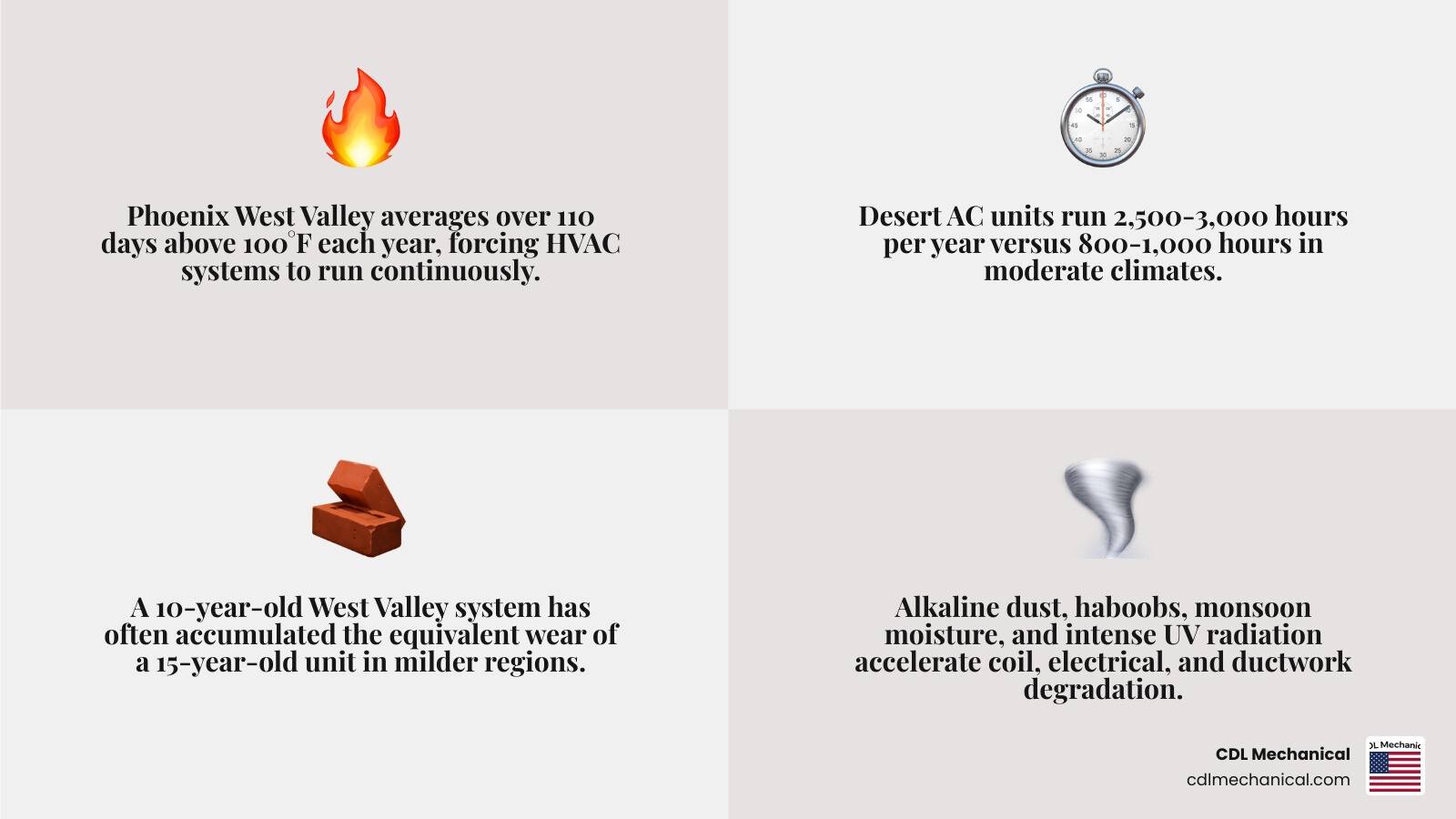
The West Valley is one of the most demanding climates in the entire country for HVAC equipment. Phoenix averages more than 110 days per year above 100°F. Your air conditioner does not get a break in the summer — it runs for hours on end, day after day, in conditions that push every component to its limit.
In moderate climates, a central AC system might run 800 to 1,000 hours per year. In the Phoenix area, that number climbs to 2,500 to 3,000 hours annually. That is roughly three times the wear in the same calendar year. A 10-year-old unit in the West Valley has often done the equivalent work of a 15-year-old system somewhere like Minneapolis.
On top of the heat, West Valley homeowners deal with alkaline dust, haboobs, monsoon moisture, and intense UV radiation — all of which accelerate wear on coils, electrical components, and ductwork in ways that national lifespan estimates simply do not account for.
Understanding how long your system is likely to last — and what you can do about it — can save you thousands of dollars and a lot of miserable summer days without cooling.
I’m Joshua Michael Bartlett, founder of CDL Mechanical and an HVAC professional with over 20 years of hands-on experience, including deep familiarity with what the desert climate does to home comfort systems — making me well-positioned to walk you through everything affecting the average lifespan of an HVAC system in the Phoenix West Valley. In this guide, I’ll break down the real numbers, the desert-specific stressors, and the practical steps you can take to get the most out of your system.
Understanding the Average Lifespan of an HVAC System in the Phoenix West Valley
When you purchase a home in communities like Glendale, Peoria, or Surprise, you inherit its climate. While manufacturers design modern air conditioners to withstand tough conditions, the reality of Low Desert living means your outdoor condenser is constantly fighting an uphill battle.
According to the Department of Energy, the extreme operating conditions in Arizona can reduce the average lifespan of a central air conditioning system by as much as 20%. Where a homeowner in a milder state might easily enjoy 18 to 20 years of trouble-free cooling, West Valley homeowners typically see their systems begin to show signs of terminal wear between years 10 and 15. Without routine preventive care, systems can fail completely in as little as 8 to 10 years.
To understand why this happens, we have to look closely at what we call the “desert journey” of an air conditioner. You can read more about these environmental factors in our detailed article on How Long Does an AC Last in the Desert?.
| Lifespan Factor | National Average Impact | Phoenix West Valley Impact |
|---|---|---|
| Annual Running Hours | 1,000 – 1,500 hours | 2,500 – 3,000+ hours |
| Peak Ambient Temperature | 85°F – 95°F | 110°F – 118°F+ |
| Air Quality & Debris | Low to moderate organic dust | High alkaline dust, sand, & monsoon debris |
| Thermal Cycling Stress | Mild daily temperature swings | 30°F to 40°F daily temperature swings |
Why the Average Lifespan of an HVAC System in the Phoenix West Valley is Shorter Than the National Average
The primary culprit behind this compressed lifespan is sheer workload. Your air conditioner is a mechanical system made of motors, bearings, copper tubing, electrical contacts, and chemical refrigerants. Like any machine, its lifespan is directly tied to its runtime hours. Because our cooling season in the West Valley easily stretches from late March through October—and sometimes into November—our systems run nearly year-round.
Additionally, the physics of cooling becomes incredibly difficult when outdoor temperatures exceed 110°F. An air conditioner does not actually “create” cold; it absorbs heat from inside your home and releases it outdoors. When the outdoor air is a scorching 115°F, your condenser has to work significantly harder to reject that indoor heat into the sizzling environment. This high-ambient stress causes the compressor—the heart of your system—to draw more electrical current, run hotter, and experience accelerated internal lubrication breakdown.
Finally, we cannot ignore thermal cycling. In the West Valley, spring and fall bring massive temperature swings. It is not uncommon to experience a 40-degree difference between a cool desert night and a blistering afternoon. This rapid expansion and contraction of the metals in your system puts immense stress on solder joints and aluminum fins, eventually leading to microscopic refrigerant leaks.
Key Factors Influencing the Average Lifespan of an HVAC System in the Phoenix West Valley
While we cannot change the Arizona weather, several critical factors under your control will determine whether your system lasts closer to 10 years or pushes past the 15-year mark:
- System Sizing: A system that is too small will run constantly without ever cooling your home, leading to premature motor burnouts. Conversely, an oversized system will “short-cycle,” turning on and off rapidly. Short-cycling places extreme wear on the compressor and electrical contactors while failing to remove humidity from your home.
- Installation Quality: How your system is put together on day one dictates its entire mechanical future. Improperly vacuumed refrigerant lines can leave moisture inside the system, creating acid that eats away at the compressor motor from the inside out. Poorly designed ductwork can restrict airflow, causing the system to choke and overheat.
- Maintenance Frequency: Think of your HVAC system like a vehicle. If you never changed the oil or replaced the air filters on a car, you wouldn’t expect it to reach 100,000 miles. In the desert, routine maintenance is your only defense against premature failure. For a deeper dive into how often your system needs professional attention, check out The Ultimate Guide to HVAC Service Frequency.
Desert Stressors: How West Valley Climate Impacts Longevity

Living in the West Valley means dealing with unique environmental challenges that do not exist in other parts of the country. If you live in Avondale, Buckeye, Goodyear, or Litchfield Park, your outdoor unit is exposed to several brutal desert elements:
- Alkaline Dust & Haboobs: The dust in our region is highly alkaline, boasting a pH level between 8 and 9. It contains abrasive minerals like calcium carbonate and silica. When a monsoon dust storm or haboob rolls through the valley, it forces these fine, abrasive particles deep into your condenser coils. This dust acts as an insulating blanket, preventing the coils from releasing heat and forcing the compressor to run hotter and longer.
- Monsoon Moisture & Humidity: While the West Valley is famous for dry heat, our summer monsoons bring sudden spikes in humidity. High humidity combined with alkaline dust creates a corrosive paste that clings to your outdoor unit’s aluminum fins, accelerating coil degradation and causing pinhole refrigerant leaks over time.
- Electrical Failures from Extreme Heat: The run capacitor is the most common failure point in Arizona during the summer. Capacitors store electrical energy to help your fan motor and compressor start up. When attic temperatures hit 150°F and outdoor temperatures hover near 115°F, these sensitive electrical components degrade rapidly. If a capacitor fails and is not replaced quickly, it can cause the fan motor or compressor to overheat and fail permanently.
- Intense UV Radiation: The Arizona sun is relentless. Over time, intense UV rays degrade exposed wiring insulation, plastic components, and even the rubber vibration pads beneath your outdoor condenser unit, leading to increased system noise and electrical short circuits.
Proactive Maintenance to Extend Your Desert HVAC System’s Life
Fortunately, you do not have to sit by and watch the desert heat destroy your investment. Implementing a proactive, consistent maintenance routine can add three to five years of useful life to your system, keeping your utility bills manageable and preventing emergency breakdowns in July.
The most important task you can perform as a homeowner is changing your air filters. In the West Valley, where dust is a constant presence, standard filters can clog quickly. If you have pets or suffer from allergies, check your filters monthly. A clogged filter restricts airflow, forcing your indoor blower motor to work twice as hard and causing your evaporator coil to freeze over.
Beyond filter changes, scheduling professional, seasonal tune-ups is critical. During a professional visit, our technicians check refrigerant levels, test capacitors for electrical degradation, tighten electrical connections, and thoroughly clean the coils. For homes utilizing heat pumps, this biannual care is even more vital because these systems run year-round to provide both heating and cooling. Learn more about protecting your dual-purpose system by reading Why Regular Heat Pump Service in Phoenix Is a Total Lifesaver.
By keeping your coils clean and your electrical components fresh, you ensure your system operates at peak efficiency. This reduces runtime hours and lowers your monthly utility bills. For practical tips on maximizing your system’s output while minimizing energy waste, explore our guide on The Secret to a Lean Mean Green HVAC Machine.
The Crossroads: When to Repair vs. Replace Your Aging Unit
Every West Valley homeowner eventually faces a difficult decision: do you continue repairing an aging air conditioner, or is it time to invest in a complete replacement?
When your system crosses the 10-year mark, major components like the compressor, condenser fan motor, or evaporator coil can fail. To help make this decision easier, we recommend using two industry-standard guidelines:
- The 50% Rule: If the cost of a single repair exceeds 50% of the cost of a comparable new system, replacing the unit is almost always the smarter financial move.
- The $5,000 Rule: Multiply the age of your system by the repair quote. If the resulting number is greater than 5,000, replacing the system is typically more economical in the long run.
For example, if you have an 11-year-old system facing a repair quote of $600, multiplying those numbers yields 6,600. Because this exceeds 5,000, investing that money into a brand-new, highly efficient system is generally a wiser decision than patching up a unit that is already nearing the end of its desert lifespan. For a deeper look at navigating this complex decision, check out The HVAC Crossroads: When to Patch It Up and When to Move On.
Warning Signs Your West Valley AC is Nearing End-of-Life
Your system will usually drop hints before it fails completely. If you notice any of the following warning signs, it is time to start planning for a replacement rather than waiting for an emergency breakdown:
- Weak or Warm Airflow: If certain rooms in your home are constantly warmer than others, or if the air blowing from your registers feels lukewarm, your compressor may be losing its pumping capacity.
- Unusual Noises: Squealing, grinding, or loud banging sounds from your outdoor unit are signs of failing motor bearings or a dying compressor.
- Rising Utility Bills: If your electric bills are climbing month after month, but your home comfort habits haven’t changed, your system is losing its efficiency and running longer to achieve the same cooling results.
- Frequent Breakdowns: If you have your local HVAC company on speed dial and are paying for multiple repairs every summer, those costs quickly add up to a down payment on a new system.
An inefficient, aging air conditioner doesn’t just impact your monthly bills; it can also affect your home’s value if you plan to sell. To learn how an outdated system can impact your home’s equity, read Is Your Old AC Killing Your Resale Price?.
Navigating Replacement Options in the West Valley
If replacement is the best path forward, you’ll want to choose a system designed to handle our specific desert demands. Today’s modern HVAC systems are incredibly advanced compared to units built a decade ago.
When shopping for a new system, pay close attention to SEER2 ratings. SEER2 (Seasonal Energy Efficiency Ratio 2) measures a system’s cooling efficiency under updated testing standards that better reflect real-world installations. In the Southwest region, high-efficiency systems can drastically reduce your summer electricity usage.
Additionally, consider upgrading to a variable-speed compressor. Unlike traditional single-stage systems that run at 100% capacity or are completely off, variable-speed systems adjust their output in tiny increments to match your home’s exact cooling needs. This allows them to run at lower, highly efficient speeds for longer periods, providing precise temperature control, better dehumidification during monsoon season, and significantly less mechanical wear and tear.
For a comprehensive walkthrough of the replacement process from start to finish, read our Residential AC Replacement in Phoenix: A Homeowner’s Survival Guide or our local Homeowners Guide: Navigating AC Replacement in Peoria.
Frequently Asked Questions about West Valley HVAC Lifespans
How long does a heat pump last in the Phoenix West Valley?
In the West Valley, a well-maintained heat pump typically lasts between 10 and 14 years. Because heat pumps provide both heating in our chilly winter nights and cooling during our intense summers, they run year-round. This constant operation accumulates twice as many running hours as a “straight cool” air conditioner, which gets to rest during the cooler winter months. This high workload causes their internal mechanical components to wear down slightly faster.
Does a smart thermostat actually extend HVAC lifespan?
Yes, but indirectly. A smart thermostat does not physically change your air conditioner’s mechanics, but it optimizes system runtimes. By preventing extreme temperature swings, scheduling cooling around your daily routine, and reducing unnecessary system cycles, a smart thermostat minimizes wear on your compressor and fan motors. This reduced strain can add valuable years to your system’s overall lifespan.
What is the best time of year to replace an HVAC system in Glendale or Peoria?
The absolute best times of year to schedule an HVAC replacement are the “shoulder seasons”—specifically spring (March to April) and fall (October to November). During these milder months, local technicians are not overwhelmed with emergency repair calls, allowing for flexible scheduling. Additionally, you will not have to suffer through a hot home while your system is offline during the installation process.
Conclusion
Managing the average lifespan of an HVAC system in the Phoenix West Valley requires a blend of realistic expectations and proactive care. While our harsh desert climate certainly tests the limits of any cooling system, consistent maintenance, timely repairs, and professional installation can help you maximize your comfort and get the absolute most out of your investment.
At CDL Mechanical, we are proud to be a family-owned HVAC company based in Glendale, AZ. We treat every customer like family, providing honest, expert service to keep your home cool and comfortable no matter how high the summer temperatures climb. Whether you need a seasonal tune-up to protect your system’s longevity or are ready to explore your replacement options, our team is here to help.
Don’t wait for the next summer heatwave to test your air conditioner’s limits. Schedule professional HVAC services in Glendale, AZ with CDL Mechanical today, and let us help you keep your home comfortable for years to come.