
How to Apply for Energy Rebates in Arizona (And Start Saving in 2026)
Knowing how to apply for energy rebates in Arizona can put thousands of dollars back in your pocket — here’s the quick version:
- Check your eligibility using the Efficiency Arizona screening tool or the A-to-Z Arizona Portal for LIHEAP/Power AZ
- Gather your documents — current utility bill, photo ID, proof of income, and citizenship documentation
- Create an account and submit your application through the relevant program portal
- Choose your pathway — either through a qualified contractor (for major upgrades) or a participating retailer (for appliances)
- Schedule any required inspection and complete the work with an approved installer
- Receive your rebate — either as a point-of-sale discount, post-inspection payment, or federal tax credit at filing
Arizona homeowners have access to a surprisingly wide range of energy incentives right now. Between the federally funded Efficiency Arizona program, LIHEAP, Power AZ, and utility rebates from providers like SRP and APS, eligible households can receive up to $14,000 toward electrification upgrades — on top of federal tax credits that can cut another $3,200 off your annual tax bill. With Arizona summers pushing well past 110°F, upgrading your home’s heating and cooling systems isn’t just a comfort decision — it’s a financial one that these programs are specifically designed to support.
But navigating multiple programs, income thresholds, and application portals at the same time can feel overwhelming. That’s exactly why this guide exists: to walk you through every step clearly, so you know exactly what to apply for, what to bring, and how to get the most out of what’s available to you.
I’m Joshua Michael Bartlett, founder of CDL Mechanical and an HVAC professional with over 20 years of hands-on experience helping Arizona homeowners make smart, efficient upgrades — and I’ve seen how much of a difference understanding how to apply for energy rebates in Arizona can make for a family’s budget. In the sections below, I’ll break down every major program and show you exactly how to take advantage of them.
Overview of Major Arizona Energy Incentive Programs
In April 2026, Arizona residents have more options than ever to lower their utility bills and upgrade their home comfort. The landscape of energy incentives is divided into three main buckets: state-wide electrification programs, low-income assistance, and utility-specific rebates.
Efficiency Arizona (HEAR and HER)
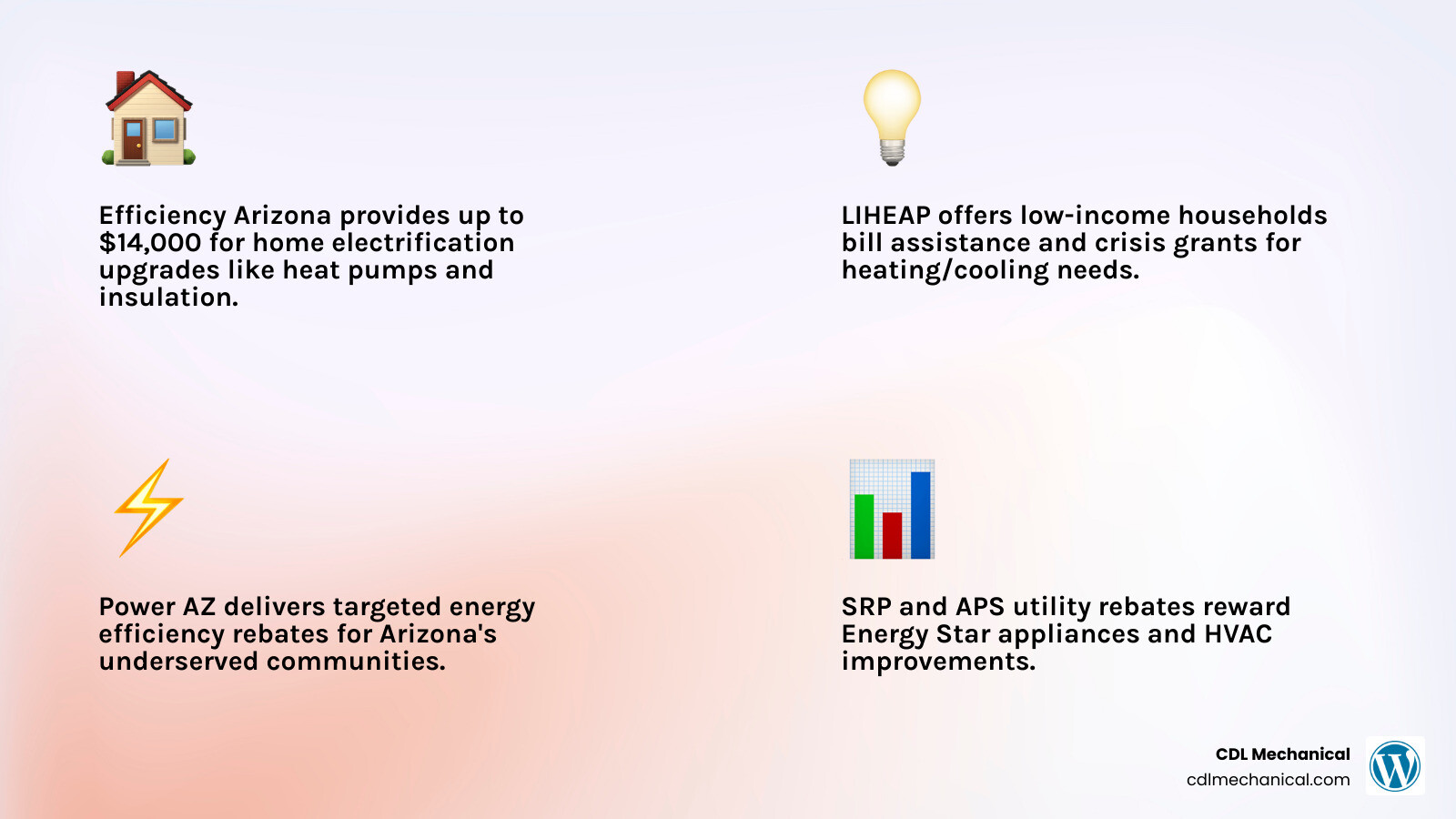
Efficiency Arizona is the flagship state program, often referred to as the Home Electrification and Appliance Rebate (HEAR) and the Home Efficiency Rebate (HER). These programs are designed to help you switch to high-efficiency electric systems. For many of our neighbors in Glendale and Peoria, this is the “big one” because it offers up to $8,000 for Heat Pumps and covers 100% of costs for low-income households (up to a $14,000 total cap).
LIHEAP and Power AZ
While Efficiency Arizona focuses on upgrades, the Low Income Home Energy Assistance Program (LIHEAP) and the newer Power AZ program focus on bill assistance and crisis support. Power AZ is particularly exciting because it expanded access to households up to 100% of the State Median Income (SMI), meaning more middle-class families in Phoenix and Scottsdale now qualify for help when energy costs spike.
Utility Rebates (SRP and APS)
Your local utility provider likely has its own stash of cash waiting for you.
- SRP Rebates: Offer up to $1,125 for energy-efficient AC units, $600 for insulation, and $400 for duct repair.
- APS Incentives: Provide rebates for smart thermostats, cool control devices, and high-efficiency HVAC upgrades.
When considering these upgrades, Understanding Seer Ratings And Their Importance is crucial, as many of these rebates require a minimum SEER2 rating to qualify.
How to Apply for Energy Rebates in Arizona: A Step-by-Step Guide

The process of how to apply for energy rebates in Arizona has become much more streamlined thanks to centralized online portals, but it still requires a bit of “homework.”
- The Screener: Start at the Efficiency Arizona website or the Governor’s Office of Resiliency hub. You’ll answer a few questions about your household size and income. This determines if you qualify for the 100% rebate (low-income) or the 50% rebate (moderate-income).
- Account Creation: You’ll need to create an account on the Arizona Clean Energy Hub or the A-to-Z Arizona Portal. This is where you’ll track your application status.
- The Assessment: For many efficiency rebates, you may need a home energy audit or a contractor assessment first. This identifies exactly where your home is losing energy.
- Approval: Do not start work until you have an eligibility determination or a reservation of funds. If you buy a new unit before getting approved, you might miss out on the rebate!
It’s also worth checking What You Need To Know About Hvac Changes In 2025 to ensure the equipment you are looking at meets the latest federal and state standards for 2026.
Preparing Your Documentation for Arizona Rebates
To keep the process moving, we recommend having a digital folder ready on your computer with the following:
- Current Utility Bill: Must show your name and the service address.
- Photo ID: A valid Arizona driver’s license or state ID.
- Proof of Income: Recent pay stubs, W-2s, or tax returns. (If you already receive DES benefits like SNAP, you might be “categorically eligible,” which simplifies things).
- Citizenship Documentation: Proof of legal residency or citizenship as required by state law for public benefits.
- Disconnection Notice: Only required if you are applying for “Crisis” assistance through LIHEAP or Power AZ.
Navigating the Online Application for Energy Rebates in Arizona
Most applications are handled through the A-to-Z Arizona Portal. When you log in:
- Choose the specific program (e.g., LIHEAP or Efficiency Arizona).
- Verify your identity (often using ID.me).
- Upload your documents.
- Prioritize your utilities. You can list your electric and gas providers in order of who you want the benefit to be paid to first.
Finalizing Your Application for Energy Rebates in Arizona
Once the work is done, there is usually a “close-out” phase.
- Post-Inspection: Some programs require a quick visit to ensure the heat pump or insulation was installed correctly.
- Contractor Sign-off: We (your contractor) will provide the final invoices and technical specs needed to trigger the payment.
- Redemption: Depending on the pathway, the rebate might go directly to the contractor (reducing your out-of-pocket cost immediately) or come to you as a check or tax credit.
Understanding Eligibility and Income Thresholds
Eligibility is the part that trips most people up. Most Arizona programs use either Area Median Income (AMI) or State Median Income (SMI) to draw the line.
Efficiency Arizona Thresholds:
- Low-Income: Households earning less than 80% of the AMI qualify for 100% of project costs (up to $14,000).
- Moderate-Income: Households earning 80% to 150% of the AMI qualify for 50% of project costs (up to $14,000).
LIHEAP vs. Power AZ (Monthly Income Limits for 2026):
| Household Size | LIHEAP Limit (60% SMI) | Power AZ Limit (100% SMI) |
|---|---|---|
| 1 Person | $2,807 | $4,679 |
| 2 People | $3,671 | $6,119 |
| 3 People | $4,535 | $7,558 |
| 4 People | $5,399 | $8,998 |
If you fall outside these ranges, don’t worry! You can still access utility-specific rebates from SRP or APS, which often don’t have income restrictions. Knowing How To Choose The Right Ac System for your specific home size is the first step toward maximizing these non-income-based savings.
Maximizing Savings: Stacking Rebates and Federal Tax Credits
One of the best “hacks” for Arizona homeowners is stacking. This means using a state rebate and a federal tax credit on the same project.
The 25C Tax Credit
The Energy Efficient Home Improvement Credit (25C) allows you to claim 30% of the cost of certain upgrades, up to $3,200 annually.
- Heat Pumps: Up to $2,000 per year.
- Windows/Doors: Up to $1,200 total (with specific limits per item).
- Home Energy Audits: $150.
The 25D Residential Clean Energy Credit
If you’re going big with solar panels or battery storage, the 25D credit offers a 30% uncapped credit through 2033.
To make this work, you subtract the state rebate from the total cost before calculating your 30% tax credit. For example, if a heat pump system costs $10,000 and you get a $4,000 Efficiency Arizona rebate, you calculate the 30% tax credit based on the remaining $6,000. For more details, check out What Hvac Systems Qualify For Tax Credits And Rebates.
Choosing the Right Pathway: Contractor vs. Retail
Efficiency Arizona offers two distinct ways to get your money: the Contractor Pathway and the Retail Pathway.
The Contractor Pathway
This is best for “whole-home” upgrades like installing a new central heat pump, sealing ducts, or adding attic insulation.
- The Process: You pick a qualified contractor (like us!), we perform an assessment, you sign an agreement, and the rebate is often applied directly to your invoice.
- The Benefit: You don’t have to wait for a check in the mail, and you know the installation meets the strict efficiency standards required for the rebate.
The Retail Pathway
This is designed for smaller, “plug-and-play” appliances like heat pump clothes dryers or electric stoves.
- The Process: You fill out a Retail Interest Form online. You’ll receive a point-of-sale coupon via email.
- The Benefit: You take that coupon to a participating retailer (like a big-box home improvement store) and get the discount right at the cash register.
Frequently Asked Questions about Arizona Energy Rebates
How do I check my eligibility for Efficiency Arizona?
The easiest way is to use the official screening tool on the Efficiency Arizona Hub. You’ll need to know your total household gross income and your zip code. Since AMI varies by county (Maricopa vs. Pinal, for example), the tool does the heavy lifting for you.
Can renters apply for energy rebates in Arizona?
Yes! Renters are eligible for many of these programs, especially for “portable” upgrades like window-unit heat pumps or induction cooktops. For larger upgrades like central air, you’ll need written permission from your landlord, but the rebate can still be applied to the project. Programs like LIHEAP and Power AZ are also fully available to renters to help with monthly utility bills.
How long does it take to receive my rebate payment?
If you use the Retail Pathway, the savings are instant at the register. For the Contractor Pathway, the rebate is typically applied to your bill immediately upon completion of the work, and the contractor waits for the state to reimburse them. If you are applying for a post-purchase utility rebate (like from SRP for an AC unit you already bought), it typically takes 4 to 8 weeks for the check to arrive after your documentation is approved.
Conclusion
At CDL Mechanical, we’ve been keeping Glendale and the surrounding West Valley cool for years, and we know that the desert heat is no joke. We also know that the cost of staying cool can be a burden. That’s why we’re so passionate about helping our customers understand how to apply for energy rebates in Arizona.
We’re a family-owned business, and we treat our customers like family. That means we don’t just install a unit and leave; we help you navigate the paperwork, ensure your system meets the highest SEER2 standards, and make sure you’re getting every penny you’re entitled to from the state and federal government. Whether you’re in Sun City, Surprise, or right here in Glendale, we’re here to help you upgrade to a more comfortable, more efficient home.
Start your energy-efficient upgrade today and let us help you maximize your Arizona energy rebates!